

1.2 Photoactive Metal Organic Frameworks
Photoactive MOFs are of particular importance for the development of efficient
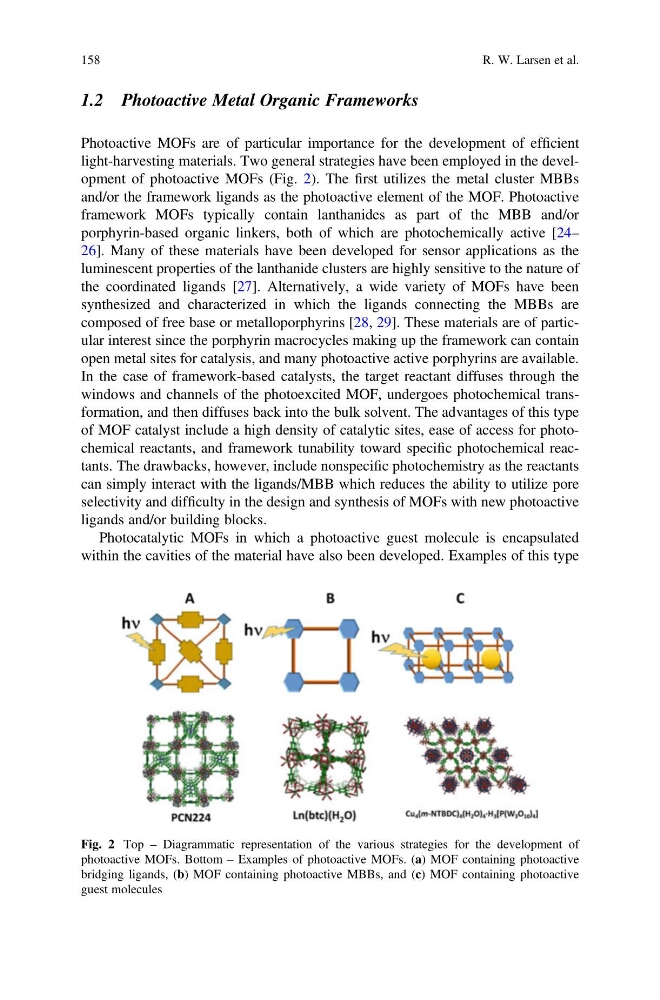
light-harvesting materials. Two general strategies have been employed in the development of photoactive MOFs (Fig. 2). The first utilizes the metal cluster MBBs
and/or the framework ligands as the photoactive element of the MOF. Photoactive
framework MOFs typically contain lanthanides as part of the MBB and/or
porphyrin-based organic linkers, both of which are photochemically active [24–
26]. Many of these materials have been developed for sensor applications as the
luminescent properties of the lanthanide clusters are highly sensitive to the nature of
the coordinated ligands [27]. Alternatively, a wide variety of MOFs have been
synthesized and characterized in which the ligands connecting the MBBs are
composed of free base or metalloporphyrins [28, 29]. These materials are of particular interest since the porphyrin macrocycles making up the framework can contain
open metal sites for catalysis, and many photoactive active porphyrins are available.
In the case of framework-based catalysts, the target reactant diffuses through the
windows and channels of the photoexcited MOF, undergoes photochemical transformation, and then diffuses back into the bulk solvent. The advantages of this type
of MOF catalyst include a high density of catalytic sites, ease of access for photochemical reactants, and framework tunability toward specific photochemical reactants. The drawbacks, however, include nonspecific photochemistry as the reactants
can simply interact with the ligands/MBB which reduces the ability to utilize pore
selectivity and difficulty in the design and synthesis of MOFs with new photoactive
ligands and/or building blocks.
Photocatalytic MOFs in which a photoactive guest molecule is encapsulated
within the cavities of the material have also been developed. Examples of this type
Fig. 2 Top – Diagrammatic representation of the various strategies for the development of
photoactive MOFs. Bottom – Examples of photoactive MOFs. (a) MOF containing photoactive
bridging ligands, (b) MOF containing photoactive MBBs, and (c) MOF containing photoactive
guest molecules
158
R. W. Larsen et al.
Photoactive MOFs are of particular importance for the development of efficient
light-harvesting materials. Two general strategies have been employed in the development of photoactive MOFs (Fig. 2). The first utilizes the metal cluster MBBs
and/or the framework ligands as the photoactive element of the MOF. Photoactive
framework MOFs typically contain lanthanides as part of the MBB and/or
porphyrin-based organic linkers, both of which are photochemically active [24–
26]. Many of these materials have been developed for sensor applications as the
luminescent properties of the lanthanide clusters are highly sensitive to the nature of
the coordinated ligands [27]. Alternatively, a wide variety of MOFs have been
synthesized and characterized in which the ligands connecting the MBBs are
composed of free base or metalloporphyrins [28, 29]. These materials are of particular interest since the porphyrin macrocycles making up the framework can contain
open metal sites for catalysis, and many photoactive active porphyrins are available.
In the case of framework-based catalysts, the target reactant diffuses through the
windows and channels of the photoexcited MOF, undergoes photochemical transformation, and then diffuses back into the bulk solvent. The advantages of this type
of MOF catalyst include a high density of catalytic sites, ease of access for photochemical reactants, and framework tunability toward specific photochemical reactants. The drawbacks, however, include nonspecific photochemistry as the reactants
can simply interact with the ligands/MBB which reduces the ability to utilize pore
selectivity and difficulty in the design and synthesis of MOFs with new photoactive
ligands and/or building blocks.
Photocatalytic MOFs in which a photoactive guest molecule is encapsulated
within the cavities of the material have also been developed. Examples of this type
Fig. 2 Top – Diagrammatic representation of the various strategies for the development of
photoactive MOFs. Bottom – Examples of photoactive MOFs. (a) MOF containing photoactive
bridging ligands, (b) MOF containing photoactive MBBs, and (c) MOF containing photoactive
guest molecules
158
R. W. Larsen et al.