

of photocatalyst have been reported in which the encapsulated guest includes
Keggin-type polyoxometalates encapsulated within an HKUST-1(Cu) framework
[30–33], free base and metalloporphyrins encapsulated within both rhoZMOF and
HKUST-1(Zn) [34–36], and Ru(II) polyimines encapsulated in pillared 2D sheet
materials [37]. This type of photoactive MOF offers several advantages including a
wide range of photoactive guests available for encapsulation; the windows leading to
the photoexcited guest can be tuned for greater reactant selectivity, and a large
library of MOFs exists that can be exploited for guest encapsulation.
1.3 Transition Metal Polyimines as Photoactive Guests
Transition metal polyimines and related compounds are an important class of
photoactive guests due to their overall stability, relatively high molar extinction
coefficients in the visible region of the optical spectrum (>10,000 M
À1 cm
À1 ), and
relatively long-lived metal-to-ligand charge transfer states (MLCT) [38, 39]. The
most widely investigated of the transition metal polyimines is [Ru(II)(2,2
0
-bipyridine) 3 ]
2+ (RuBpy). The excited state photophysics of the RuBpy complex
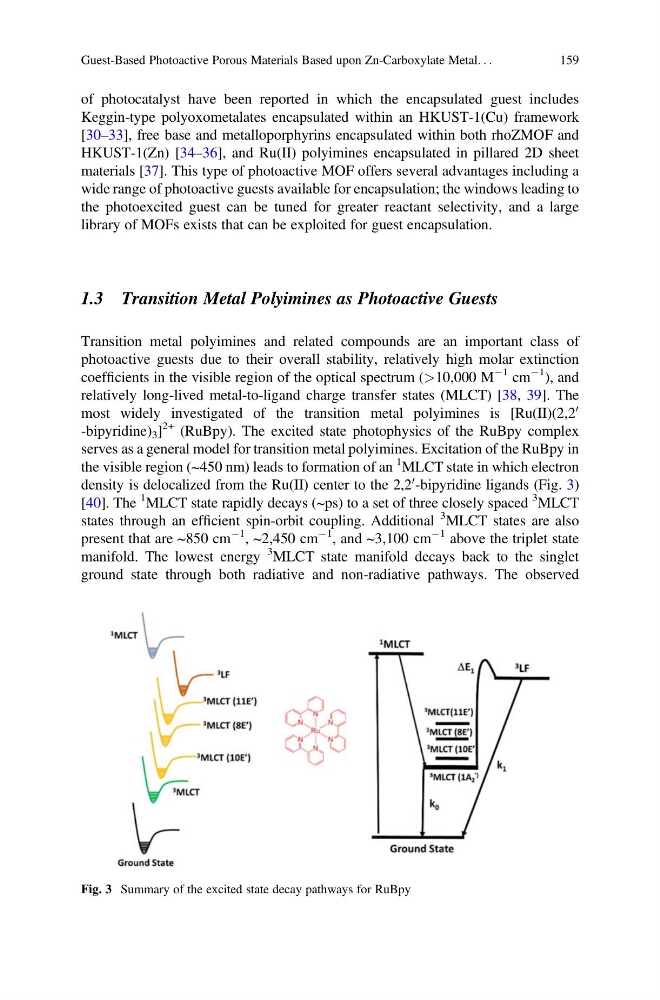
serves as a general model for transition metal polyimines. Excitation of the RuBpy in
the visible region (~450 nm) leads to formation of an
1 MLCT state in which electron
density is delocalized from the Ru(II) center to the 2,2
0 -bipyridine ligands (Fig. 3)
[40]. The
1 MLCT state rapidly decays (~ps) to a set of three closely spaced
3 MLCT
states through an efficient spin-orbit coupling. Additional
3 MLCT states are also
present that are ~850 cm
À1 , ~2,450 cm
À1 , and ~3,100 cm
À1 above the triplet state
manifold. The lowest energy
3 MLCT state manifold decays back to the singlet
ground state through both radiative and non-radiative pathways. The observed
Fig. 3 Summary of the excited state decay pathways for RuBpy
Guest-Based Photoactive Porous Materials Based upon Zn-Carboxylate Metal. . .
159
Keggin-type polyoxometalates encapsulated within an HKUST-1(Cu) framework
[30–33], free base and metalloporphyrins encapsulated within both rhoZMOF and
HKUST-1(Zn) [34–36], and Ru(II) polyimines encapsulated in pillared 2D sheet
materials [37]. This type of photoactive MOF offers several advantages including a
wide range of photoactive guests available for encapsulation; the windows leading to
the photoexcited guest can be tuned for greater reactant selectivity, and a large
library of MOFs exists that can be exploited for guest encapsulation.
1.3 Transition Metal Polyimines as Photoactive Guests
Transition metal polyimines and related compounds are an important class of
photoactive guests due to their overall stability, relatively high molar extinction
coefficients in the visible region of the optical spectrum (>10,000 M
À1 cm
À1 ), and
relatively long-lived metal-to-ligand charge transfer states (MLCT) [38, 39]. The
most widely investigated of the transition metal polyimines is [Ru(II)(2,2
0
-bipyridine) 3 ]
2+ (RuBpy). The excited state photophysics of the RuBpy complex
serves as a general model for transition metal polyimines. Excitation of the RuBpy in
the visible region (~450 nm) leads to formation of an
1 MLCT state in which electron
density is delocalized from the Ru(II) center to the 2,2
0 -bipyridine ligands (Fig. 3)
[40]. The
1 MLCT state rapidly decays (~ps) to a set of three closely spaced
3 MLCT
states through an efficient spin-orbit coupling. Additional
3 MLCT states are also
present that are ~850 cm
À1 , ~2,450 cm
À1 , and ~3,100 cm
À1 above the triplet state
manifold. The lowest energy
3 MLCT state manifold decays back to the singlet
ground state through both radiative and non-radiative pathways. The observed
Fig. 3 Summary of the excited state decay pathways for RuBpy
Guest-Based Photoactive Porous Materials Based upon Zn-Carboxylate Metal. . .
159