

ligands connecting the MBBs can be functionalized, and the scale can be selected
from nano- to mesoporous. These factors allow for extraordinary versatility in
structure, and function not available in other porous materials such as zeolites,
porous Si, or hydrogels. In terms of structural diversity, these materials extend
from discrete nanoscale polyhedral to large extended porous networks. These networks, with nanoscale cavities, are of particular importance to guest-based functional materials since the cavities can accommodate a wide variety of guest
molecules. Examples of MOF networks include numerous zeolite topologies
[11, 12], quartz diamond [13], perovskites [14, 15], rutile [16], and feldspar [17]
to name only a few.
The most notable applications for MOFs have been in the area of gas storage and
separations [18, 19]. One of the earliest targets for MOF gas storage was H 2 due to
the potential for MOFs to serve as a hydrogen supply for hydrogen-oxygen fuel
cells. The weight percent of H 2 storage has been reported as high as 10% for MOF-5
and SNU-6 at 77 K [20]. A more recent effort has been focused on CO 2 sequestration
for use in remediation of greenhouse gasses with Mg-MOF-74 having one of the
largest uptakes (5.3 mg/g at 40
C) [21]. Other gas storage applications include toxic
industrial chemicals (TICs) such as NO x , CO, SO 2 , and Cl 2 as well as other energyrelated gases including CH 4 [22]. Various MOFs have also been the target for
heterogeneous catalyst development centered primarily on oxidation reactions
[23]. Catalytic sites can be either engineered into the framework through the
MBBs or organic linkers (metalloporphyrins) or encapsulated within the large
interior cavities. The MOF channels and windows can modulate the diffusion of
both reactants and products to and from the catalytic sites.
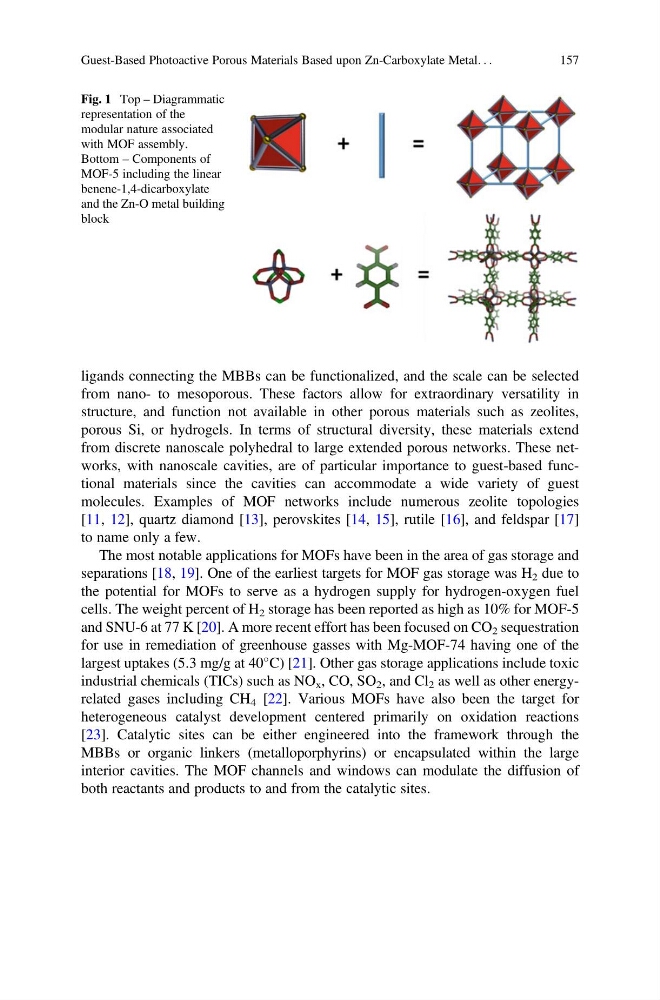
Fig. 1 Top – Diagrammatic
representation of the
modular nature associated
with MOF assembly.
Bottom – Components of
MOF-5 including the linear
benene-1,4-dicarboxylate
and the Zn-O metal building
block
Guest-Based Photoactive Porous Materials Based upon Zn-Carboxylate Metal. . .
157
from nano- to mesoporous. These factors allow for extraordinary versatility in
structure, and function not available in other porous materials such as zeolites,
porous Si, or hydrogels. In terms of structural diversity, these materials extend
from discrete nanoscale polyhedral to large extended porous networks. These networks, with nanoscale cavities, are of particular importance to guest-based functional materials since the cavities can accommodate a wide variety of guest
molecules. Examples of MOF networks include numerous zeolite topologies
[11, 12], quartz diamond [13], perovskites [14, 15], rutile [16], and feldspar [17]
to name only a few.
The most notable applications for MOFs have been in the area of gas storage and
separations [18, 19]. One of the earliest targets for MOF gas storage was H 2 due to
the potential for MOFs to serve as a hydrogen supply for hydrogen-oxygen fuel
cells. The weight percent of H 2 storage has been reported as high as 10% for MOF-5
and SNU-6 at 77 K [20]. A more recent effort has been focused on CO 2 sequestration
for use in remediation of greenhouse gasses with Mg-MOF-74 having one of the
largest uptakes (5.3 mg/g at 40
C) [21]. Other gas storage applications include toxic
industrial chemicals (TICs) such as NO x , CO, SO 2 , and Cl 2 as well as other energyrelated gases including CH 4 [22]. Various MOFs have also been the target for
heterogeneous catalyst development centered primarily on oxidation reactions
[23]. Catalytic sites can be either engineered into the framework through the
MBBs or organic linkers (metalloporphyrins) or encapsulated within the large
interior cavities. The MOF channels and windows can modulate the diffusion of
both reactants and products to and from the catalytic sites.
Fig. 1 Top – Diagrammatic
representation of the
modular nature associated
with MOF assembly.
Bottom – Components of
MOF-5 including the linear
benene-1,4-dicarboxylate
and the Zn-O metal building
block
Guest-Based Photoactive Porous Materials Based upon Zn-Carboxylate Metal. . .
157