

light. The latter was found to be more efficient to trigger the MC-to-SP conversion
than thermal treatment. Consequently, the open merocyanine form is thermally
stabilized when inserted in the different MOF hosts. However, this stabilization
seems to depend on the type of the MOF scaffold. The reasons for that have not been
elucidated so far.
With this work, Ruschewitz and co-workers were the first to develop hybrid
switch@MOF systems containing spirooxazines, which show a high photostability
and reversibility of switching. Both properties are obligatory for the construction of
functional materials, and, therefore, these SP-O@MOF systems are of high potential
for future applications.
3 Conclusion and Future Perspectives
The tailored design and synthesis of smart materials is a challenging task in modern
materials chemistry. In this respect, MOFs have attracted a tremendous interest in
recent years, since these porous materials can be synthesized in a LEGO-like manner
starting from metal cations and organic linkers. The isoreticular approach by Yaghi
and co-workers [87] is a perfect example of this fascinating branch of materials
science.
When combining these versatile MOFs with the numerous photochromic mainly
organic molecules that were developed in the last decades, an almost uncountable
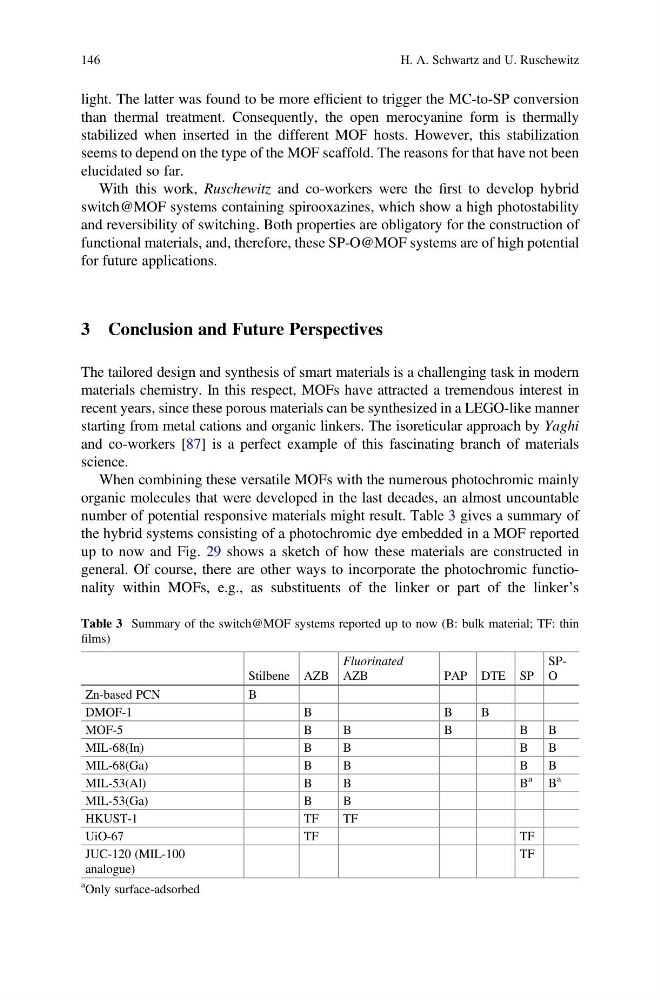
number of potential responsive materials might result. Table 3 gives a summary of
the hybrid systems consisting of a photochromic dye embedded in a MOF reported
up to now and Fig. 29 shows a sketch of how these materials are constructed in
general. Of course, there are other ways to incorporate the photochromic functionality within MOFs, e.g., as substituents of the linker or part of the linker’s
Table 3 Summary of the switch@MOF systems reported up to now (B: bulk material; TF: thin
films)
Stilbene AZB
Fluorinated
AZB
PAP DTE SP
SPO
Zn-based PCN
B
DMOF-1
B
B
B
MOF-5
B
B
B
B
B
MIL-68(In)
B
B
B
B
MIL-68(Ga)
B
B
B
B
MIL-53(Al)
B
B
B
a
B
a
MIL-53(Ga)
B
B
HKUST-1
TF
TF
UiO-67
TF
TF
JUC-120 (MIL-100
analogue)
TF
a Only surface-adsorbed
146
H. A. Schwartz and U. Ruschewitz
than thermal treatment. Consequently, the open merocyanine form is thermally
stabilized when inserted in the different MOF hosts. However, this stabilization
seems to depend on the type of the MOF scaffold. The reasons for that have not been
elucidated so far.
With this work, Ruschewitz and co-workers were the first to develop hybrid
switch@MOF systems containing spirooxazines, which show a high photostability
and reversibility of switching. Both properties are obligatory for the construction of
functional materials, and, therefore, these SP-O@MOF systems are of high potential
for future applications.
3 Conclusion and Future Perspectives
The tailored design and synthesis of smart materials is a challenging task in modern
materials chemistry. In this respect, MOFs have attracted a tremendous interest in
recent years, since these porous materials can be synthesized in a LEGO-like manner
starting from metal cations and organic linkers. The isoreticular approach by Yaghi
and co-workers [87] is a perfect example of this fascinating branch of materials
science.
When combining these versatile MOFs with the numerous photochromic mainly
organic molecules that were developed in the last decades, an almost uncountable
number of potential responsive materials might result. Table 3 gives a summary of
the hybrid systems consisting of a photochromic dye embedded in a MOF reported
up to now and Fig. 29 shows a sketch of how these materials are constructed in
general. Of course, there are other ways to incorporate the photochromic functionality within MOFs, e.g., as substituents of the linker or part of the linker’s
Table 3 Summary of the switch@MOF systems reported up to now (B: bulk material; TF: thin
films)
Stilbene AZB
Fluorinated
AZB
PAP DTE SP
SPO
Zn-based PCN
B
DMOF-1
B
B
B
MOF-5
B
B
B
B
B
MIL-68(In)
B
B
B
B
MIL-68(Ga)
B
B
B
B
MIL-53(Al)
B
B
B
a
B
a
MIL-53(Ga)
B
B
HKUST-1
TF
TF
UiO-67
TF
TF
JUC-120 (MIL-100
analogue)
TF
a Only surface-adsorbed
146
H. A. Schwartz and U. Ruschewitz