

backbone. But these approaches do not utilize the great variety of possible MOF
hosts as well as photochromic guests, not to mention the high synthetic efforts that
are needed to construct such systems.
It was the aim of this chapter to introduce the reader into the developing field of
photochromic dyes non-covalently attached to the voids of porous MOFs. Synthetic
procedures as well as methods, how to characterize these new responsive materials,
were addressed. It is surely challenging to get detailed information about these
guest@MOF systems due to the high mobility of the embedded guest molecules.
How can we be sure that the guest is embedded in the pores of the MOFs and not just
adsorbed on the surfaces of MOF particles? How can we quantify the loading? Can
we get structural information on the embedment of the guest within the voids of a
specific MOF, and what are the underlying host-guest and maybe – for high
loadings – guest-guest interactions?
However, most fascinating are the properties of the resulting hybrid materials:
remote control of gas uptake and release, light-triggered changes of absorption
properties – already visible by drastic color changes to the naked eye –
solvatochromic behavior of a dye within a specific MOF pore that resembles the
behavior of these dyes in solvents and led to the description of MOFs as “solid
solvents” [152] or the reversible photoswitching of electronic conductivity [154] to
name a few.
It is surprising that the research on switch@MOF systems only started in 2010
with the pioneering work of Fujita and co-workers [125], who embedded stilbene in
a porous coordination network, which is another term for a MOF. Within less than
10 years, the methods and materials described in this chapter were developed. Not
very surprisingly, most work was done on azobenzene, probably still the best
investigated photochromic dye molecule. However, by functionalization of
azobenzene, i.e., fluorination or PEG substituents, interesting materials were
obtained, which, as an example, allowed an almost quantitative photoswitching
[137]. Moreover, also other examples of photochromic dyes were embedded in
MOFs, i.e., diarylethenes, spiropyrans, and spirooxazines. Each of them has specific
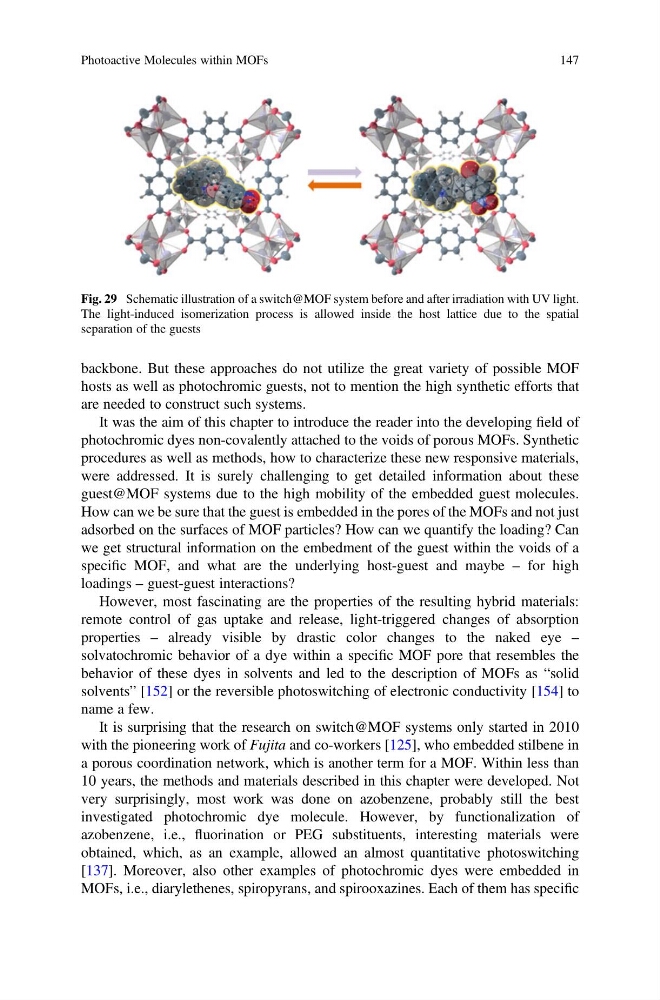
Fig. 29 Schematic illustration of a switch@MOF system before and after irradiation with UV light.
The light-induced isomerization process is allowed inside the host lattice due to the spatial
separation of the guests
Photoactive Molecules within MOFs
147
hosts as well as photochromic guests, not to mention the high synthetic efforts that
are needed to construct such systems.
It was the aim of this chapter to introduce the reader into the developing field of
photochromic dyes non-covalently attached to the voids of porous MOFs. Synthetic
procedures as well as methods, how to characterize these new responsive materials,
were addressed. It is surely challenging to get detailed information about these
guest@MOF systems due to the high mobility of the embedded guest molecules.
How can we be sure that the guest is embedded in the pores of the MOFs and not just
adsorbed on the surfaces of MOF particles? How can we quantify the loading? Can
we get structural information on the embedment of the guest within the voids of a
specific MOF, and what are the underlying host-guest and maybe – for high
loadings – guest-guest interactions?
However, most fascinating are the properties of the resulting hybrid materials:
remote control of gas uptake and release, light-triggered changes of absorption
properties – already visible by drastic color changes to the naked eye –
solvatochromic behavior of a dye within a specific MOF pore that resembles the
behavior of these dyes in solvents and led to the description of MOFs as “solid
solvents” [152] or the reversible photoswitching of electronic conductivity [154] to
name a few.
It is surprising that the research on switch@MOF systems only started in 2010
with the pioneering work of Fujita and co-workers [125], who embedded stilbene in
a porous coordination network, which is another term for a MOF. Within less than
10 years, the methods and materials described in this chapter were developed. Not
very surprisingly, most work was done on azobenzene, probably still the best
investigated photochromic dye molecule. However, by functionalization of
azobenzene, i.e., fluorination or PEG substituents, interesting materials were
obtained, which, as an example, allowed an almost quantitative photoswitching
[137]. Moreover, also other examples of photochromic dyes were embedded in
MOFs, i.e., diarylethenes, spiropyrans, and spirooxazines. Each of them has specific
Fig. 29 Schematic illustration of a switch@MOF system before and after irradiation with UV light.
The light-induced isomerization process is allowed inside the host lattice due to the spatial
separation of the guests
Photoactive Molecules within MOFs
147