

[152]. Furthermore, the absorption bands of the excited isomer are increasingly blueshifted from MOF-5 to MIL-68(In/Ga) and MIL-53(Al). With respect to the
solvatochromic response of SP-O, MOF-5 represents the most polar host lattice
followed by the MIL-68 family and MIL-53(Al) (note: here, SP-O is only surfaceadsorbed). This MOF polarity order nicely substantiates the results on
SP-Nitro@MOF composites (see Fig. 22) [152].
Subsequently, the authors studied the photostability and the fatigue resistance of
these SP-O@MOF systems by IR and UV/vis spectroscopy. Since exposure to UV
light causes a decrease of the SP and an increase of the MC bands, IR spectroscopy
was applied to monitor the light-induced changes. That way, the successful isomerization was proven and, moreover, for the first time IR data of the excited
merocyanine isomer of SP-O were assigned to the respective vibrational bands. In
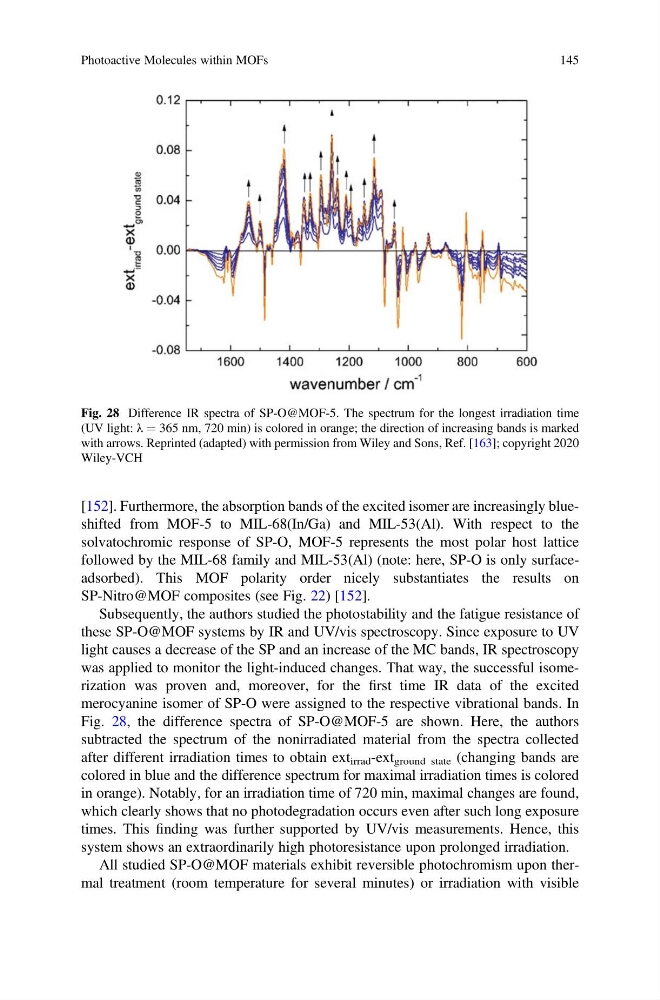
Fig. 28, the difference spectra of SP-O@MOF-5 are shown. Here, the authors
subtracted the spectrum of the nonirradiated material from the spectra collected
after different irradiation times to obtain ext irrad -ext ground state (changing bands are
colored in blue and the difference spectrum for maximal irradiation times is colored
in orange). Notably, for an irradiation time of 720 min, maximal changes are found,
which clearly shows that no photodegradation occurs even after such long exposure
times. This finding was further supported by UV/vis measurements. Hence, this
system shows an extraordinarily high photoresistance upon prolonged irradiation.
All studied SP-O@MOF materials exhibit reversible photochromism upon thermal treatment (room temperature for several minutes) or irradiation with visible
Fig. 28 Difference IR spectra of SP-O@MOF-5. The spectrum for the longest irradiation time
(UV light: λ ¼ 365 nm, 720 min) is colored in orange; the direction of increasing bands is marked
with arrows. Reprinted (adapted) with permission from Wiley and Sons, Ref. [163]; copyright 2020
Wiley-VCH
Photoactive Molecules within MOFs
145
solvatochromic response of SP-O, MOF-5 represents the most polar host lattice
followed by the MIL-68 family and MIL-53(Al) (note: here, SP-O is only surfaceadsorbed). This MOF polarity order nicely substantiates the results on
SP-Nitro@MOF composites (see Fig. 22) [152].
Subsequently, the authors studied the photostability and the fatigue resistance of
these SP-O@MOF systems by IR and UV/vis spectroscopy. Since exposure to UV
light causes a decrease of the SP and an increase of the MC bands, IR spectroscopy
was applied to monitor the light-induced changes. That way, the successful isomerization was proven and, moreover, for the first time IR data of the excited
merocyanine isomer of SP-O were assigned to the respective vibrational bands. In
Fig. 28, the difference spectra of SP-O@MOF-5 are shown. Here, the authors
subtracted the spectrum of the nonirradiated material from the spectra collected
after different irradiation times to obtain ext irrad -ext ground state (changing bands are
colored in blue and the difference spectrum for maximal irradiation times is colored
in orange). Notably, for an irradiation time of 720 min, maximal changes are found,
which clearly shows that no photodegradation occurs even after such long exposure
times. This finding was further supported by UV/vis measurements. Hence, this
system shows an extraordinarily high photoresistance upon prolonged irradiation.
All studied SP-O@MOF materials exhibit reversible photochromism upon thermal treatment (room temperature for several minutes) or irradiation with visible
Fig. 28 Difference IR spectra of SP-O@MOF-5. The spectrum for the longest irradiation time
(UV light: λ ¼ 365 nm, 720 min) is colored in orange; the direction of increasing bands is marked
with arrows. Reprinted (adapted) with permission from Wiley and Sons, Ref. [163]; copyright 2020
Wiley-VCH
Photoactive Molecules within MOFs
145