

compounds is known since the 1960s [162]. Only with the description of the
extraordinary photostability of 1,3,3-trimethylindolino-naphthospirooxazine
(denoted as SP-O) by Chu in 1983 [162] these molecules gained more attention.
Similar to spiropyrans, spirooxazines convert to the strongly colored merocyanine
form upon irradiation with UV light. Depending on substituents and the surrounding
medium, the excited species shows an absorption maximum with an asymmetric
shape and a blue- or red-shifted shoulder [33] in the range 480–670 nm.
Spirooxazines are known to show positive and negative solvatochromism, which
is dependent on the substituents. The photochromic and solvatochromic response
combined with an enhanced photostability make spirooxazines very promising
candidates for insertion into porous hosts, e.g., spirooxazine@MOF composite
materials.
For this reason, Ruschewitz and co-workers started investigations on SP-O
embedded in different MOF hosts [163]. Similar to their work published on
azobenzenes, its fluorinated derivatives [129, 137], and spiropyrans [152], the
authors chose MOF-5 [55], MIL-68(In) [132], MIL-68(Ga) [132], and MIL-53(Al)
[133] as suitable host matrices with respect to pore size and adsorption properties.
The incorporation of the spirooxazine SP-O was achieved via a gas phase loading
process to exclude the influence of solvent molecules on all further investigations.
The successful embedment was confirmed by XRPD for MOF-5, MIL-68(In) and
MIL-68(Ga), respectively. However, similar to the results on SP-Nitro [152], no
modulation in the reflection intensities nor a significant change in their 2θ values was
observed for MIL-53(Al) as host material. Again, the results of XPS measurements
prove a surface adsorption of SP-O on MIL-53(Al), whereas the photoswitchable
molecule is incorporated inside the other MOF hosts of this study. Via a combined
analysis using XPS and DSC/TGA data, the composition of the hybrid systems was
determined, and, additionally, strong host-guest interactions were found.
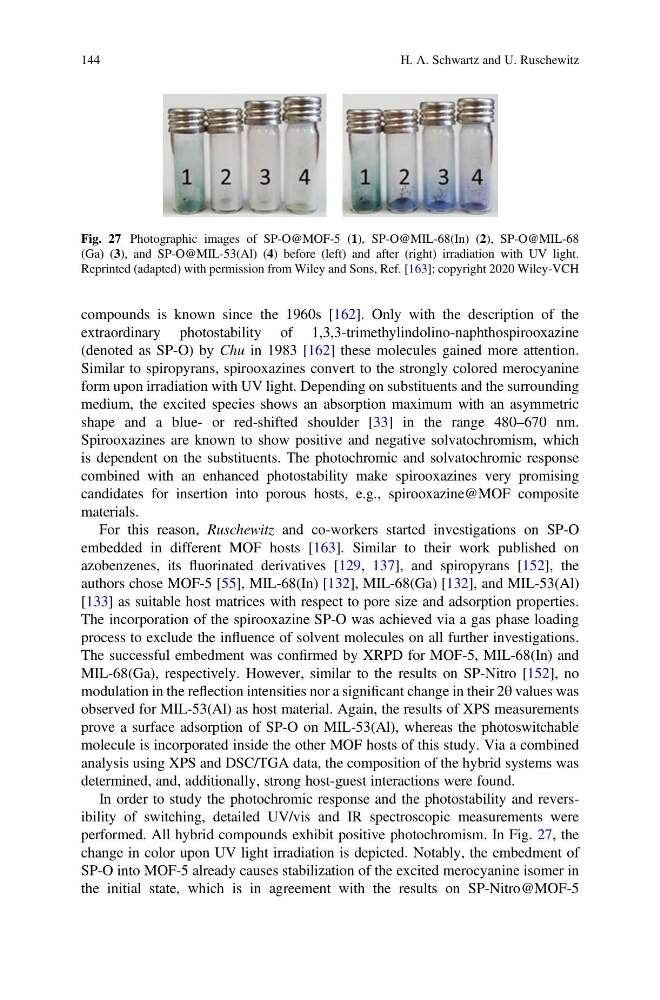
In order to study the photochromic response and the photostability and reversibility of switching, detailed UV/vis and IR spectroscopic measurements were
performed. All hybrid compounds exhibit positive photochromism. In Fig. 27, the
change in color upon UV light irradiation is depicted. Notably, the embedment of
SP-O into MOF-5 already causes stabilization of the excited merocyanine isomer in
the initial state, which is in agreement with the results on SP-Nitro@MOF-5
Fig. 27 Photographic images of SP-O@MOF-5 (1), SP-O@MIL-68(In) (2), SP-O@MIL-68
(Ga) (3), and SP-O@MIL-53(Al) (4) before (left) and after (right) irradiation with UV light.
Reprinted (adapted) with permission from Wiley and Sons, Ref. [163]; copyright 2020 Wiley-VCH
144
H. A. Schwartz and U. Ruschewitz
extraordinary photostability of 1,3,3-trimethylindolino-naphthospirooxazine
(denoted as SP-O) by Chu in 1983 [162] these molecules gained more attention.
Similar to spiropyrans, spirooxazines convert to the strongly colored merocyanine
form upon irradiation with UV light. Depending on substituents and the surrounding
medium, the excited species shows an absorption maximum with an asymmetric
shape and a blue- or red-shifted shoulder [33] in the range 480–670 nm.
Spirooxazines are known to show positive and negative solvatochromism, which
is dependent on the substituents. The photochromic and solvatochromic response
combined with an enhanced photostability make spirooxazines very promising
candidates for insertion into porous hosts, e.g., spirooxazine@MOF composite
materials.
For this reason, Ruschewitz and co-workers started investigations on SP-O
embedded in different MOF hosts [163]. Similar to their work published on
azobenzenes, its fluorinated derivatives [129, 137], and spiropyrans [152], the
authors chose MOF-5 [55], MIL-68(In) [132], MIL-68(Ga) [132], and MIL-53(Al)
[133] as suitable host matrices with respect to pore size and adsorption properties.
The incorporation of the spirooxazine SP-O was achieved via a gas phase loading
process to exclude the influence of solvent molecules on all further investigations.
The successful embedment was confirmed by XRPD for MOF-5, MIL-68(In) and
MIL-68(Ga), respectively. However, similar to the results on SP-Nitro [152], no
modulation in the reflection intensities nor a significant change in their 2θ values was
observed for MIL-53(Al) as host material. Again, the results of XPS measurements
prove a surface adsorption of SP-O on MIL-53(Al), whereas the photoswitchable
molecule is incorporated inside the other MOF hosts of this study. Via a combined
analysis using XPS and DSC/TGA data, the composition of the hybrid systems was
determined, and, additionally, strong host-guest interactions were found.
In order to study the photochromic response and the photostability and reversibility of switching, detailed UV/vis and IR spectroscopic measurements were
performed. All hybrid compounds exhibit positive photochromism. In Fig. 27, the
change in color upon UV light irradiation is depicted. Notably, the embedment of
SP-O into MOF-5 already causes stabilization of the excited merocyanine isomer in
the initial state, which is in agreement with the results on SP-Nitro@MOF-5
Fig. 27 Photographic images of SP-O@MOF-5 (1), SP-O@MIL-68(In) (2), SP-O@MIL-68
(Ga) (3), and SP-O@MIL-53(Al) (4) before (left) and after (right) irradiation with UV light.
Reprinted (adapted) with permission from Wiley and Sons, Ref. [163]; copyright 2020 Wiley-VCH
144
H. A. Schwartz and U. Ruschewitz