

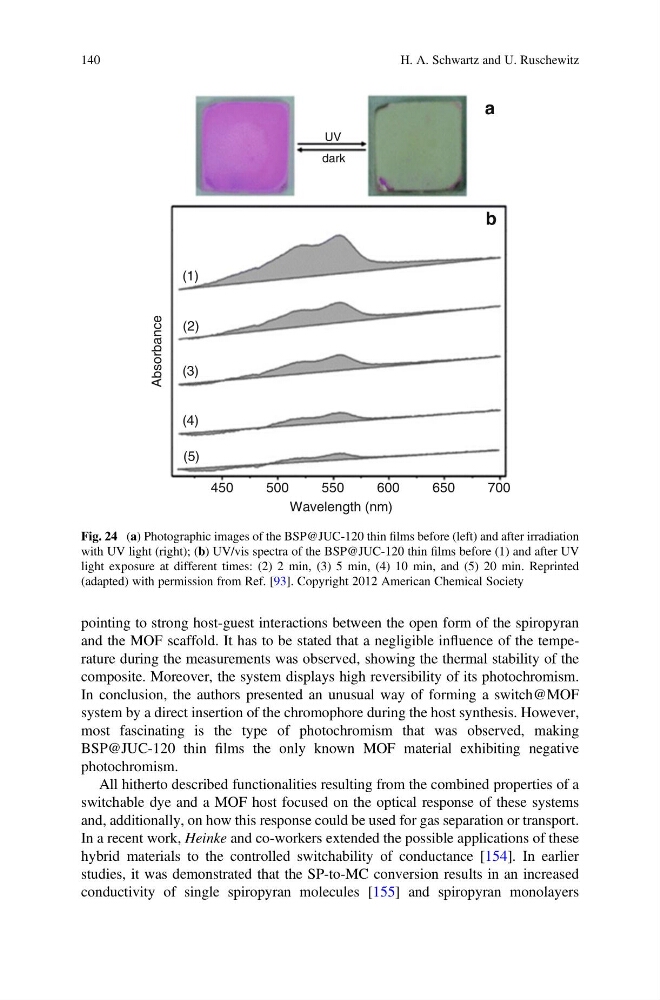
pointing to strong host-guest interactions between the open form of the spiropyran
and the MOF scaffold. It has to be stated that a negligible influence of the temperature during the measurements was observed, showing the thermal stability of the
composite. Moreover, the system displays high reversibility of its photochromism.
In conclusion, the authors presented an unusual way of forming a switch@MOF
system by a direct insertion of the chromophore during the host synthesis. However,
most fascinating is the type of photochromism that was observed, making
BSP@JUC-120 thin films the only known MOF material exhibiting negative
photochromism.
All hitherto described functionalities resulting from the combined properties of a
switchable dye and a MOF host focused on the optical response of these systems
and, additionally, on how this response could be used for gas separation or transport.
In a recent work, Heinke and co-workers extended the possible applications of these
hybrid materials to the controlled switchability of conductance [154]. In earlier
studies, it was demonstrated that the SP-to-MC conversion results in an increased
conductivity of single spiropyran molecules [155] and spiropyran monolayers
UV
dark
(1)
a
b
(2)
(3)
(4)
(5)
450
500
550
Wavelength (nm)
Absorbance
600
650
700
Fig. 24 (a) Photographic images of the BSP@JUC-120 thin films before (left) and after irradiation
with UV light (right); (b) UV/vis spectra of the BSP@JUC-120 thin films before (1) and after UV
light exposure at different times: (2) 2 min, (3) 5 min, (4) 10 min, and (5) 20 min. Reprinted
(adapted) with permission from Ref. [93]. Copyright 2012 American Chemical Society
140
H. A. Schwartz and U. Ruschewitz
and the MOF scaffold. It has to be stated that a negligible influence of the temperature during the measurements was observed, showing the thermal stability of the
composite. Moreover, the system displays high reversibility of its photochromism.
In conclusion, the authors presented an unusual way of forming a switch@MOF
system by a direct insertion of the chromophore during the host synthesis. However,
most fascinating is the type of photochromism that was observed, making
BSP@JUC-120 thin films the only known MOF material exhibiting negative
photochromism.
All hitherto described functionalities resulting from the combined properties of a
switchable dye and a MOF host focused on the optical response of these systems
and, additionally, on how this response could be used for gas separation or transport.
In a recent work, Heinke and co-workers extended the possible applications of these
hybrid materials to the controlled switchability of conductance [154]. In earlier
studies, it was demonstrated that the SP-to-MC conversion results in an increased
conductivity of single spiropyran molecules [155] and spiropyran monolayers
UV
dark
(1)
a
b
(2)
(3)
(4)
(5)
450
500
550
Wavelength (nm)
Absorbance
600
650
700
Fig. 24 (a) Photographic images of the BSP@JUC-120 thin films before (left) and after irradiation
with UV light (right); (b) UV/vis spectra of the BSP@JUC-120 thin films before (1) and after UV
light exposure at different times: (2) 2 min, (3) 5 min, (4) 10 min, and (5) 20 min. Reprinted
(adapted) with permission from Ref. [93]. Copyright 2012 American Chemical Society
140
H. A. Schwartz and U. Ruschewitz