

morphology and gas adsorption/desorption, the authors thoroughly studied this new
guest@MOF composite.
All switch@MOF systems described and presented up to now exhibited positive
photochromism: i.e., in the ground state, the switch is colorless or almost colorless,
whereas irradiation with light of a specific wavelength causes the formation of a
thermodynamically less stable species with an absorption band in the visible range of
light. Consequently, the absorption maximum of the excited state is positioned at
longer wavelengths than the respective maximum of the ground state.
In contrast to that, for BSP@JUC-120 a negative, reverse or antidromic photochromism is reported for the first time. Surprisingly, the BSP@JUC-120 thin films
are already deeply colored before UV light irradiation. After exposure to UV light,
the initially deeply colored films turn colorless (see Fig. 24a). The films revert to
their initial colored state, when kept in the dark. In order to study the switching
process, in situ UV/vis spectra were recorded (see Fig. 24b). Before UV light
treatment, an absorption maximum at 556 nm and a small blue-shifted shoulder
were observed, which could clearly be attributed to the open merocyanine form of
BSP showing that the open merocyanine form is stabilized inside JUC-120. Upon
UV light irradiation, the absorption maximum at 556 nm decreases indicating the
proceeding population of the closed spiropyran form of BSP. The authors explained
this negative photochromism, where the usually stable SP form represents a metastable state, by a rather polar environment given by the MOF pores. Similar findings
have already been published, e.g., by Wark and co-workers [18], who implemented a
spiropyran into a zeolite matrix and also found the open merocyanine form to be
stabilized in the initial state.
To probe the ability of the BSP@JUC-120 thin films to be implemented in
devices, the authors performed fluorescence spectroscopic measurements on fading
and fatigue resistance. The photorelaxation from MC-to-SP proceeds slowly,
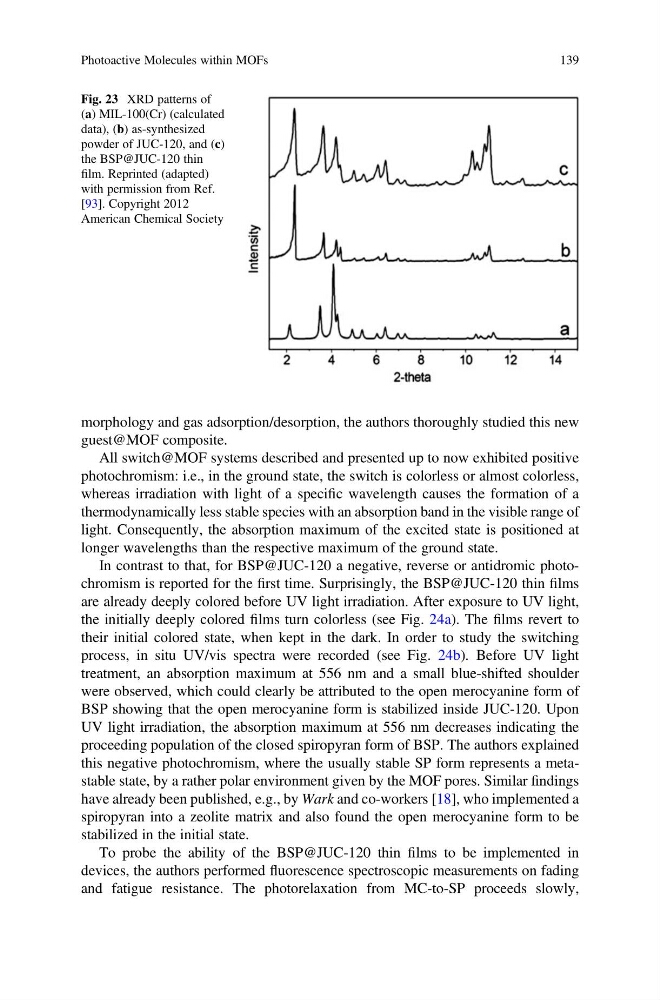
Fig. 23 XRD patterns of
(a) MIL-100(Cr) (calculated
data), (b) as-synthesized
powder of JUC-120, and (c)
the BSP@JUC-120 thin
film. Reprinted (adapted)
with permission from Ref.
[93]. Copyright 2012
American Chemical Society
Photoactive Molecules within MOFs
139
guest@MOF composite.
All switch@MOF systems described and presented up to now exhibited positive
photochromism: i.e., in the ground state, the switch is colorless or almost colorless,
whereas irradiation with light of a specific wavelength causes the formation of a
thermodynamically less stable species with an absorption band in the visible range of
light. Consequently, the absorption maximum of the excited state is positioned at
longer wavelengths than the respective maximum of the ground state.
In contrast to that, for BSP@JUC-120 a negative, reverse or antidromic photochromism is reported for the first time. Surprisingly, the BSP@JUC-120 thin films
are already deeply colored before UV light irradiation. After exposure to UV light,
the initially deeply colored films turn colorless (see Fig. 24a). The films revert to
their initial colored state, when kept in the dark. In order to study the switching
process, in situ UV/vis spectra were recorded (see Fig. 24b). Before UV light
treatment, an absorption maximum at 556 nm and a small blue-shifted shoulder
were observed, which could clearly be attributed to the open merocyanine form of
BSP showing that the open merocyanine form is stabilized inside JUC-120. Upon
UV light irradiation, the absorption maximum at 556 nm decreases indicating the
proceeding population of the closed spiropyran form of BSP. The authors explained
this negative photochromism, where the usually stable SP form represents a metastable state, by a rather polar environment given by the MOF pores. Similar findings
have already been published, e.g., by Wark and co-workers [18], who implemented a
spiropyran into a zeolite matrix and also found the open merocyanine form to be
stabilized in the initial state.
To probe the ability of the BSP@JUC-120 thin films to be implemented in
devices, the authors performed fluorescence spectroscopic measurements on fading
and fatigue resistance. The photorelaxation from MC-to-SP proceeds slowly,
Fig. 23 XRD patterns of
(a) MIL-100(Cr) (calculated
data), (b) as-synthesized
powder of JUC-120, and (c)
the BSP@JUC-120 thin
film. Reprinted (adapted)
with permission from Ref.
[93]. Copyright 2012
American Chemical Society
Photoactive Molecules within MOFs
139