

2.4.2 Thin Films
Already in 2012, Zhu and co-workers started their investigations on a
spiropyran@MOF composite [93]. Instead of a bulk MOF material, the object of
the presented work was the formation of a spiropyran@MOF thin film. In occasion
of that, the precursors for an indium trimesate-based MOF and, as a new method of
dye insertion, the guest molecule, namely, 1-(2-hydroxy-ethyl)-3,3dimethylindolino-6
0 -nitrobenzospiropyran (denoted as BSP), were dispersed in a
H 2 O-DMF mixture and reacted in a microwave. Subsequently, the formed composite was spin-coated on quartz glass. The resulting MOF thin films were designated
as BSP@JUC-120, with JUC-120 representing a new analogue of MIL-100, which
is typically formed with trivalent Al, Fe, and Cr cations [167–169]. The successful
synthesis was confirmed by XRPD measurements. The diffraction pattern of
JUC-120 matches the calculated pattern of MIL-100(Cr) in all apparent peak positions (see Fig. 23a, b, respectively). When loaded with BSP, no substantial differences are observed in comparison to the unloaded JUC-120 thin film. The peak
positions remain unaffected, while slight changes in the reflection intensities are
found (Fig. 23c), which indicate the successful embedment of the photochromic dye.
In a next step, the authors determined the pore diameters of the accessible voids of
JUC-120, which are suitable for BSP inclusion and, most importantly, light-induced
conversion processes. In further measurements on thermal stability, surface
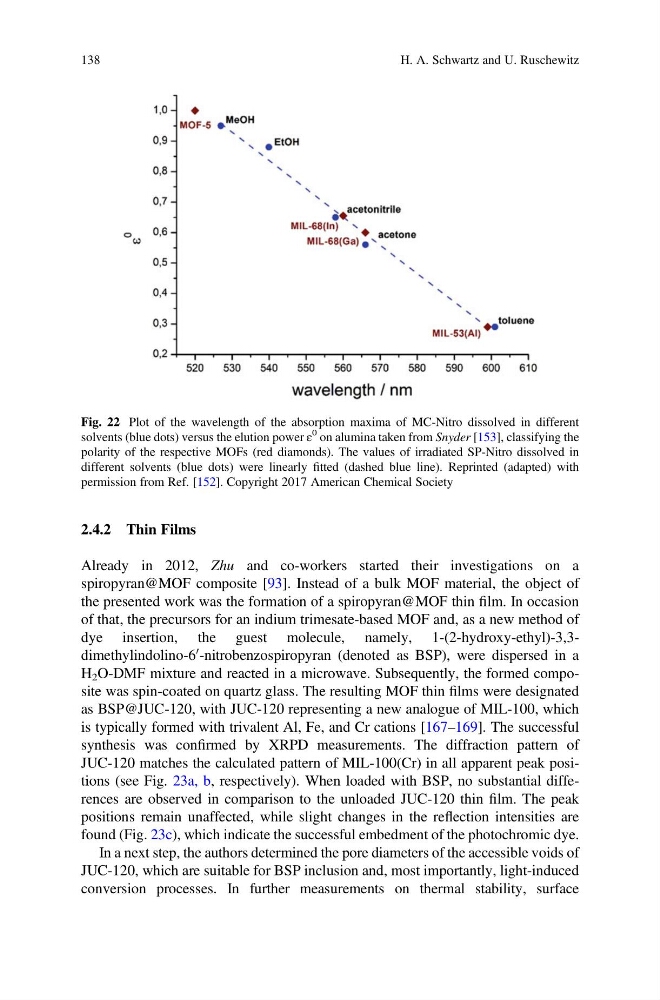
Fig. 22 Plot of the wavelength of the absorption maxima of MC-Nitro dissolved in different
solvents (blue dots) versus the elution power ε
0 on alumina taken from Snyder [153], classifying the
polarity of the respective MOFs (red diamonds). The values of irradiated SP-Nitro dissolved in
different solvents (blue dots) were linearly fitted (dashed blue line). Reprinted (adapted) with
permission from Ref. [152]. Copyright 2017 American Chemical Society
138
H. A. Schwartz and U. Ruschewitz
Already in 2012, Zhu and co-workers started their investigations on a
spiropyran@MOF composite [93]. Instead of a bulk MOF material, the object of
the presented work was the formation of a spiropyran@MOF thin film. In occasion
of that, the precursors for an indium trimesate-based MOF and, as a new method of
dye insertion, the guest molecule, namely, 1-(2-hydroxy-ethyl)-3,3dimethylindolino-6
0 -nitrobenzospiropyran (denoted as BSP), were dispersed in a
H 2 O-DMF mixture and reacted in a microwave. Subsequently, the formed composite was spin-coated on quartz glass. The resulting MOF thin films were designated
as BSP@JUC-120, with JUC-120 representing a new analogue of MIL-100, which
is typically formed with trivalent Al, Fe, and Cr cations [167–169]. The successful
synthesis was confirmed by XRPD measurements. The diffraction pattern of
JUC-120 matches the calculated pattern of MIL-100(Cr) in all apparent peak positions (see Fig. 23a, b, respectively). When loaded with BSP, no substantial differences are observed in comparison to the unloaded JUC-120 thin film. The peak
positions remain unaffected, while slight changes in the reflection intensities are
found (Fig. 23c), which indicate the successful embedment of the photochromic dye.
In a next step, the authors determined the pore diameters of the accessible voids of
JUC-120, which are suitable for BSP inclusion and, most importantly, light-induced
conversion processes. In further measurements on thermal stability, surface
Fig. 22 Plot of the wavelength of the absorption maxima of MC-Nitro dissolved in different
solvents (blue dots) versus the elution power ε
0 on alumina taken from Snyder [153], classifying the
polarity of the respective MOFs (red diamonds). The values of irradiated SP-Nitro dissolved in
different solvents (blue dots) were linearly fitted (dashed blue line). Reprinted (adapted) with
permission from Ref. [152]. Copyright 2017 American Chemical Society
138
H. A. Schwartz and U. Ruschewitz