

[156]. Moreover, by the combination of spiropyrans with conducting polymers, a
conductivity switching by a factor of 2.5 was achieved [157]. Based on these
considerations, the nitro-substituted spiropyran SP-Nitro, which had already successfully been incorporated in MOFs [152], was chosen and loaded via a diffusion
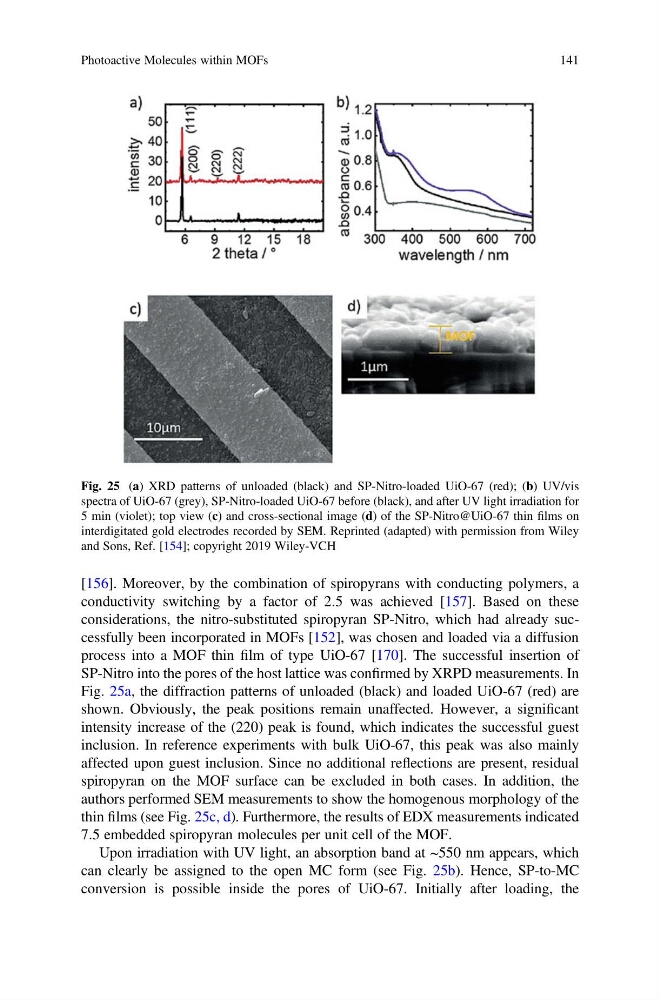
process into a MOF thin film of type UiO-67 [170]. The successful insertion of
SP-Nitro into the pores of the host lattice was confirmed by XRPD measurements. In
Fig. 25a, the diffraction patterns of unloaded (black) and loaded UiO-67 (red) are
shown. Obviously, the peak positions remain unaffected. However, a significant
intensity increase of the (220) peak is found, which indicates the successful guest
inclusion. In reference experiments with bulk UiO-67, this peak was also mainly
affected upon guest inclusion. Since no additional reflections are present, residual
spiropyran on the MOF surface can be excluded in both cases. In addition, the
authors performed SEM measurements to show the homogenous morphology of the
thin films (see Fig. 25c, d). Furthermore, the results of EDX measurements indicated
7.5 embedded spiropyran molecules per unit cell of the MOF.
Upon irradiation with UV light, an absorption band at ~550 nm appears, which
can clearly be assigned to the open MC form (see Fig. 25b). Hence, SP-to-MC
conversion is possible inside the pores of UiO-67. Initially after loading, the
Fig. 25 (a) XRD patterns of unloaded (black) and SP-Nitro-loaded UiO-67 (red); (b) UV/vis
spectra of UiO-67 (grey), SP-Nitro-loaded UiO-67 before (black), and after UV light irradiation for
5 min (violet); top view (c) and cross-sectional image (d) of the SP-Nitro@UiO-67 thin films on
interdigitated gold electrodes recorded by SEM. Reprinted (adapted) with permission from Wiley
and Sons, Ref. [154]; copyright 2019 Wiley-VCH
Photoactive Molecules within MOFs
141
conductivity switching by a factor of 2.5 was achieved [157]. Based on these
considerations, the nitro-substituted spiropyran SP-Nitro, which had already successfully been incorporated in MOFs [152], was chosen and loaded via a diffusion
process into a MOF thin film of type UiO-67 [170]. The successful insertion of
SP-Nitro into the pores of the host lattice was confirmed by XRPD measurements. In
Fig. 25a, the diffraction patterns of unloaded (black) and loaded UiO-67 (red) are
shown. Obviously, the peak positions remain unaffected. However, a significant
intensity increase of the (220) peak is found, which indicates the successful guest
inclusion. In reference experiments with bulk UiO-67, this peak was also mainly
affected upon guest inclusion. Since no additional reflections are present, residual
spiropyran on the MOF surface can be excluded in both cases. In addition, the
authors performed SEM measurements to show the homogenous morphology of the
thin films (see Fig. 25c, d). Furthermore, the results of EDX measurements indicated
7.5 embedded spiropyran molecules per unit cell of the MOF.
Upon irradiation with UV light, an absorption band at ~550 nm appears, which
can clearly be assigned to the open MC form (see Fig. 25b). Hence, SP-to-MC
conversion is possible inside the pores of UiO-67. Initially after loading, the
Fig. 25 (a) XRD patterns of unloaded (black) and SP-Nitro-loaded UiO-67 (red); (b) UV/vis
spectra of UiO-67 (grey), SP-Nitro-loaded UiO-67 before (black), and after UV light irradiation for
5 min (violet); top view (c) and cross-sectional image (d) of the SP-Nitro@UiO-67 thin films on
interdigitated gold electrodes recorded by SEM. Reprinted (adapted) with permission from Wiley
and Sons, Ref. [154]; copyright 2019 Wiley-VCH
Photoactive Molecules within MOFs
141