

molecule and thus, gas transport of probe molecules. By controlled thermal desorption, which was directly followed by CO 2 permeance measurements at 353 K under
in situ UV light irradiation (365 nm), photoswitching as well as gas transport was
realized. Here, the maximum switchable amount of AZB directly corresponds to a
drastic increase in CO 2 permeance. Analogous measurements on bulk AZB@UiO67 corroborate the results on the ultrathin films.
In a next step, the membrane with the ideal AZB-filling was used to remote
control the membrane permeation of a H 2 :CO 2 mixture by light. Figure 19b depicts
the reversible gas permeation after irradiation with UV light (365 nm) and visible
light (455 nm). Interestingly, the light-induced E-to-Z conversion causes an increase
in CO 2 permeation. When present in its E state, the H 2 /CO 2 separation factor is 14.7,
which the authors suggested to originate from gating processes rather than electrostatic effects [114]. After irradiation with UV light and the concomitant formation of
the Z state, a H 2 /CO 2 selectivity of 10.1 and a higher CO 2 permeance are reached.
Additionally, the H 2 permeance also increases slightly upon E-to-Z conversion of
AZB inside UiO-67 and decreases vice versa, which indicates gating processes. As a
consequence of size changes of the AZB moiety upon isomerization [14], the thus
reduced effective pore diameter is assumed to cause the changing separation factors
of 10.1:14.7.
To understand the mechanism of AZB@UiO-67 switching, UV/vis and IR
spectroscopic measurements were applied. From UV/vis spectroscopic data, 12%
of the AZB molecules inside the host matrix were determined to be switchable.
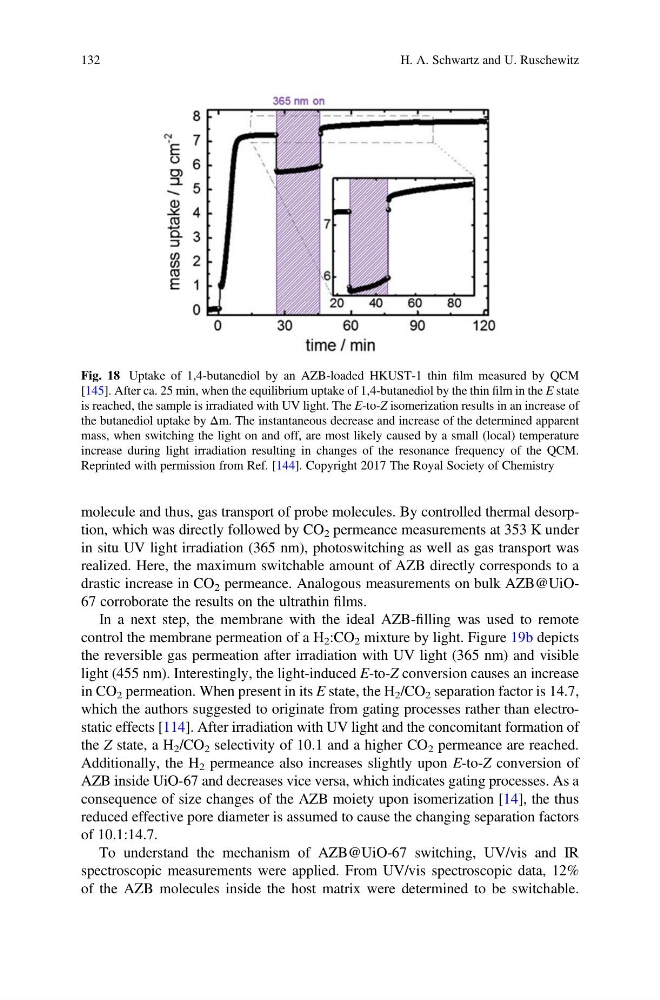
Fig. 18 Uptake of 1,4-butanediol by an AZB-loaded HKUST-1 thin film measured by QCM
[145]. After ca. 25 min, when the equilibrium uptake of 1,4-butanediol by the thin film in the E state
is reached, the sample is irradiated with UV light. The E-to-Z isomerization results in an increase of
the butanediol uptake by Δm. The instantaneous decrease and increase of the determined apparent
mass, when switching the light on and off, are most likely caused by a small (local) temperature
increase during light irradiation resulting in changes of the resonance frequency of the QCM.
Reprinted with permission from Ref. [144]. Copyright 2017 The Royal Society of Chemistry
132
H. A. Schwartz and U. Ruschewitz
in situ UV light irradiation (365 nm), photoswitching as well as gas transport was
realized. Here, the maximum switchable amount of AZB directly corresponds to a
drastic increase in CO 2 permeance. Analogous measurements on bulk AZB@UiO67 corroborate the results on the ultrathin films.
In a next step, the membrane with the ideal AZB-filling was used to remote
control the membrane permeation of a H 2 :CO 2 mixture by light. Figure 19b depicts
the reversible gas permeation after irradiation with UV light (365 nm) and visible
light (455 nm). Interestingly, the light-induced E-to-Z conversion causes an increase
in CO 2 permeation. When present in its E state, the H 2 /CO 2 separation factor is 14.7,
which the authors suggested to originate from gating processes rather than electrostatic effects [114]. After irradiation with UV light and the concomitant formation of
the Z state, a H 2 /CO 2 selectivity of 10.1 and a higher CO 2 permeance are reached.
Additionally, the H 2 permeance also increases slightly upon E-to-Z conversion of
AZB inside UiO-67 and decreases vice versa, which indicates gating processes. As a
consequence of size changes of the AZB moiety upon isomerization [14], the thus
reduced effective pore diameter is assumed to cause the changing separation factors
of 10.1:14.7.
To understand the mechanism of AZB@UiO-67 switching, UV/vis and IR
spectroscopic measurements were applied. From UV/vis spectroscopic data, 12%
of the AZB molecules inside the host matrix were determined to be switchable.
Fig. 18 Uptake of 1,4-butanediol by an AZB-loaded HKUST-1 thin film measured by QCM
[145]. After ca. 25 min, when the equilibrium uptake of 1,4-butanediol by the thin film in the E state
is reached, the sample is irradiated with UV light. The E-to-Z isomerization results in an increase of
the butanediol uptake by Δm. The instantaneous decrease and increase of the determined apparent
mass, when switching the light on and off, are most likely caused by a small (local) temperature
increase during light irradiation resulting in changes of the resonance frequency of the QCM.
Reprinted with permission from Ref. [144]. Copyright 2017 The Royal Society of Chemistry
132
H. A. Schwartz and U. Ruschewitz