

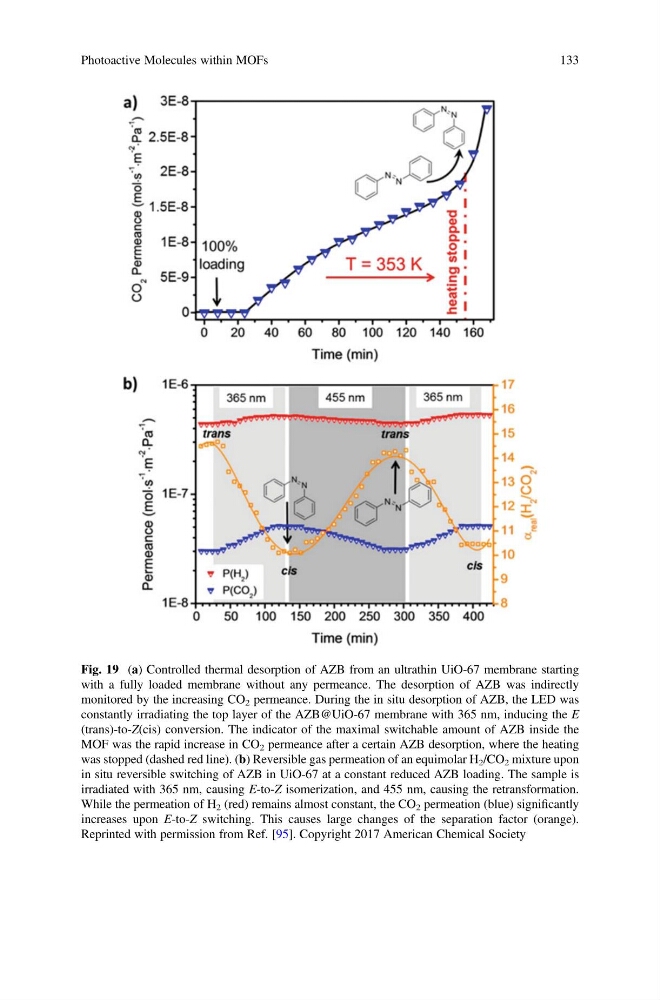
Fig. 19 (a) Controlled thermal desorption of AZB from an ultrathin UiO-67 membrane starting
with a fully loaded membrane without any permeance. The desorption of AZB was indirectly
monitored by the increasing CO 2 permeance. During the in situ desorption of AZB, the LED was
constantly irradiating the top layer of the AZB@UiO-67 membrane with 365 nm, inducing the E
(trans)-to-Z(cis) conversion. The indicator of the maximal switchable amount of AZB inside the
MOF was the rapid increase in CO 2 permeance after a certain AZB desorption, where the heating
was stopped (dashed red line). (b) Reversible gas permeation of an equimolar H 2 /CO 2 mixture upon
in situ reversible switching of AZB in UiO-67 at a constant reduced AZB loading. The sample is
irradiated with 365 nm, causing E-to-Z isomerization, and 455 nm, causing the retransformation.
While the permeation of H 2 (red) remains almost constant, the CO 2 permeation (blue) significantly
increases upon E-to-Z switching. This causes large changes of the separation factor (orange).
Reprinted with permission from Ref. [95]. Copyright 2017 American Chemical Society
Photoactive Molecules within MOFs
133
with a fully loaded membrane without any permeance. The desorption of AZB was indirectly
monitored by the increasing CO 2 permeance. During the in situ desorption of AZB, the LED was
constantly irradiating the top layer of the AZB@UiO-67 membrane with 365 nm, inducing the E
(trans)-to-Z(cis) conversion. The indicator of the maximal switchable amount of AZB inside the
MOF was the rapid increase in CO 2 permeance after a certain AZB desorption, where the heating
was stopped (dashed red line). (b) Reversible gas permeation of an equimolar H 2 /CO 2 mixture upon
in situ reversible switching of AZB in UiO-67 at a constant reduced AZB loading. The sample is
irradiated with 365 nm, causing E-to-Z isomerization, and 455 nm, causing the retransformation.
While the permeation of H 2 (red) remains almost constant, the CO 2 permeation (blue) significantly
increases upon E-to-Z switching. This causes large changes of the separation factor (orange).
Reprinted with permission from Ref. [95]. Copyright 2017 American Chemical Society
Photoactive Molecules within MOFs
133