

Also in 2017, Caro and co-workers presented their studies on photoswitchable
MOF membranes containing azobenzene as photoactive unit und UiO-67 as host
matrix (UiO denotes Universitetet i Oslo) [95]. In contrast to Heinke and co-workers
[144], the authors applied a synthetically much easier but rarely described approach
to grow the MOF ultrathin films. For the first time, they solvothermally synthesized a
submicrometer-sized thin UiO-67 membrane on an α-Al 2 O 3 support. To avoid
cracking of this membrane, AZB insertion was performed via diffusion from acetone. Residual AZB was washed off by dipping the membrane in a fresh acetone
solution. Afterwards, the composite thin film was dried in air to remove the solvent
to exclusively elucidate the AZB-MOF interactions. In a reference experiment, bulk
UiO-67 was loaded with AZB via a gas phase loading process.
N 2 sorption isotherms of pristine and loaded UiO-67 membranes showed an AZB
loading without any free space left inside the MOF’s pores. Therefore, switching of
AZB from its E to Z isomer is sterically hindered. It is not surprising that for this fully
loaded MOF membrane no gas flux is observed, see Fig. 19a. As a consequence, the
authors desorbed some azobenzene in order to achieve photoswitching of the dye
1.0
0.5
0.4
0.3
0.2
0.1
300
300
325 350 0.08
0.07
400
400
450 500
500
550
600
0.8
0.6
0.4
0.2
0.0
0.24
0.22
0.20
0.18
0.16
absorbance
absorbance at 320 nm
wavelength / nm
start
530 nm
400 nm
530 nm
400 nm
530 nm
400 nm
530 nm
400 nm
530 nm
a
b
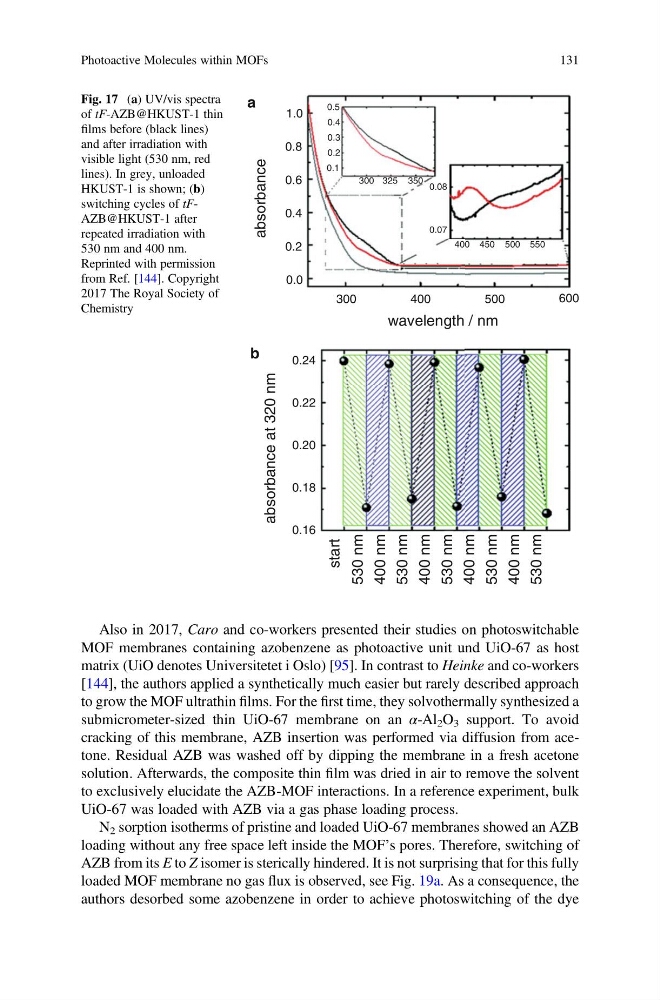
Fig. 17 (a) UV/vis spectra
of tF-AZB@HKUST-1 thin
films before (black lines)
and after irradiation with
visible light (530 nm, red
lines). In grey, unloaded
HKUST-1 is shown; (b)
switching cycles of tFAZB@HKUST-1 after
repeated irradiation with
530 nm and 400 nm.
Reprinted with permission
from Ref. [144]. Copyright
2017 The Royal Society of
Chemistry
Photoactive Molecules within MOFs
131
MOF membranes containing azobenzene as photoactive unit und UiO-67 as host
matrix (UiO denotes Universitetet i Oslo) [95]. In contrast to Heinke and co-workers
[144], the authors applied a synthetically much easier but rarely described approach
to grow the MOF ultrathin films. For the first time, they solvothermally synthesized a
submicrometer-sized thin UiO-67 membrane on an α-Al 2 O 3 support. To avoid
cracking of this membrane, AZB insertion was performed via diffusion from acetone. Residual AZB was washed off by dipping the membrane in a fresh acetone
solution. Afterwards, the composite thin film was dried in air to remove the solvent
to exclusively elucidate the AZB-MOF interactions. In a reference experiment, bulk
UiO-67 was loaded with AZB via a gas phase loading process.
N 2 sorption isotherms of pristine and loaded UiO-67 membranes showed an AZB
loading without any free space left inside the MOF’s pores. Therefore, switching of
AZB from its E to Z isomer is sterically hindered. It is not surprising that for this fully
loaded MOF membrane no gas flux is observed, see Fig. 19a. As a consequence, the
authors desorbed some azobenzene in order to achieve photoswitching of the dye
1.0
0.5
0.4
0.3
0.2
0.1
300
300
325 350 0.08
0.07
400
400
450 500
500
550
600
0.8
0.6
0.4
0.2
0.0
0.24
0.22
0.20
0.18
0.16
absorbance
absorbance at 320 nm
wavelength / nm
start
530 nm
400 nm
530 nm
400 nm
530 nm
400 nm
530 nm
400 nm
530 nm
a
b
Fig. 17 (a) UV/vis spectra
of tF-AZB@HKUST-1 thin
films before (black lines)
and after irradiation with
visible light (530 nm, red
lines). In grey, unloaded
HKUST-1 is shown; (b)
switching cycles of tFAZB@HKUST-1 after
repeated irradiation with
530 nm and 400 nm.
Reprinted with permission
from Ref. [144]. Copyright
2017 The Royal Society of
Chemistry
Photoactive Molecules within MOFs
131