

gas-phase loading process or a direct incorporation during the thin film synthesis,
they chose diffusion of both guest molecules from an ethanolic solution into the host
matrix. In a first step, AZB as the photoswitchable part was thoroughly examined by
a variety of methods. The successful embedment of AZB was confirmed by UV/vis
(Fig. 16a) and IR spectroscopy (Fig. 16d) as well as by XPS (Fig. 16e) and XRD
measurements. Additionally, depth profiles measured by Time-of-Flight Secondary
Ion Mass Spectrometry (ToF-SIMS) proved the homogeneity of the AZB@HKUST1 thin films, which are depicted in Fig. 16f.
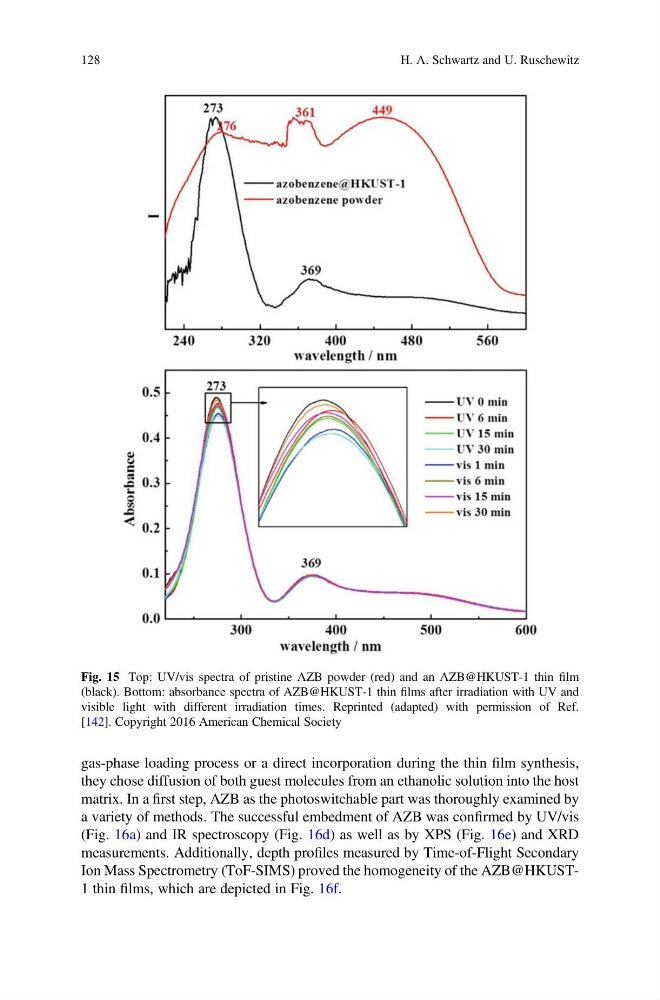
Fig. 15 Top: UV/vis spectra of pristine AZB powder (red) and an AZB@HKUST-1 thin film
(black). Bottom: absorbance spectra of AZB@HKUST-1 thin films after irradiation with UV and
visible light with different irradiation times. Reprinted (adapted) with permission of Ref.
[142]. Copyright 2016 American Chemical Society
128
H. A. Schwartz and U. Ruschewitz
they chose diffusion of both guest molecules from an ethanolic solution into the host
matrix. In a first step, AZB as the photoswitchable part was thoroughly examined by
a variety of methods. The successful embedment of AZB was confirmed by UV/vis
(Fig. 16a) and IR spectroscopy (Fig. 16d) as well as by XPS (Fig. 16e) and XRD
measurements. Additionally, depth profiles measured by Time-of-Flight Secondary
Ion Mass Spectrometry (ToF-SIMS) proved the homogeneity of the AZB@HKUST1 thin films, which are depicted in Fig. 16f.
Fig. 15 Top: UV/vis spectra of pristine AZB powder (red) and an AZB@HKUST-1 thin film
(black). Bottom: absorbance spectra of AZB@HKUST-1 thin films after irradiation with UV and
visible light with different irradiation times. Reprinted (adapted) with permission of Ref.
[142]. Copyright 2016 American Chemical Society
128
H. A. Schwartz and U. Ruschewitz