

2.2.2 Thin Films
In 2016, Zhang and co-workers presented the first photochromic guest-encapsulated
MOF thin film and studied the resulting photochromic properties [142]. The authors
used a modified liquid phase epitaxial growth (LPE) method to insert plain
azobenzene directly into a MOF thin film of type HKUST-1 (HKUST denotes
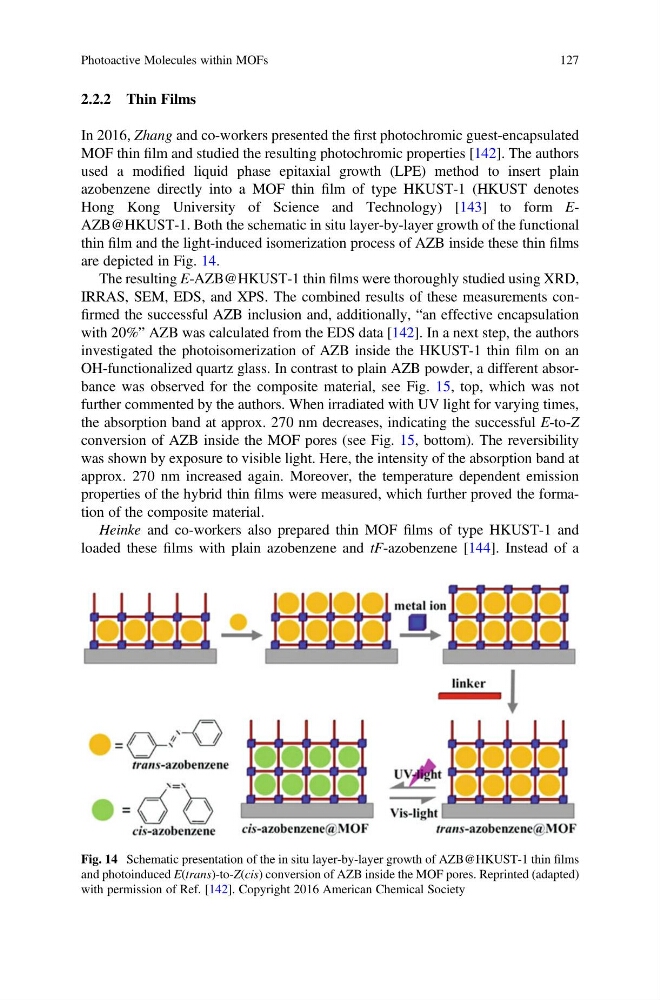
Hong Kong University of Science and Technology) [143] to form EAZB@HKUST-1. Both the schematic in situ layer-by-layer growth of the functional
thin film and the light-induced isomerization process of AZB inside these thin films
are depicted in Fig. 14.
The resulting E-AZB@HKUST-1 thin films were thoroughly studied using XRD,
IRRAS, SEM, EDS, and XPS. The combined results of these measurements confirmed the successful AZB inclusion and, additionally, “an effective encapsulation
with 20%” AZB was calculated from the EDS data [142]. In a next step, the authors
investigated the photoisomerization of AZB inside the HKUST-1 thin film on an
OH-functionalized quartz glass. In contrast to plain AZB powder, a different absorbance was observed for the composite material, see Fig. 15, top, which was not
further commented by the authors. When irradiated with UV light for varying times,
the absorption band at approx. 270 nm decreases, indicating the successful E-to-Z
conversion of AZB inside the MOF pores (see Fig. 15, bottom). The reversibility
was shown by exposure to visible light. Here, the intensity of the absorption band at
approx. 270 nm increased again. Moreover, the temperature dependent emission
properties of the hybrid thin films were measured, which further proved the formation of the composite material.
Heinke and co-workers also prepared thin MOF films of type HKUST-1 and
loaded these films with plain azobenzene and tF-azobenzene [144]. Instead of a
Fig. 14 Schematic presentation of the in situ layer-by-layer growth of AZB@HKUST-1 thin films
and photoinduced E(trans)-to-Z(cis) conversion of AZB inside the MOF pores. Reprinted (adapted)
with permission of Ref. [142]. Copyright 2016 American Chemical Society
Photoactive Molecules within MOFs
127
In 2016, Zhang and co-workers presented the first photochromic guest-encapsulated
MOF thin film and studied the resulting photochromic properties [142]. The authors
used a modified liquid phase epitaxial growth (LPE) method to insert plain
azobenzene directly into a MOF thin film of type HKUST-1 (HKUST denotes
Hong Kong University of Science and Technology) [143] to form EAZB@HKUST-1. Both the schematic in situ layer-by-layer growth of the functional
thin film and the light-induced isomerization process of AZB inside these thin films
are depicted in Fig. 14.
The resulting E-AZB@HKUST-1 thin films were thoroughly studied using XRD,
IRRAS, SEM, EDS, and XPS. The combined results of these measurements confirmed the successful AZB inclusion and, additionally, “an effective encapsulation
with 20%” AZB was calculated from the EDS data [142]. In a next step, the authors
investigated the photoisomerization of AZB inside the HKUST-1 thin film on an
OH-functionalized quartz glass. In contrast to plain AZB powder, a different absorbance was observed for the composite material, see Fig. 15, top, which was not
further commented by the authors. When irradiated with UV light for varying times,
the absorption band at approx. 270 nm decreases, indicating the successful E-to-Z
conversion of AZB inside the MOF pores (see Fig. 15, bottom). The reversibility
was shown by exposure to visible light. Here, the intensity of the absorption band at
approx. 270 nm increased again. Moreover, the temperature dependent emission
properties of the hybrid thin films were measured, which further proved the formation of the composite material.
Heinke and co-workers also prepared thin MOF films of type HKUST-1 and
loaded these films with plain azobenzene and tF-azobenzene [144]. Instead of a
Fig. 14 Schematic presentation of the in situ layer-by-layer growth of AZB@HKUST-1 thin films
and photoinduced E(trans)-to-Z(cis) conversion of AZB inside the MOF pores. Reprinted (adapted)
with permission of Ref. [142]. Copyright 2016 American Chemical Society
Photoactive Molecules within MOFs
127