

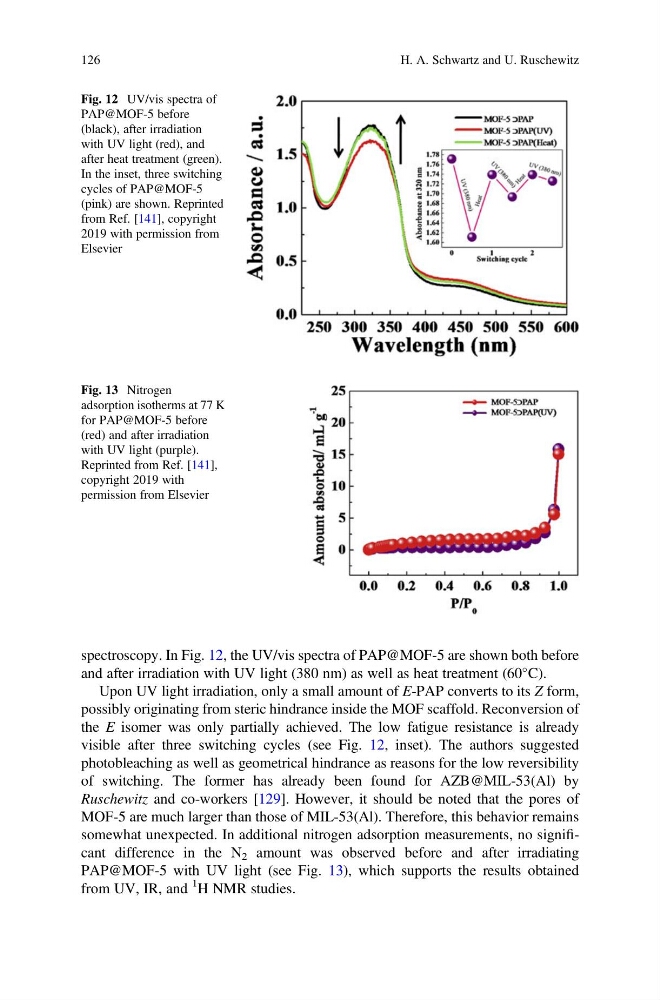
spectroscopy. In Fig. 12, the UV/vis spectra of PAP@MOF-5 are shown both before
and after irradiation with UV light (380 nm) as well as heat treatment (60
C).
Upon UV light irradiation, only a small amount of E-PAP converts to its Z form,
possibly originating from steric hindrance inside the MOF scaffold. Reconversion of
the E isomer was only partially achieved. The low fatigue resistance is already
visible after three switching cycles (see Fig. 12, inset). The authors suggested
photobleaching as well as geometrical hindrance as reasons for the low reversibility
of switching. The former has already been found for AZB@MIL-53(Al) by
Ruschewitz and co-workers [129]. However, it should be noted that the pores of
MOF-5 are much larger than those of MIL-53(Al). Therefore, this behavior remains
somewhat unexpected. In additional nitrogen adsorption measurements, no significant difference in the N 2 amount was observed before and after irradiating
PAP@MOF-5 with UV light (see Fig. 13), which supports the results obtained
from UV, IR, and
1 H NMR studies.
Fig. 12 UV/vis spectra of
PAP@MOF-5 before
(black), after irradiation
with UV light (red), and
after heat treatment (green).
In the inset, three switching
cycles of PAP@MOF-5
(pink) are shown. Reprinted
from Ref. [141], copyright
2019 with permission from
Elsevier
Fig. 13 Nitrogen
adsorption isotherms at 77 K
for PAP@MOF-5 before
(red) and after irradiation
with UV light (purple).
Reprinted from Ref. [141],
copyright 2019 with
permission from Elsevier
126
H. A. Schwartz and U. Ruschewitz
and after irradiation with UV light (380 nm) as well as heat treatment (60
C).
Upon UV light irradiation, only a small amount of E-PAP converts to its Z form,
possibly originating from steric hindrance inside the MOF scaffold. Reconversion of
the E isomer was only partially achieved. The low fatigue resistance is already
visible after three switching cycles (see Fig. 12, inset). The authors suggested
photobleaching as well as geometrical hindrance as reasons for the low reversibility
of switching. The former has already been found for AZB@MIL-53(Al) by
Ruschewitz and co-workers [129]. However, it should be noted that the pores of
MOF-5 are much larger than those of MIL-53(Al). Therefore, this behavior remains
somewhat unexpected. In additional nitrogen adsorption measurements, no significant difference in the N 2 amount was observed before and after irradiating
PAP@MOF-5 with UV light (see Fig. 13), which supports the results obtained
from UV, IR, and
1 H NMR studies.
Fig. 12 UV/vis spectra of
PAP@MOF-5 before
(black), after irradiation
with UV light (red), and
after heat treatment (green).
In the inset, three switching
cycles of PAP@MOF-5
(pink) are shown. Reprinted
from Ref. [141], copyright
2019 with permission from
Elsevier
Fig. 13 Nitrogen
adsorption isotherms at 77 K
for PAP@MOF-5 before
(red) and after irradiation
with UV light (purple).
Reprinted from Ref. [141],
copyright 2019 with
permission from Elsevier
126
H. A. Schwartz and U. Ruschewitz