

reconversion was achieved by heat treatment at 60
C, which is similar to the results
achieved for pristine PAP. The absorption spectra of PAP@DMOF-1 before and
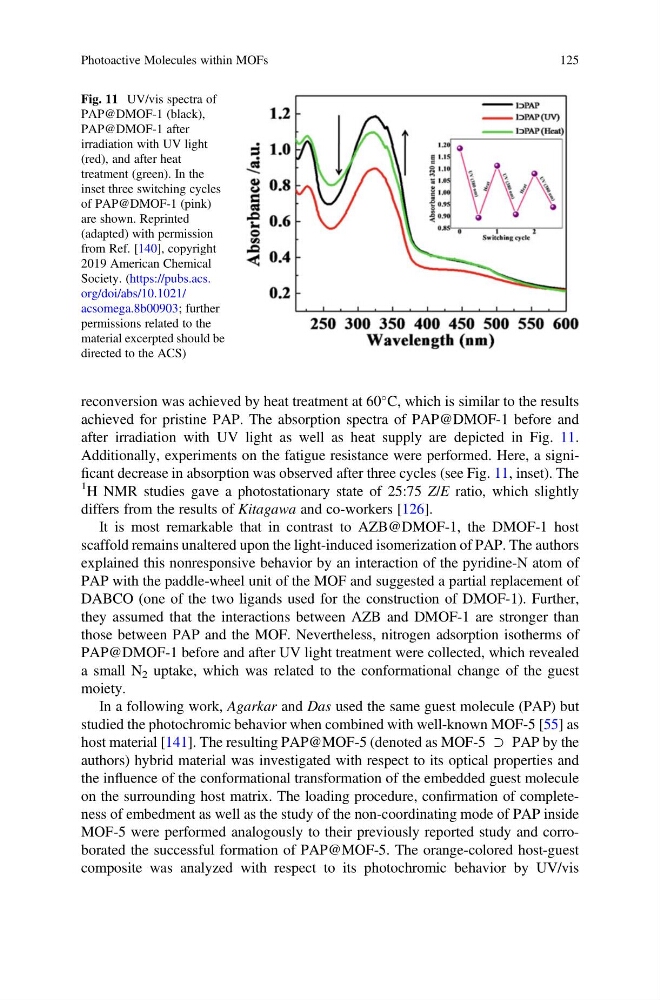
after irradiation with UV light as well as heat supply are depicted in Fig. 11.
Additionally, experiments on the fatigue resistance were performed. Here, a significant decrease in absorption was observed after three cycles (see Fig. 11, inset). The
1 H NMR studies gave a photostationary state of 25:75 Z/E ratio, which slightly
differs from the results of Kitagawa and co-workers [126].
It is most remarkable that in contrast to AZB@DMOF-1, the DMOF-1 host
scaffold remains unaltered upon the light-induced isomerization of PAP. The authors
explained this nonresponsive behavior by an interaction of the pyridine-N atom of
PAP with the paddle-wheel unit of the MOF and suggested a partial replacement of
DABCO (one of the two ligands used for the construction of DMOF-1). Further,
they assumed that the interactions between AZB and DMOF-1 are stronger than
those between PAP and the MOF. Nevertheless, nitrogen adsorption isotherms of
PAP@DMOF-1 before and after UV light treatment were collected, which revealed
a small N 2 uptake, which was related to the conformational change of the guest
moiety.
In a following work, Agarkar and Das used the same guest molecule (PAP) but
studied the photochromic behavior when combined with well-known MOF-5 [55] as
host material [141]. The resulting PAP@MOF-5 (denoted as MOF-5 ⊃ PAP by the
authors) hybrid material was investigated with respect to its optical properties and
the influence of the conformational transformation of the embedded guest molecule
on the surrounding host matrix. The loading procedure, confirmation of completeness of embedment as well as the study of the non-coordinating mode of PAP inside
MOF-5 were performed analogously to their previously reported study and corroborated the successful formation of PAP@MOF-5. The orange-colored host-guest
composite was analyzed with respect to its photochromic behavior by UV/vis
Fig. 11 UV/vis spectra of
PAP@DMOF-1 (black),
PAP@DMOF-1 after
irradiation with UV light
(red), and after heat
treatment (green). In the
inset three switching cycles
of PAP@DMOF-1 (pink)
are shown. Reprinted
(adapted) with permission
from Ref. [140], copyright
2019 American Chemical
Society. (https://pubs.acs.
org/doi/abs/10.1021/
acsomega.8b00903; further
permissions related to the
material excerpted should be
directed to the ACS)
Photoactive Molecules within MOFs
125
C, which is similar to the results
achieved for pristine PAP. The absorption spectra of PAP@DMOF-1 before and
after irradiation with UV light as well as heat supply are depicted in Fig. 11.
Additionally, experiments on the fatigue resistance were performed. Here, a significant decrease in absorption was observed after three cycles (see Fig. 11, inset). The
1 H NMR studies gave a photostationary state of 25:75 Z/E ratio, which slightly
differs from the results of Kitagawa and co-workers [126].
It is most remarkable that in contrast to AZB@DMOF-1, the DMOF-1 host
scaffold remains unaltered upon the light-induced isomerization of PAP. The authors
explained this nonresponsive behavior by an interaction of the pyridine-N atom of
PAP with the paddle-wheel unit of the MOF and suggested a partial replacement of
DABCO (one of the two ligands used for the construction of DMOF-1). Further,
they assumed that the interactions between AZB and DMOF-1 are stronger than
those between PAP and the MOF. Nevertheless, nitrogen adsorption isotherms of
PAP@DMOF-1 before and after UV light treatment were collected, which revealed
a small N 2 uptake, which was related to the conformational change of the guest
moiety.
In a following work, Agarkar and Das used the same guest molecule (PAP) but
studied the photochromic behavior when combined with well-known MOF-5 [55] as
host material [141]. The resulting PAP@MOF-5 (denoted as MOF-5 ⊃ PAP by the
authors) hybrid material was investigated with respect to its optical properties and
the influence of the conformational transformation of the embedded guest molecule
on the surrounding host matrix. The loading procedure, confirmation of completeness of embedment as well as the study of the non-coordinating mode of PAP inside
MOF-5 were performed analogously to their previously reported study and corroborated the successful formation of PAP@MOF-5. The orange-colored host-guest
composite was analyzed with respect to its photochromic behavior by UV/vis
Fig. 11 UV/vis spectra of
PAP@DMOF-1 (black),
PAP@DMOF-1 after
irradiation with UV light
(red), and after heat
treatment (green). In the
inset three switching cycles
of PAP@DMOF-1 (pink)
are shown. Reprinted
(adapted) with permission
from Ref. [140], copyright
2019 American Chemical
Society. (https://pubs.acs.
org/doi/abs/10.1021/
acsomega.8b00903; further
permissions related to the
material excerpted should be
directed to the ACS)
Photoactive Molecules within MOFs
125