

material by illumination with green and blue light without the need of UV light.
Even more, the system consisting of tF-AZB and MIL-68(In) exhibits no significant
fatigue upon several switching cycles, making this composite material promising for
future applications. Thus, the authors presented the first guest@MOF systems with
almost quantitative switching and detailed investigations on the underlying hostguest interactions to explain the optical properties of these materials from a structural
point of view.
In ongoing studies, Agarkar and Das started to investigate the azobenzene
derivative 2-phenylazopyridine (PAP) and focused their work on DMOF-1 [127]
as host scaffold in a first step [140], mainly following the work of Kitagawa and
co-workers [126] on AZB@DMOF-1. Because of the structural similarity of PAP
and AZB, the authors expected a similar light-induced guest-to-host structural
transmission, which had already been observed for the AZB@DMOF-1 composite
upon UV light irradiation [126]. Accordingly, the dye molecule in its E form was
embedded into the MOF framework by adsorption through melting and the successful guest inclusion was confirmed by a leaching experiment. Here, the
PAP@DMOF-1 (denoted as 1 ⊃ PAP by the authors) sample was mixed with
chloroform. PAP is known to be highly soluble in chloroform, hence, non-inserted
molecules would be detectable by UV/vis spectroscopy.
No absorption band was observed, thus verifying the complete embedment of
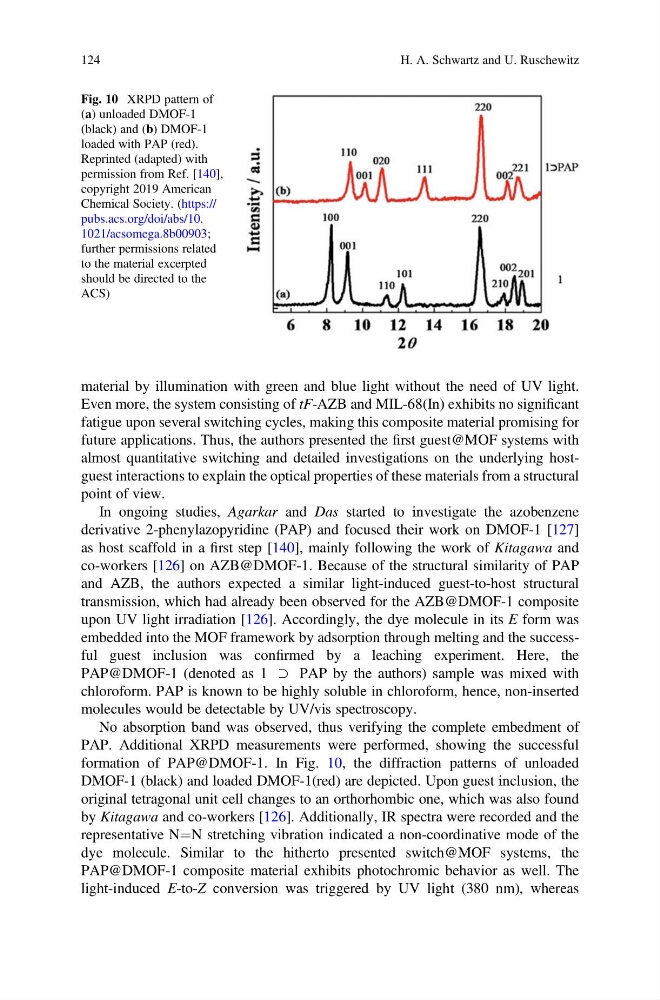
PAP. Additional XRPD measurements were performed, showing the successful
formation of PAP@DMOF-1. In Fig. 10, the diffraction patterns of unloaded
DMOF-1 (black) and loaded DMOF-1(red) are depicted. Upon guest inclusion, the
original tetragonal unit cell changes to an orthorhombic one, which was also found
by Kitagawa and co-workers [126]. Additionally, IR spectra were recorded and the
representative N¼N stretching vibration indicated a non-coordinative mode of the
dye molecule. Similar to the hitherto presented switch@MOF systems, the
PAP@DMOF-1 composite material exhibits photochromic behavior as well. The
light-induced E-to-Z conversion was triggered by UV light (380 nm), whereas
Fig. 10 XRPD pattern of
(a) unloaded DMOF-1
(black) and (b) DMOF-1
loaded with PAP (red).
Reprinted (adapted) with
permission from Ref. [140],
copyright 2019 American
Chemical Society. (https://
pubs.acs.org/doi/abs/10.
1021/acsomega.8b00903;
further permissions related
to the material excerpted
should be directed to the
ACS)
124
H. A. Schwartz and U. Ruschewitz
Even more, the system consisting of tF-AZB and MIL-68(In) exhibits no significant
fatigue upon several switching cycles, making this composite material promising for
future applications. Thus, the authors presented the first guest@MOF systems with
almost quantitative switching and detailed investigations on the underlying hostguest interactions to explain the optical properties of these materials from a structural
point of view.
In ongoing studies, Agarkar and Das started to investigate the azobenzene
derivative 2-phenylazopyridine (PAP) and focused their work on DMOF-1 [127]
as host scaffold in a first step [140], mainly following the work of Kitagawa and
co-workers [126] on AZB@DMOF-1. Because of the structural similarity of PAP
and AZB, the authors expected a similar light-induced guest-to-host structural
transmission, which had already been observed for the AZB@DMOF-1 composite
upon UV light irradiation [126]. Accordingly, the dye molecule in its E form was
embedded into the MOF framework by adsorption through melting and the successful guest inclusion was confirmed by a leaching experiment. Here, the
PAP@DMOF-1 (denoted as 1 ⊃ PAP by the authors) sample was mixed with
chloroform. PAP is known to be highly soluble in chloroform, hence, non-inserted
molecules would be detectable by UV/vis spectroscopy.
No absorption band was observed, thus verifying the complete embedment of
PAP. Additional XRPD measurements were performed, showing the successful
formation of PAP@DMOF-1. In Fig. 10, the diffraction patterns of unloaded
DMOF-1 (black) and loaded DMOF-1(red) are depicted. Upon guest inclusion, the
original tetragonal unit cell changes to an orthorhombic one, which was also found
by Kitagawa and co-workers [126]. Additionally, IR spectra were recorded and the
representative N¼N stretching vibration indicated a non-coordinative mode of the
dye molecule. Similar to the hitherto presented switch@MOF systems, the
PAP@DMOF-1 composite material exhibits photochromic behavior as well. The
light-induced E-to-Z conversion was triggered by UV light (380 nm), whereas
Fig. 10 XRPD pattern of
(a) unloaded DMOF-1
(black) and (b) DMOF-1
loaded with PAP (red).
Reprinted (adapted) with
permission from Ref. [140],
copyright 2019 American
Chemical Society. (https://
pubs.acs.org/doi/abs/10.
1021/acsomega.8b00903;
further permissions related
to the material excerpted
should be directed to the
ACS)
124
H. A. Schwartz and U. Ruschewitz