

TH
+ at the outer ZL surface in sample 1. We have two effects: avoidance of
aggregate formation and protection. Spectroscopic evidence supports the interpretation [17]. The properties of ZL are fundamentally different from those observed with
zeolite Y (ZY). TH
+ exchanged zeolite Y results in pink-colored samples characteristic for H aggregates of this dye. The color changes from pink to blue when drying
TH
+
ZY and back to pink upon rehydration. This means that TH
+ within the
supercages of zeolite Y is present as monomers when the zeolite is dry and as
H-aggregated dimers when it is wet, [18] while TH
+ is present as monomer within
the channels of ZL, independent of whether the sample is “wet” or “dry.” Details of
the structure of TH
+
-ZL was revealed many years after these observations were made
[19]. The more we learned about the properties of ZL as a host, the more we were
surprised by its unique properties for creating highly organized systems [14–16, 20,
21]. The important progress regarding the understanding of the structure of hostguest composites was made possible by the availability of advanced computational
tools, modern powder diffraction techniques, and luminescence microscopy [1]. The
remarkable evolution justifies devoting this article to zeolite L.
ZL is a so-called large pore 12-membered ring zeolite with one-dimensional
channel system. It was discovered by Breck and Flaningen (1968) as synthetic
material and observed many years later in nature by Artioli and Kvick [10, 11,
22]. ZL possesses circular pore aperture with a crystallographic diameter of 0.71 nm.
It belongs to the low-silica zeolites with a molar composition of
(M
+
) 9 ([AlO 2 ] 9 [SiO 2 ] 27 )xnH 2 O, where M
+ are monovalent cations, usually K
+ . The
framework of ZL possesses therefore anionic properties which are compensated by,
e.g., alkali ions. The latter can be exchanged to some extent by other cations. We
represent the structure of ZL and features of its morphology in Fig. 2 in a more
intuitive way that allows imaging important properties. Precise structural data can be
found in references [12, 23, 24].
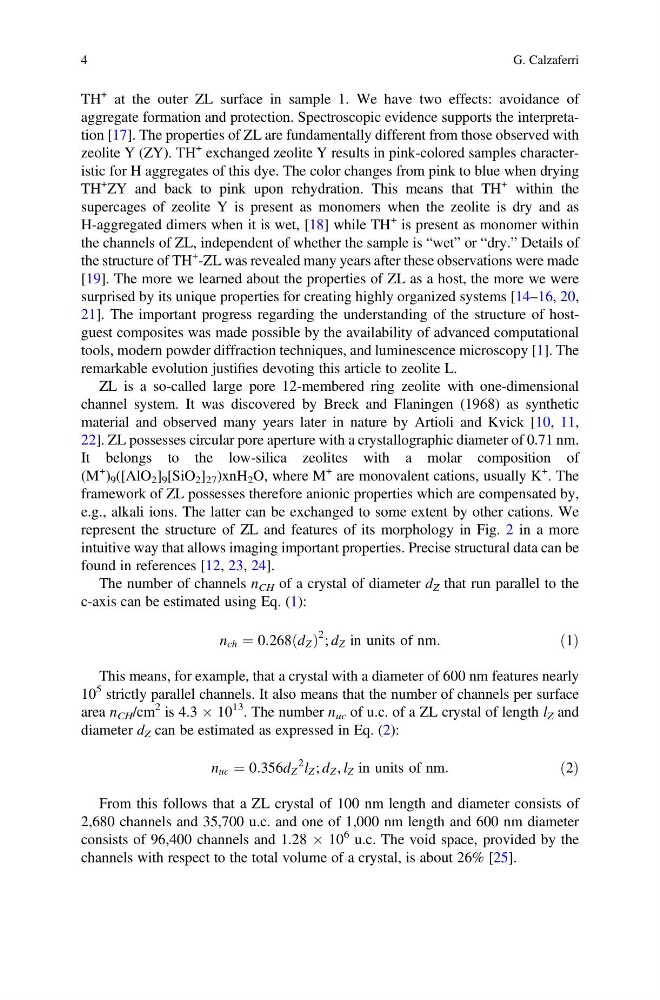
The number of channels n CH of a crystal of diameter d Z that run parallel to the
c-axis can be estimated using Eq. (1):
n ch ¼ 0:268 d Z
ð Þ
2 ; d Z in units of nm:
ð1Þ
This means, for example, that a crystal with a diameter of 600 nm features nearly
10
5 strictly parallel channels. It also means that the number of channels per surface
area n CH /cm
2 is 4.3 Â 10
13 . The number n uc of u.c. of a ZL crystal of length l Z and
diameter d Z can be estimated as expressed in Eq. (2):
n uc ¼ 0:356d Z
2 l Z ; d Z , l Z in units of nm:
ð2Þ
From this follows that a ZL crystal of 100 nm length and diameter consists of
2,680 channels and 35,700 u.c. and one of 1,000 nm length and 600 nm diameter
consists of 96,400 channels and 1.28 Â 10
6 u.c. The void space, provided by the
channels with respect to the total volume of a crystal, is about 26% [25].
4
G. Calzaferri
+ at the outer ZL surface in sample 1. We have two effects: avoidance of
aggregate formation and protection. Spectroscopic evidence supports the interpretation [17]. The properties of ZL are fundamentally different from those observed with
zeolite Y (ZY). TH
+ exchanged zeolite Y results in pink-colored samples characteristic for H aggregates of this dye. The color changes from pink to blue when drying
TH
+
ZY and back to pink upon rehydration. This means that TH
+ within the
supercages of zeolite Y is present as monomers when the zeolite is dry and as
H-aggregated dimers when it is wet, [18] while TH
+ is present as monomer within
the channels of ZL, independent of whether the sample is “wet” or “dry.” Details of
the structure of TH
+
-ZL was revealed many years after these observations were made
[19]. The more we learned about the properties of ZL as a host, the more we were
surprised by its unique properties for creating highly organized systems [14–16, 20,
21]. The important progress regarding the understanding of the structure of hostguest composites was made possible by the availability of advanced computational
tools, modern powder diffraction techniques, and luminescence microscopy [1]. The
remarkable evolution justifies devoting this article to zeolite L.
ZL is a so-called large pore 12-membered ring zeolite with one-dimensional
channel system. It was discovered by Breck and Flaningen (1968) as synthetic
material and observed many years later in nature by Artioli and Kvick [10, 11,
22]. ZL possesses circular pore aperture with a crystallographic diameter of 0.71 nm.
It belongs to the low-silica zeolites with a molar composition of
(M
+
) 9 ([AlO 2 ] 9 [SiO 2 ] 27 )xnH 2 O, where M
+ are monovalent cations, usually K
+ . The
framework of ZL possesses therefore anionic properties which are compensated by,
e.g., alkali ions. The latter can be exchanged to some extent by other cations. We
represent the structure of ZL and features of its morphology in Fig. 2 in a more
intuitive way that allows imaging important properties. Precise structural data can be
found in references [12, 23, 24].
The number of channels n CH of a crystal of diameter d Z that run parallel to the
c-axis can be estimated using Eq. (1):
n ch ¼ 0:268 d Z
ð Þ
2 ; d Z in units of nm:
ð1Þ
This means, for example, that a crystal with a diameter of 600 nm features nearly
10
5 strictly parallel channels. It also means that the number of channels per surface
area n CH /cm
2 is 4.3 Â 10
13 . The number n uc of u.c. of a ZL crystal of length l Z and
diameter d Z can be estimated as expressed in Eq. (2):
n uc ¼ 0:356d Z
2 l Z ; d Z , l Z in units of nm:
ð2Þ
From this follows that a ZL crystal of 100 nm length and diameter consists of
2,680 channels and 35,700 u.c. and one of 1,000 nm length and 600 nm diameter
consists of 96,400 channels and 1.28 Â 10
6 u.c. The void space, provided by the
channels with respect to the total volume of a crystal, is about 26% [25].
4
G. Calzaferri