

ranging from catalysis, lubricant technology, pigments, sensing, optics, optoelectronics, biology, drug delivery, diagnostics, and even human medicine. ZL seems to
be the only known thermally and mechanically stable material with linear channels
of about 1 nm diameter where the size of the particles and, hence, the length of the
channels can be tuned in the range from about 30 nm up to 20,000 nm and which can
be synthesized as crystals of different morphology such as discs, barrels, and
elongated tubes. This means that crystals consisting of about 250 up to 10
8 strictly
parallel channels are available. The anionic framework of ZL allows inserting
cationic species by means of ion exchange and neutral species from the gas phase
or from dispersions, using an appropriate liquid phase, and it enables attaching
reversible or covalently bound functionalities [14–16].
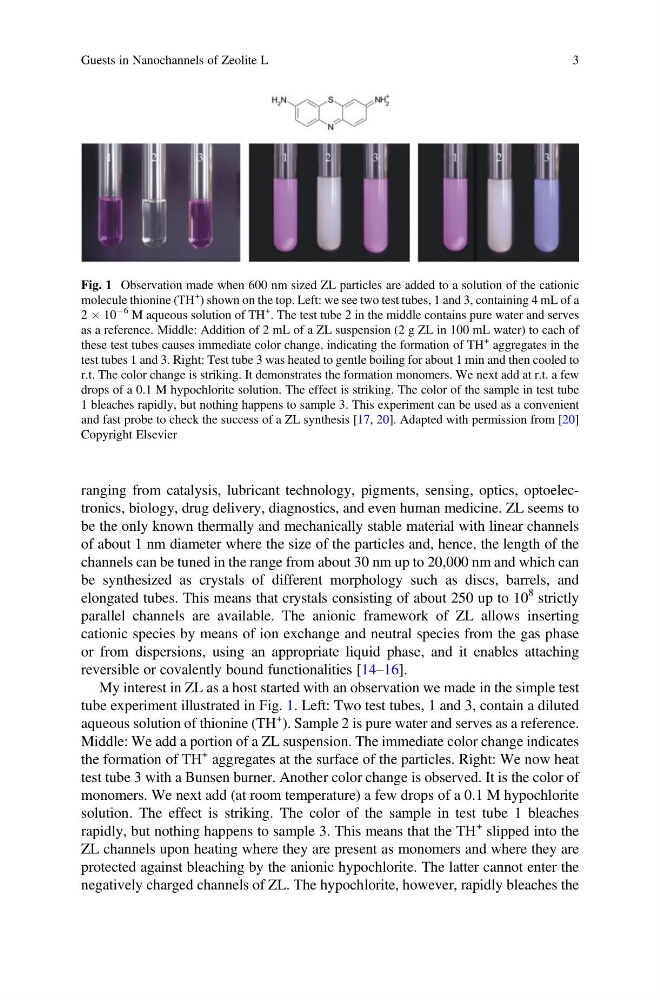
My interest in ZL as a host started with an observation we made in the simple test
tube experiment illustrated in Fig. 1. Left: Two test tubes, 1 and 3, contain a diluted
aqueous solution of thionine (TH
+ ). Sample 2 is pure water and serves as a reference.
Middle: We add a portion of a ZL suspension. The immediate color change indicates
the formation of TH
+ aggregates at the surface of the particles. Right: We now heat
test tube 3 with a Bunsen burner. Another color change is observed. It is the color of
monomers. We next add (at room temperature) a few drops of a 0.1 M hypochlorite
solution. The effect is striking. The color of the sample in test tube 1 bleaches
rapidly, but nothing happens to sample 3. This means that the TH
+ slipped into the
ZL channels upon heating where they are present as monomers and where they are
protected against bleaching by the anionic hypochlorite. The latter cannot enter the
negatively charged channels of ZL. The hypochlorite, however, rapidly bleaches the
Fig. 1 Observation made when 600 nm sized ZL particles are added to a solution of the cationic
molecule thionine (TH
+ ) shown on the top. Left: we see two test tubes, 1 and 3, containing 4 mL of a
2 Â 10
À6 M aqueous solution of TH
+ . The test tube 2 in the middle contains pure water and serves
as a reference. Middle: Addition of 2 mL of a ZL suspension (2 g ZL in 100 mL water) to each of
these test tubes causes immediate color change, indicating the formation of TH
+ aggregates in the
test tubes 1 and 3. Right: Test tube 3 was heated to gentle boiling for about 1 min and then cooled to
r.t. The color change is striking. It demonstrates the formation monomers. We next add at r.t. a few
drops of a 0.1 M hypochlorite solution. The effect is striking. The color of the sample in test tube
1 bleaches rapidly, but nothing happens to sample 3. This experiment can be used as a convenient
and fast probe to check the success of a ZL synthesis [17, 20]. Adapted with permission from [20]
Copyright Elsevier
Guests in Nanochannels of Zeolite L
3
be the only known thermally and mechanically stable material with linear channels
of about 1 nm diameter where the size of the particles and, hence, the length of the
channels can be tuned in the range from about 30 nm up to 20,000 nm and which can
be synthesized as crystals of different morphology such as discs, barrels, and
elongated tubes. This means that crystals consisting of about 250 up to 10
8 strictly
parallel channels are available. The anionic framework of ZL allows inserting
cationic species by means of ion exchange and neutral species from the gas phase
or from dispersions, using an appropriate liquid phase, and it enables attaching
reversible or covalently bound functionalities [14–16].
My interest in ZL as a host started with an observation we made in the simple test
tube experiment illustrated in Fig. 1. Left: Two test tubes, 1 and 3, contain a diluted
aqueous solution of thionine (TH
+ ). Sample 2 is pure water and serves as a reference.
Middle: We add a portion of a ZL suspension. The immediate color change indicates
the formation of TH
+ aggregates at the surface of the particles. Right: We now heat
test tube 3 with a Bunsen burner. Another color change is observed. It is the color of
monomers. We next add (at room temperature) a few drops of a 0.1 M hypochlorite
solution. The effect is striking. The color of the sample in test tube 1 bleaches
rapidly, but nothing happens to sample 3. This means that the TH
+ slipped into the
ZL channels upon heating where they are present as monomers and where they are
protected against bleaching by the anionic hypochlorite. The latter cannot enter the
negatively charged channels of ZL. The hypochlorite, however, rapidly bleaches the
Fig. 1 Observation made when 600 nm sized ZL particles are added to a solution of the cationic
molecule thionine (TH
+ ) shown on the top. Left: we see two test tubes, 1 and 3, containing 4 mL of a
2 Â 10
À6 M aqueous solution of TH
+ . The test tube 2 in the middle contains pure water and serves
as a reference. Middle: Addition of 2 mL of a ZL suspension (2 g ZL in 100 mL water) to each of
these test tubes causes immediate color change, indicating the formation of TH
+ aggregates in the
test tubes 1 and 3. Right: Test tube 3 was heated to gentle boiling for about 1 min and then cooled to
r.t. The color change is striking. It demonstrates the formation monomers. We next add at r.t. a few
drops of a 0.1 M hypochlorite solution. The effect is striking. The color of the sample in test tube
1 bleaches rapidly, but nothing happens to sample 3. This experiment can be used as a convenient
and fast probe to check the success of a ZL synthesis [17, 20]. Adapted with permission from [20]
Copyright Elsevier
Guests in Nanochannels of Zeolite L
3