

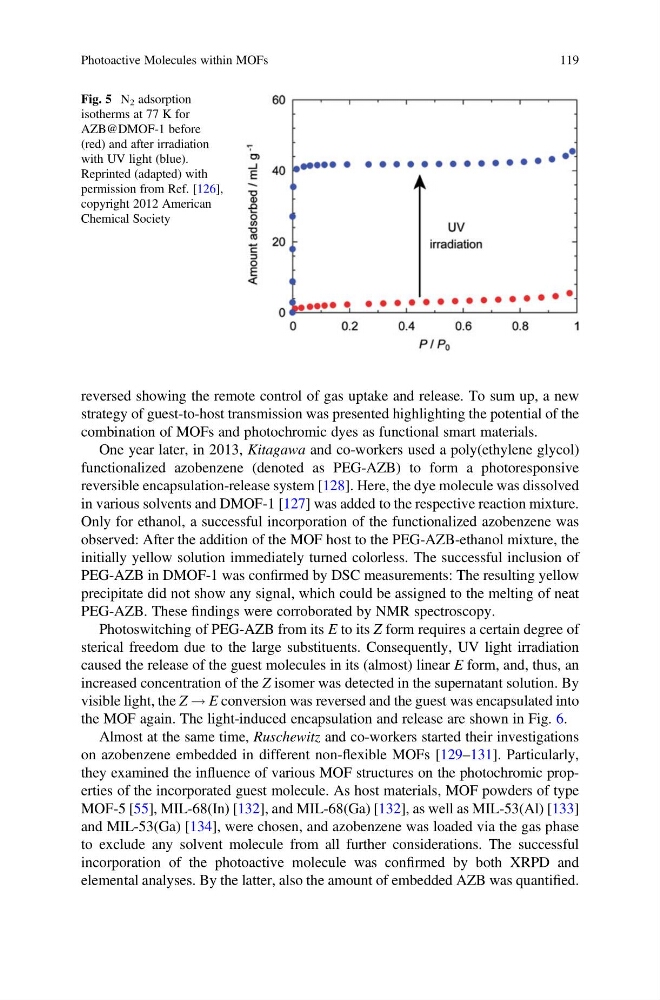
reversed showing the remote control of gas uptake and release. To sum up, a new
strategy of guest-to-host transmission was presented highlighting the potential of the
combination of MOFs and photochromic dyes as functional smart materials.
One year later, in 2013, Kitagawa and co-workers used a poly(ethylene glycol)
functionalized azobenzene (denoted as PEG-AZB) to form a photoresponsive
reversible encapsulation-release system [128]. Here, the dye molecule was dissolved
in various solvents and DMOF-1 [127] was added to the respective reaction mixture.
Only for ethanol, a successful incorporation of the functionalized azobenzene was
observed: After the addition of the MOF host to the PEG-AZB-ethanol mixture, the
initially yellow solution immediately turned colorless. The successful inclusion of
PEG-AZB in DMOF-1 was confirmed by DSC measurements: The resulting yellow
precipitate did not show any signal, which could be assigned to the melting of neat
PEG-AZB. These findings were corroborated by NMR spectroscopy.
Photoswitching of PEG-AZB from its E to its Z form requires a certain degree of
sterical freedom due to the large substituents. Consequently, UV light irradiation
caused the release of the guest molecules in its (almost) linear E form, and, thus, an
increased concentration of the Z isomer was detected in the supernatant solution. By
visible light, the Z ! E conversion was reversed and the guest was encapsulated into
the MOF again. The light-induced encapsulation and release are shown in Fig. 6.
Almost at the same time, Ruschewitz and co-workers started their investigations
on azobenzene embedded in different non-flexible MOFs [129–131]. Particularly,
they examined the influence of various MOF structures on the photochromic properties of the incorporated guest molecule. As host materials, MOF powders of type
MOF-5 [55], MIL-68(In) [132], and MIL-68(Ga) [132], as well as MIL-53(Al) [133]
and MIL-53(Ga) [134], were chosen, and azobenzene was loaded via the gas phase
to exclude any solvent molecule from all further considerations. The successful
incorporation of the photoactive molecule was confirmed by both XRPD and
elemental analyses. By the latter, also the amount of embedded AZB was quantified.
Fig. 5 N 2 adsorption
isotherms at 77 K for
AZB@DMOF-1 before
(red) and after irradiation
with UV light (blue).
Reprinted (adapted) with
permission from Ref. [126],
copyright 2012 American
Chemical Society
Photoactive Molecules within MOFs
119
strategy of guest-to-host transmission was presented highlighting the potential of the
combination of MOFs and photochromic dyes as functional smart materials.
One year later, in 2013, Kitagawa and co-workers used a poly(ethylene glycol)
functionalized azobenzene (denoted as PEG-AZB) to form a photoresponsive
reversible encapsulation-release system [128]. Here, the dye molecule was dissolved
in various solvents and DMOF-1 [127] was added to the respective reaction mixture.
Only for ethanol, a successful incorporation of the functionalized azobenzene was
observed: After the addition of the MOF host to the PEG-AZB-ethanol mixture, the
initially yellow solution immediately turned colorless. The successful inclusion of
PEG-AZB in DMOF-1 was confirmed by DSC measurements: The resulting yellow
precipitate did not show any signal, which could be assigned to the melting of neat
PEG-AZB. These findings were corroborated by NMR spectroscopy.
Photoswitching of PEG-AZB from its E to its Z form requires a certain degree of
sterical freedom due to the large substituents. Consequently, UV light irradiation
caused the release of the guest molecules in its (almost) linear E form, and, thus, an
increased concentration of the Z isomer was detected in the supernatant solution. By
visible light, the Z ! E conversion was reversed and the guest was encapsulated into
the MOF again. The light-induced encapsulation and release are shown in Fig. 6.
Almost at the same time, Ruschewitz and co-workers started their investigations
on azobenzene embedded in different non-flexible MOFs [129–131]. Particularly,
they examined the influence of various MOF structures on the photochromic properties of the incorporated guest molecule. As host materials, MOF powders of type
MOF-5 [55], MIL-68(In) [132], and MIL-68(Ga) [132], as well as MIL-53(Al) [133]
and MIL-53(Ga) [134], were chosen, and azobenzene was loaded via the gas phase
to exclude any solvent molecule from all further considerations. The successful
incorporation of the photoactive molecule was confirmed by both XRPD and
elemental analyses. By the latter, also the amount of embedded AZB was quantified.
Fig. 5 N 2 adsorption
isotherms at 77 K for
AZB@DMOF-1 before
(red) and after irradiation
with UV light (blue).
Reprinted (adapted) with
permission from Ref. [126],
copyright 2012 American
Chemical Society
Photoactive Molecules within MOFs
119