

X-ray powder diffraction is an elegant way to follow the incorporation process,
since for non-flexible MOFs the embedment is accompanied by a modulation of the
reflection intensities. This is caused by the changed electron density arising from the
guest molecules inside the MOF pores, while the reflection positions remain unaffected. On the contrary, for flexible MOFs such as the MIL-53 family [133, 134] or
DMOF-1 [127] described earlier, inclusion of a guest molecule may cause the
so-called breathing effect and typically significant changes of the diffraction pattern
with respect to intensities and 2θ positions are observed. Furthermore, if the dye is
not completely embedded, additional reflections of the guest moiety would be visible
in the respective XRPD pattern. In Fig. 7, the comparison of unloaded and loaded
MOF-5 is depicted, showing the modulation of intensities upon guest loading,
especially visible for the third reflection.
The light-induced E-to-Z conversion was quantified by means of IR spectroscopy,
since the E and Z isomer exhibit distinguishable IR bands. For AZB 0.66 @MIL-68
(In), 30% of the Z isomer was found, whereas 27% for AZB 0.66 @MIL-68(Ga) and
25% for AZB 5 @MOF-5 were reported. Surprisingly, no photoswitching was
observed for MIL-53(Al) as host material at all. To understand the reasons for the
inhibited isomerization in MIL-53(Al) from a structural point of view, the authors
conducted high resolution synchrotron powder diffraction measurements to solve the
structures of AZB 0.66 @MIL-68(Ga) and AZB 0.5 @MIL-53(Al). The resulting crystal
structures are shown in Fig. 8.
Obviously, the E-to-Z isomerization of AZB in MIL-53(Al) is sterically hindered,
whereas no such hindrance is found in MIL-68(Ga). As a consequence, the size and
the shape of the host pores as well as the orientation and the amount of the
incorporated azobenzene molecules within these pores significantly influence the
light response of the resulting photoswitch@MOF systems.
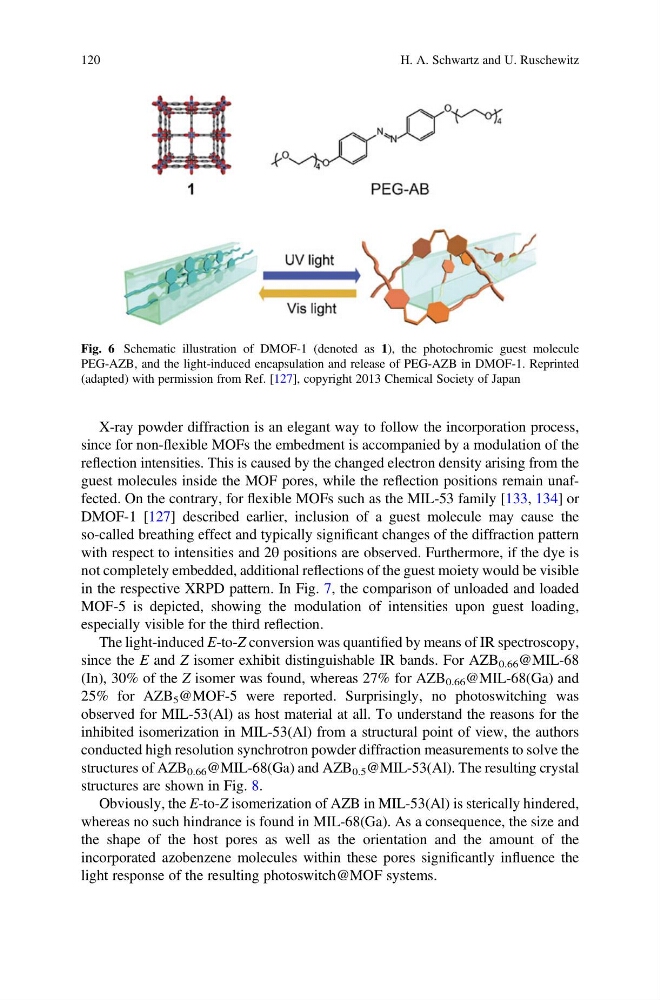
Fig. 6 Schematic illustration of DMOF-1 (denoted as 1), the photochromic guest molecule
PEG-AZB, and the light-induced encapsulation and release of PEG-AZB in DMOF-1. Reprinted
(adapted) with permission from Ref. [127], copyright 2013 Chemical Society of Japan
120
H. A. Schwartz and U. Ruschewitz
since for non-flexible MOFs the embedment is accompanied by a modulation of the
reflection intensities. This is caused by the changed electron density arising from the
guest molecules inside the MOF pores, while the reflection positions remain unaffected. On the contrary, for flexible MOFs such as the MIL-53 family [133, 134] or
DMOF-1 [127] described earlier, inclusion of a guest molecule may cause the
so-called breathing effect and typically significant changes of the diffraction pattern
with respect to intensities and 2θ positions are observed. Furthermore, if the dye is
not completely embedded, additional reflections of the guest moiety would be visible
in the respective XRPD pattern. In Fig. 7, the comparison of unloaded and loaded
MOF-5 is depicted, showing the modulation of intensities upon guest loading,
especially visible for the third reflection.
The light-induced E-to-Z conversion was quantified by means of IR spectroscopy,
since the E and Z isomer exhibit distinguishable IR bands. For AZB 0.66 @MIL-68
(In), 30% of the Z isomer was found, whereas 27% for AZB 0.66 @MIL-68(Ga) and
25% for AZB 5 @MOF-5 were reported. Surprisingly, no photoswitching was
observed for MIL-53(Al) as host material at all. To understand the reasons for the
inhibited isomerization in MIL-53(Al) from a structural point of view, the authors
conducted high resolution synchrotron powder diffraction measurements to solve the
structures of AZB 0.66 @MIL-68(Ga) and AZB 0.5 @MIL-53(Al). The resulting crystal
structures are shown in Fig. 8.
Obviously, the E-to-Z isomerization of AZB in MIL-53(Al) is sterically hindered,
whereas no such hindrance is found in MIL-68(Ga). As a consequence, the size and
the shape of the host pores as well as the orientation and the amount of the
incorporated azobenzene molecules within these pores significantly influence the
light response of the resulting photoswitch@MOF systems.
Fig. 6 Schematic illustration of DMOF-1 (denoted as 1), the photochromic guest molecule
PEG-AZB, and the light-induced encapsulation and release of PEG-AZB in DMOF-1. Reprinted
(adapted) with permission from Ref. [127], copyright 2013 Chemical Society of Japan
120
H. A. Schwartz and U. Ruschewitz