

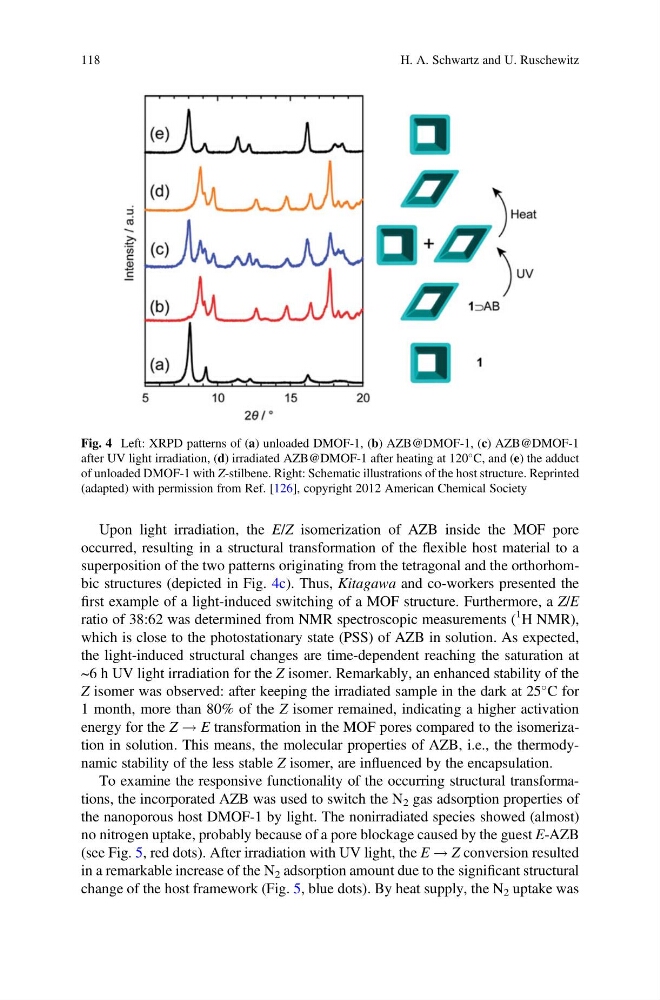
Upon light irradiation, the E/Z isomerization of AZB inside the MOF pore
occurred, resulting in a structural transformation of the flexible host material to a
superposition of the two patterns originating from the tetragonal and the orthorhombic structures (depicted in Fig. 4c). Thus, Kitagawa and co-workers presented the
first example of a light-induced switching of a MOF structure. Furthermore, a Z/E
ratio of 38:62 was determined from NMR spectroscopic measurements (
1 H NMR),
which is close to the photostationary state (PSS) of AZB in solution. As expected,
the light-induced structural changes are time-dependent reaching the saturation at
~6 h UV light irradiation for the Z isomer. Remarkably, an enhanced stability of the
Z isomer was observed: after keeping the irradiated sample in the dark at 25
C for
1 month, more than 80% of the Z isomer remained, indicating a higher activation
energy for the Z ! E transformation in the MOF pores compared to the isomerization in solution. This means, the molecular properties of AZB, i.e., the thermodynamic stability of the less stable Z isomer, are influenced by the encapsulation.
To examine the responsive functionality of the occurring structural transformations, the incorporated AZB was used to switch the N 2 gas adsorption properties of
the nanoporous host DMOF-1 by light. The nonirradiated species showed (almost)
no nitrogen uptake, probably because of a pore blockage caused by the guest E-AZB
(see Fig. 5, red dots). After irradiation with UV light, the E ! Z conversion resulted
in a remarkable increase of the N 2 adsorption amount due to the significant structural
change of the host framework (Fig. 5, blue dots). By heat supply, the N 2 uptake was
Fig. 4 Left: XRPD patterns of (a) unloaded DMOF-1, (b) AZB@DMOF-1, (c) AZB@DMOF-1
after UV light irradiation, (d) irradiated AZB@DMOF-1 after heating at 120
C, and (e) the adduct
of unloaded DMOF-1 with Z-stilbene. Right: Schematic illustrations of the host structure. Reprinted
(adapted) with permission from Ref. [126], copyright 2012 American Chemical Society
118
H. A. Schwartz and U. Ruschewitz
occurred, resulting in a structural transformation of the flexible host material to a
superposition of the two patterns originating from the tetragonal and the orthorhombic structures (depicted in Fig. 4c). Thus, Kitagawa and co-workers presented the
first example of a light-induced switching of a MOF structure. Furthermore, a Z/E
ratio of 38:62 was determined from NMR spectroscopic measurements (
1 H NMR),
which is close to the photostationary state (PSS) of AZB in solution. As expected,
the light-induced structural changes are time-dependent reaching the saturation at
~6 h UV light irradiation for the Z isomer. Remarkably, an enhanced stability of the
Z isomer was observed: after keeping the irradiated sample in the dark at 25
C for
1 month, more than 80% of the Z isomer remained, indicating a higher activation
energy for the Z ! E transformation in the MOF pores compared to the isomerization in solution. This means, the molecular properties of AZB, i.e., the thermodynamic stability of the less stable Z isomer, are influenced by the encapsulation.
To examine the responsive functionality of the occurring structural transformations, the incorporated AZB was used to switch the N 2 gas adsorption properties of
the nanoporous host DMOF-1 by light. The nonirradiated species showed (almost)
no nitrogen uptake, probably because of a pore blockage caused by the guest E-AZB
(see Fig. 5, red dots). After irradiation with UV light, the E ! Z conversion resulted
in a remarkable increase of the N 2 adsorption amount due to the significant structural
change of the host framework (Fig. 5, blue dots). By heat supply, the N 2 uptake was
Fig. 4 Left: XRPD patterns of (a) unloaded DMOF-1, (b) AZB@DMOF-1, (c) AZB@DMOF-1
after UV light irradiation, (d) irradiated AZB@DMOF-1 after heating at 120
C, and (e) the adduct
of unloaded DMOF-1 with Z-stilbene. Right: Schematic illustrations of the host structure. Reprinted
(adapted) with permission from Ref. [126], copyright 2012 American Chemical Society
118
H. A. Schwartz and U. Ruschewitz