

against microcystin-LR and reached a detection limit of 18 pM [78]. Many other
methods for MC-LR detection have been reported and showed good detection limits,
but the impedimetric aptasensor tops with its simplicity, low-cost, and rapid
detection.
3.2.2 Pesticides and Bisphenol A
Pesticides are chemicals that kill fungi, bacteria, insects, snails, slugs, or weed to
avoid plant diseases, plant damage, or suppressed growth. Subgroups of pesticides
are insecticides, which are substances that are used to kill, harm, repel, or mitigate a
specific species of insects. Insecticides are often used to increase crop yields and
improve the quality of agricultural products. The use of insecticides in modern
agriculture contaminates the natural environment, which can pose a potential health
risk to humans. One of the most extensively employed insecticides is acetamiprid
that belongs to the class of systemic broad-spectrum insecticides and is used for
controlling insects such as Lepidoptera and Thysanoptera [88]. Aptamer-based
biosensors for the detection of acetamiprid are reviewed in Verdian [89] including
optical and electrochemical transducers. An impedimetric aptasensor for detection of
acetamiprid residues in wastewater and tomatoes was developed by Fan et al. who
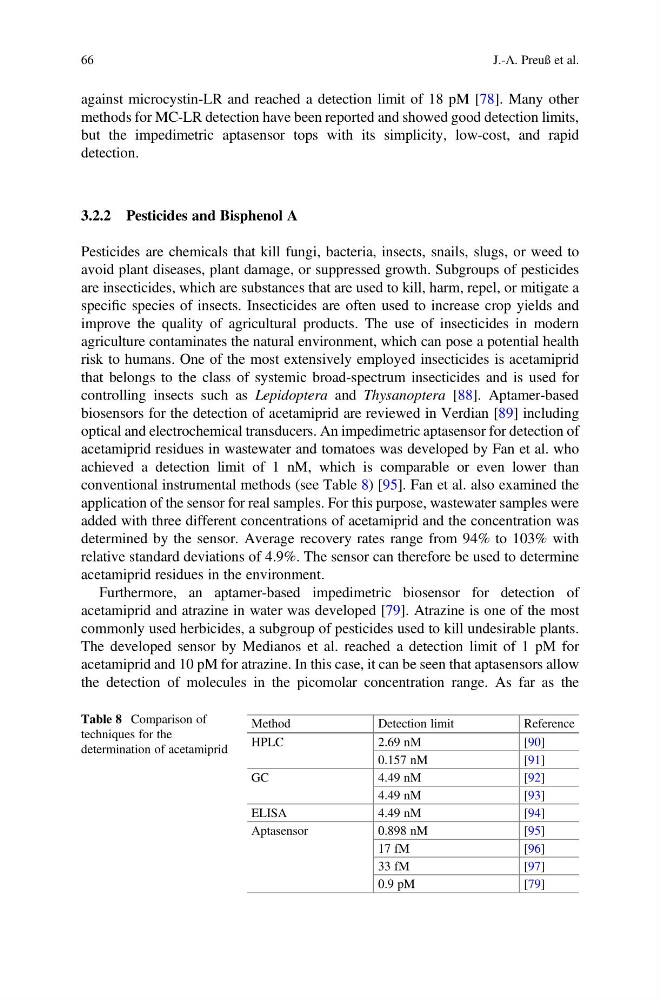
achieved a detection limit of 1 nM, which is comparable or even lower than
conventional instrumental methods (see Table 8) [95]. Fan et al. also examined the
application of the sensor for real samples. For this purpose, wastewater samples were
added with three different concentrations of acetamiprid and the concentration was
determined by the sensor. Average recovery rates range from 94% to 103% with
relative standard deviations of 4.9%. The sensor can therefore be used to determine
acetamiprid residues in the environment.
Furthermore, an aptamer-based impedimetric biosensor for detection of
acetamiprid and atrazine in water was developed [79]. Atrazine is one of the most
commonly used herbicides, a subgroup of pesticides used to kill undesirable plants.
The developed sensor by Medianos et al. reached a detection limit of 1 pM for
acetamiprid and 10 pM for atrazine. In this case, it can be seen that aptasensors allow
the detection of molecules in the picomolar concentration range. As far as the
Table 8 Comparison of
techniques for the
determination of acetamiprid
Method
Detection limit
Reference
HPLC
2.69 nM
[90]
0.157 nM
[91]
GC
4.49 nM
[92]
4.49 nM
[93]
ELISA
4.49 nM
[94]
Aptasensor
0.898 nM
[95]
17 fM
[96]
33 fM
[97]
0.9 pM
[79]
66
J.-A. Preuß et al.
methods for MC-LR detection have been reported and showed good detection limits,
but the impedimetric aptasensor tops with its simplicity, low-cost, and rapid
detection.
3.2.2 Pesticides and Bisphenol A
Pesticides are chemicals that kill fungi, bacteria, insects, snails, slugs, or weed to
avoid plant diseases, plant damage, or suppressed growth. Subgroups of pesticides
are insecticides, which are substances that are used to kill, harm, repel, or mitigate a
specific species of insects. Insecticides are often used to increase crop yields and
improve the quality of agricultural products. The use of insecticides in modern
agriculture contaminates the natural environment, which can pose a potential health
risk to humans. One of the most extensively employed insecticides is acetamiprid
that belongs to the class of systemic broad-spectrum insecticides and is used for
controlling insects such as Lepidoptera and Thysanoptera [88]. Aptamer-based
biosensors for the detection of acetamiprid are reviewed in Verdian [89] including
optical and electrochemical transducers. An impedimetric aptasensor for detection of
acetamiprid residues in wastewater and tomatoes was developed by Fan et al. who
achieved a detection limit of 1 nM, which is comparable or even lower than
conventional instrumental methods (see Table 8) [95]. Fan et al. also examined the
application of the sensor for real samples. For this purpose, wastewater samples were
added with three different concentrations of acetamiprid and the concentration was
determined by the sensor. Average recovery rates range from 94% to 103% with
relative standard deviations of 4.9%. The sensor can therefore be used to determine
acetamiprid residues in the environment.
Furthermore, an aptamer-based impedimetric biosensor for detection of
acetamiprid and atrazine in water was developed [79]. Atrazine is one of the most
commonly used herbicides, a subgroup of pesticides used to kill undesirable plants.
The developed sensor by Medianos et al. reached a detection limit of 1 pM for
acetamiprid and 10 pM for atrazine. In this case, it can be seen that aptasensors allow
the detection of molecules in the picomolar concentration range. As far as the
Table 8 Comparison of
techniques for the
determination of acetamiprid
Method
Detection limit
Reference
HPLC
2.69 nM
[90]
0.157 nM
[91]
GC
4.49 nM
[92]
4.49 nM
[93]
ELISA
4.49 nM
[94]
Aptasensor
0.898 nM
[95]
17 fM
[96]
33 fM
[97]
0.9 pM
[79]
66
J.-A. Preuß et al.