

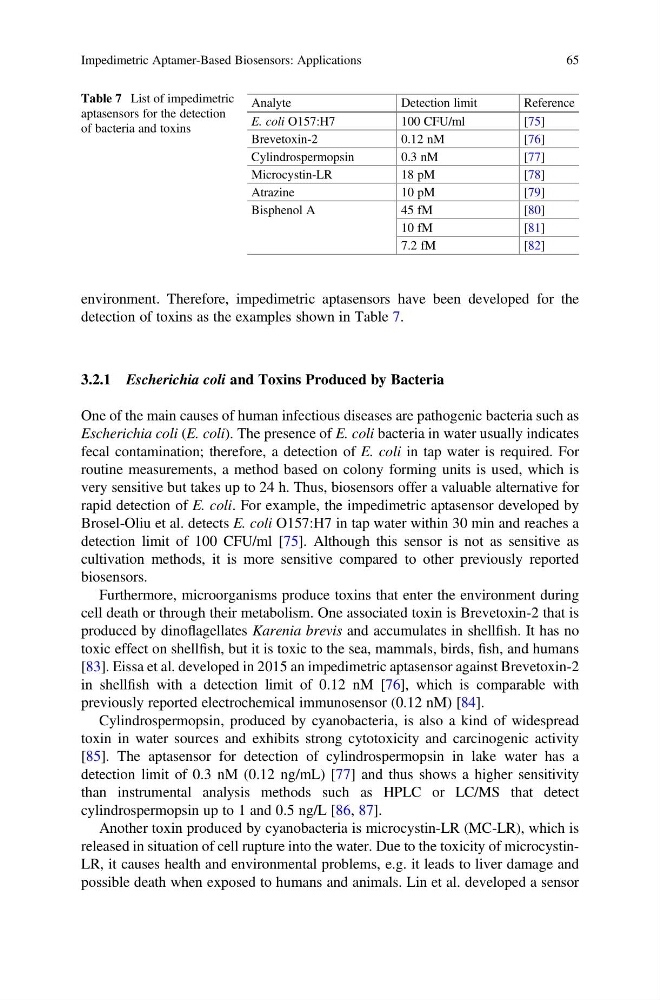
environment. Therefore, impedimetric aptasensors have been developed for the
detection of toxins as the examples shown in Table 7.
3.2.1 Escherichia coli and Toxins Produced by Bacteria
One of the main causes of human infectious diseases are pathogenic bacteria such as
Escherichia coli (E. coli). The presence of E. coli bacteria in water usually indicates
fecal contamination; therefore, a detection of E. coli in tap water is required. For
routine measurements, a method based on colony forming units is used, which is
very sensitive but takes up to 24 h. Thus, biosensors offer a valuable alternative for
rapid detection of E. coli. For example, the impedimetric aptasensor developed by
Brosel-Oliu et al. detects E. coli O157:H7 in tap water within 30 min and reaches a
detection limit of 100 CFU/ml [75]. Although this sensor is not as sensitive as
cultivation methods, it is more sensitive compared to other previously reported
biosensors.
Furthermore, microorganisms produce toxins that enter the environment during
cell death or through their metabolism. One associated toxin is Brevetoxin-2 that is
produced by dinoflagellates Karenia brevis and accumulates in shellfish. It has no
toxic effect on shellfish, but it is toxic to the sea, mammals, birds, fish, and humans
[83]. Eissa et al. developed in 2015 an impedimetric aptasensor against Brevetoxin-2
in shellfish with a detection limit of 0.12 nM [76], which is comparable with
previously reported electrochemical immunosensor (0.12 nM) [84].
Cylindrospermopsin, produced by cyanobacteria, is also a kind of widespread
toxin in water sources and exhibits strong cytotoxicity and carcinogenic activity
[85]. The aptasensor for detection of cylindrospermopsin in lake water has a
detection limit of 0.3 nM (0.12 ng/mL) [77] and thus shows a higher sensitivity
than instrumental analysis methods such as HPLC or LC/MS that detect
cylindrospermopsin up to 1 and 0.5 ng/L [86, 87].
Another toxin produced by cyanobacteria is microcystin-LR (MC-LR), which is
released in situation of cell rupture into the water. Due to the toxicity of microcystinLR, it causes health and environmental problems, e.g. it leads to liver damage and
possible death when exposed to humans and animals. Lin et al. developed a sensor
Table 7 List of impedimetric
aptasensors for the detection
of bacteria and toxins
Analyte
Detection limit
Reference
E. coli O157:H7
100 CFU/ml
[75]
Brevetoxin-2
0.12 nM
[76]
Cylindrospermopsin
0.3 nM
[77]
Microcystin-LR
18 pM
[78]
Atrazine
10 pM
[79]
Bisphenol A
45 fM
[80]
10 fM
[81]
7.2 fM
[82]
Impedimetric Aptamer-Based Biosensors: Applications
65
detection of toxins as the examples shown in Table 7.
3.2.1 Escherichia coli and Toxins Produced by Bacteria
One of the main causes of human infectious diseases are pathogenic bacteria such as
Escherichia coli (E. coli). The presence of E. coli bacteria in water usually indicates
fecal contamination; therefore, a detection of E. coli in tap water is required. For
routine measurements, a method based on colony forming units is used, which is
very sensitive but takes up to 24 h. Thus, biosensors offer a valuable alternative for
rapid detection of E. coli. For example, the impedimetric aptasensor developed by
Brosel-Oliu et al. detects E. coli O157:H7 in tap water within 30 min and reaches a
detection limit of 100 CFU/ml [75]. Although this sensor is not as sensitive as
cultivation methods, it is more sensitive compared to other previously reported
biosensors.
Furthermore, microorganisms produce toxins that enter the environment during
cell death or through their metabolism. One associated toxin is Brevetoxin-2 that is
produced by dinoflagellates Karenia brevis and accumulates in shellfish. It has no
toxic effect on shellfish, but it is toxic to the sea, mammals, birds, fish, and humans
[83]. Eissa et al. developed in 2015 an impedimetric aptasensor against Brevetoxin-2
in shellfish with a detection limit of 0.12 nM [76], which is comparable with
previously reported electrochemical immunosensor (0.12 nM) [84].
Cylindrospermopsin, produced by cyanobacteria, is also a kind of widespread
toxin in water sources and exhibits strong cytotoxicity and carcinogenic activity
[85]. The aptasensor for detection of cylindrospermopsin in lake water has a
detection limit of 0.3 nM (0.12 ng/mL) [77] and thus shows a higher sensitivity
than instrumental analysis methods such as HPLC or LC/MS that detect
cylindrospermopsin up to 1 and 0.5 ng/L [86, 87].
Another toxin produced by cyanobacteria is microcystin-LR (MC-LR), which is
released in situation of cell rupture into the water. Due to the toxicity of microcystinLR, it causes health and environmental problems, e.g. it leads to liver damage and
possible death when exposed to humans and animals. Lin et al. developed a sensor
Table 7 List of impedimetric
aptasensors for the detection
of bacteria and toxins
Analyte
Detection limit
Reference
E. coli O157:H7
100 CFU/ml
[75]
Brevetoxin-2
0.12 nM
[76]
Cylindrospermopsin
0.3 nM
[77]
Microcystin-LR
18 pM
[78]
Atrazine
10 pM
[79]
Bisphenol A
45 fM
[80]
10 fM
[81]
7.2 fM
[82]
Impedimetric Aptamer-Based Biosensors: Applications
65