

similar results to estradiol in buffer solution. Also Lin et al. developed in 2012 an
aptasensor for the detection of 17ß-estradiol with a detection limit of 2 pM
[72]. With the sensor, it was possible to detect 17ß-estradiol in urine, which was
added with 17ß-estradiol. Average recovery rates range from 92% to 101% with
relative standard deviations below 4.4%. The sensor can therefore be used to
determine 17ß-estradiol in urine samples.
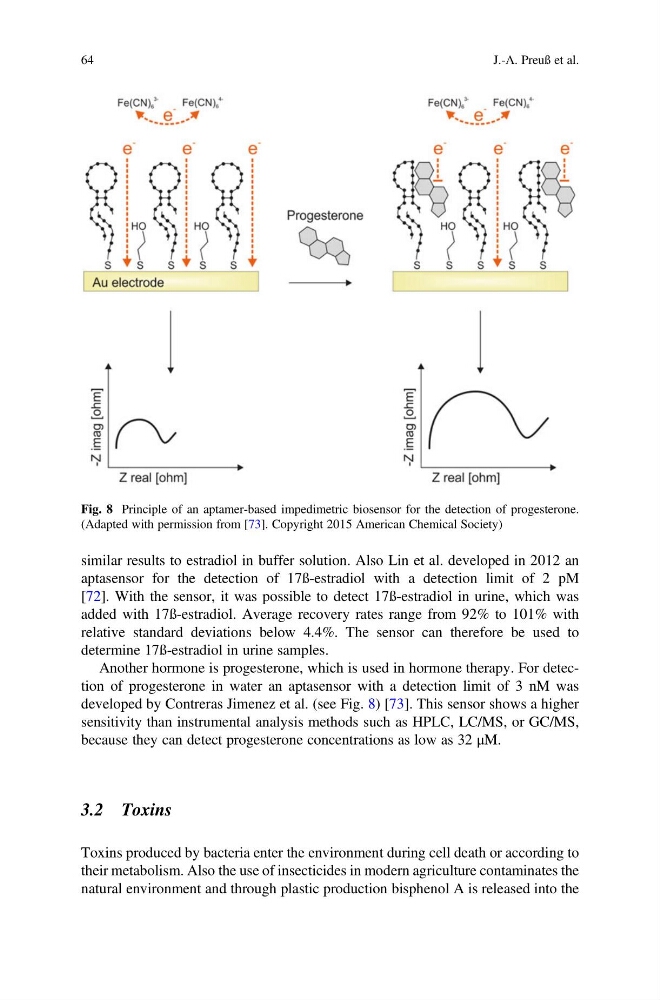
Another hormone is progesterone, which is used in hormone therapy. For detection of progesterone in water an aptasensor with a detection limit of 3 nM was
developed by Contreras Jimenez et al. (see Fig. 8) [73]. This sensor shows a higher
sensitivity than instrumental analysis methods such as HPLC, LC/MS, or GC/MS,
because they can detect progesterone concentrations as low as 32 μM.
3.2 Toxins
Toxins produced by bacteria enter the environment during cell death or according to
their metabolism. Also the use of insecticides in modern agriculture contaminates the
natural environment and through plastic production bisphenol A is released into the
Fig. 8 Principle of an aptamer-based impedimetric biosensor for the detection of progesterone.
(Adapted with permission from [73]. Copyright 2015 American Chemical Society)
64
J.-A. Preuß et al.
aptasensor for the detection of 17ß-estradiol with a detection limit of 2 pM
[72]. With the sensor, it was possible to detect 17ß-estradiol in urine, which was
added with 17ß-estradiol. Average recovery rates range from 92% to 101% with
relative standard deviations below 4.4%. The sensor can therefore be used to
determine 17ß-estradiol in urine samples.
Another hormone is progesterone, which is used in hormone therapy. For detection of progesterone in water an aptasensor with a detection limit of 3 nM was
developed by Contreras Jimenez et al. (see Fig. 8) [73]. This sensor shows a higher
sensitivity than instrumental analysis methods such as HPLC, LC/MS, or GC/MS,
because they can detect progesterone concentrations as low as 32 μM.
3.2 Toxins
Toxins produced by bacteria enter the environment during cell death or according to
their metabolism. Also the use of insecticides in modern agriculture contaminates the
natural environment and through plastic production bisphenol A is released into the
Fig. 8 Principle of an aptamer-based impedimetric biosensor for the detection of progesterone.
(Adapted with permission from [73]. Copyright 2015 American Chemical Society)
64
J.-A. Preuß et al.