

studies are officially accounted, 4 of them being at clinical phase III and 1 available
on the pharmaceutical market [96]. Outside clinical applications, other fields of
intensive investigations are biosensors [97], drug delivery [98], proteomics and
biomarker discovery [99], food safety [100], and molecular imaging [101], just to
mention a few. The common point between all aptamer application domains is the
extraordinary molecular recognition capability with the modulation of the affinity
interaction. Specific features characterizing the application of aptamer ligands on
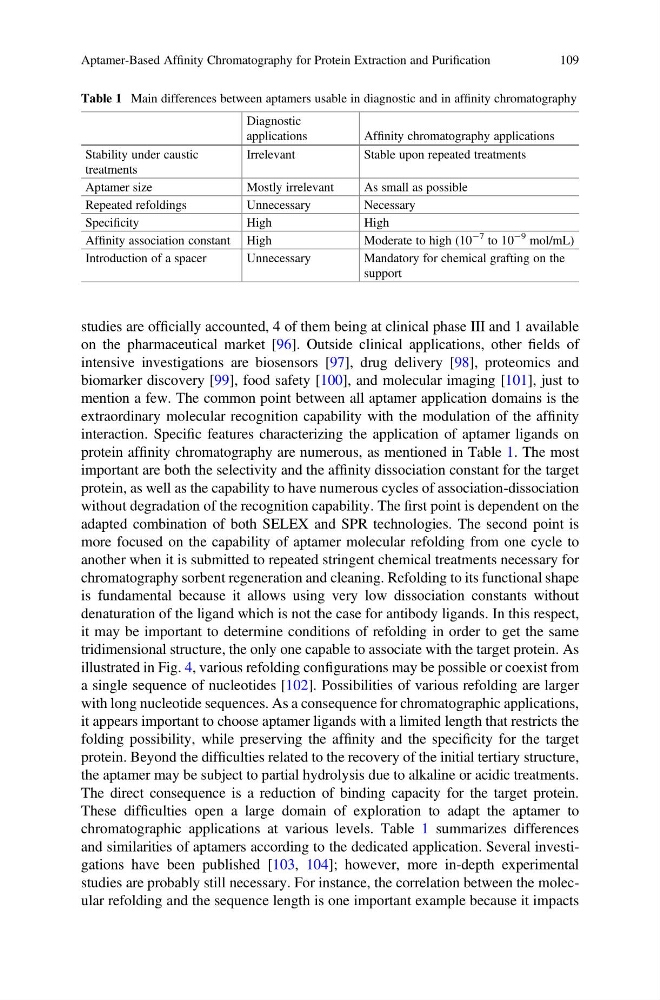
protein affinity chromatography are numerous, as mentioned in Table 1. The most
important are both the selectivity and the affinity dissociation constant for the target
protein, as well as the capability to have numerous cycles of association-dissociation
without degradation of the recognition capability. The first point is dependent on the
adapted combination of both SELEX and SPR technologies. The second point is
more focused on the capability of aptamer molecular refolding from one cycle to
another when it is submitted to repeated stringent chemical treatments necessary for
chromatography sorbent regeneration and cleaning. Refolding to its functional shape
is fundamental because it allows using very low dissociation constants without
denaturation of the ligand which is not the case for antibody ligands. In this respect,
it may be important to determine conditions of refolding in order to get the same
tridimensional structure, the only one capable to associate with the target protein. As
illustrated in Fig. 4, various refolding configurations may be possible or coexist from
a single sequence of nucleotides [102]. Possibilities of various refolding are larger
with long nucleotide sequences. As a consequence for chromatographic applications,
it appears important to choose aptamer ligands with a limited length that restricts the
folding possibility, while preserving the affinity and the specificity for the target
protein. Beyond the difficulties related to the recovery of the initial tertiary structure,
the aptamer may be subject to partial hydrolysis due to alkaline or acidic treatments.
The direct consequence is a reduction of binding capacity for the target protein.
These difficulties open a large domain of exploration to adapt the aptamer to
chromatographic applications at various levels. Table 1 summarizes differences
and similarities of aptamers according to the dedicated application. Several investigations have been published [103, 104]; however, more in-depth experimental
studies are probably still necessary. For instance, the correlation between the molecular refolding and the sequence length is one important example because it impacts
Table 1 Main differences between aptamers usable in diagnostic and in affinity chromatography
Diagnostic
applications
Affinity chromatography applications
Stability under caustic
treatments
Irrelevant
Stable upon repeated treatments
Aptamer size
Mostly irrelevant
As small as possible
Repeated refoldings
Unnecessary
Necessary
Specificity
High
High
Affinity association constant High
Moderate to high (10
À7 to 10
À9 mol/mL)
Introduction of a spacer
Unnecessary
Mandatory for chemical grafting on the
support
Aptamer-Based Affinity Chromatography for Protein Extraction and Purification
109
on the pharmaceutical market [96]. Outside clinical applications, other fields of
intensive investigations are biosensors [97], drug delivery [98], proteomics and
biomarker discovery [99], food safety [100], and molecular imaging [101], just to
mention a few. The common point between all aptamer application domains is the
extraordinary molecular recognition capability with the modulation of the affinity
interaction. Specific features characterizing the application of aptamer ligands on
protein affinity chromatography are numerous, as mentioned in Table 1. The most
important are both the selectivity and the affinity dissociation constant for the target
protein, as well as the capability to have numerous cycles of association-dissociation
without degradation of the recognition capability. The first point is dependent on the
adapted combination of both SELEX and SPR technologies. The second point is
more focused on the capability of aptamer molecular refolding from one cycle to
another when it is submitted to repeated stringent chemical treatments necessary for
chromatography sorbent regeneration and cleaning. Refolding to its functional shape
is fundamental because it allows using very low dissociation constants without
denaturation of the ligand which is not the case for antibody ligands. In this respect,
it may be important to determine conditions of refolding in order to get the same
tridimensional structure, the only one capable to associate with the target protein. As
illustrated in Fig. 4, various refolding configurations may be possible or coexist from
a single sequence of nucleotides [102]. Possibilities of various refolding are larger
with long nucleotide sequences. As a consequence for chromatographic applications,
it appears important to choose aptamer ligands with a limited length that restricts the
folding possibility, while preserving the affinity and the specificity for the target
protein. Beyond the difficulties related to the recovery of the initial tertiary structure,
the aptamer may be subject to partial hydrolysis due to alkaline or acidic treatments.
The direct consequence is a reduction of binding capacity for the target protein.
These difficulties open a large domain of exploration to adapt the aptamer to
chromatographic applications at various levels. Table 1 summarizes differences
and similarities of aptamers according to the dedicated application. Several investigations have been published [103, 104]; however, more in-depth experimental
studies are probably still necessary. For instance, the correlation between the molecular refolding and the sequence length is one important example because it impacts
Table 1 Main differences between aptamers usable in diagnostic and in affinity chromatography
Diagnostic
applications
Affinity chromatography applications
Stability under caustic
treatments
Irrelevant
Stable upon repeated treatments
Aptamer size
Mostly irrelevant
As small as possible
Repeated refoldings
Unnecessary
Necessary
Specificity
High
High
Affinity association constant High
Moderate to high (10
À7 to 10
À9 mol/mL)
Introduction of a spacer
Unnecessary
Mandatory for chemical grafting on the
support
Aptamer-Based Affinity Chromatography for Protein Extraction and Purification
109