

the binding capacity for the target protein. It is expected that refolding of shorter
sequences would be easier to predict. In addition, small aptamers would represent an
advantage for affinity chromatography, because for a given grafting rate (amount of
grafted aptamer per mL of chromatographic support), the amount of captured protein
is higher as a result of the favorable molecular weight ratio between the protein and
the aptamer.
Another large and important subject of investigation is the oriented grafting
chemistry. It involves a number of chemical reactions, various spacer arms of
different lengths and structure, grafting density, and other parameters that will be
discussed in the following section. The domain is so vast, that for the moment, it is
far from being exhaustively covered. Beyond the mode of grafting, the configuration
of the aptamer during the grafting step is also to be considered. Actually, it is
possible to operate the immobilization reaction under denaturing conditions, when
the oligonucleotide is linearized, or alternatively, grafting conditions could be
adjusted to maintain the integrity of the tertiary structure of the macromolecule.
All the above considerations are self-explanatory of the extremely narrow link
between the aptamer selection and the final use in affinity chromatography, to the
point that they are considered intimately integrated operations for an optimized
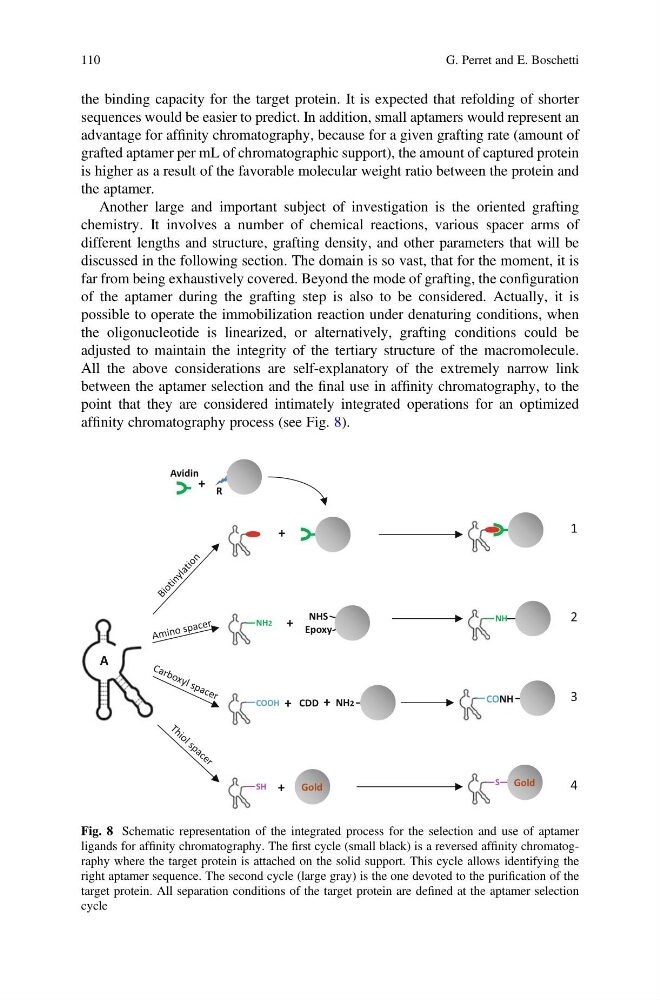
affinity chromatography process (see Fig. 8).
NH2
COOH
SH
Avidin
+
CDD
Gold
NHS
Epoxy
+
+
+
NH2
+
NH
S
CONH
Gold
1
2
3
4
A
R
+
Fig. 8 Schematic representation of the integrated process for the selection and use of aptamer
ligands for affinity chromatography. The first cycle (small black) is a reversed affinity chromatography where the target protein is attached on the solid support. This cycle allows identifying the
right aptamer sequence. The second cycle (large gray) is the one devoted to the purification of the
target protein. All separation conditions of the target protein are defined at the aptamer selection
cycle
110
G. Perret and E. Boschetti
sequences would be easier to predict. In addition, small aptamers would represent an
advantage for affinity chromatography, because for a given grafting rate (amount of
grafted aptamer per mL of chromatographic support), the amount of captured protein
is higher as a result of the favorable molecular weight ratio between the protein and
the aptamer.
Another large and important subject of investigation is the oriented grafting
chemistry. It involves a number of chemical reactions, various spacer arms of
different lengths and structure, grafting density, and other parameters that will be
discussed in the following section. The domain is so vast, that for the moment, it is
far from being exhaustively covered. Beyond the mode of grafting, the configuration
of the aptamer during the grafting step is also to be considered. Actually, it is
possible to operate the immobilization reaction under denaturing conditions, when
the oligonucleotide is linearized, or alternatively, grafting conditions could be
adjusted to maintain the integrity of the tertiary structure of the macromolecule.
All the above considerations are self-explanatory of the extremely narrow link
between the aptamer selection and the final use in affinity chromatography, to the
point that they are considered intimately integrated operations for an optimized
affinity chromatography process (see Fig. 8).
NH2
COOH
SH
Avidin
+
CDD
Gold
NHS
Epoxy
+
+
+
NH2
+
NH
S
CONH
Gold
1
2
3
4
A
R
+
Fig. 8 Schematic representation of the integrated process for the selection and use of aptamer
ligands for affinity chromatography. The first cycle (small black) is a reversed affinity chromatography where the target protein is attached on the solid support. This cycle allows identifying the
right aptamer sequence. The second cycle (large gray) is the one devoted to the purification of the
target protein. All separation conditions of the target protein are defined at the aptamer selection
cycle
110
G. Perret and E. Boschetti