

be tried with the objective to protect the biological properties of the target protein,
while dissociating exhaustively the protein-aptamer complex. Desorption with metal
ions chelators (e.g., EDTA) is a frequent possibility among other strategies when the
initial interaction step is performed in the presence of metal ions (e.g., calcium).
Most generally, the number of cycles to reach the optimal conditions is 8–10.
The amplification of DNA-type oligonucleotides is performed using PCR technology, while RT-PCR followed by in vitro transcription is generally adopted in the
case of RNA-type oligonucleotides.
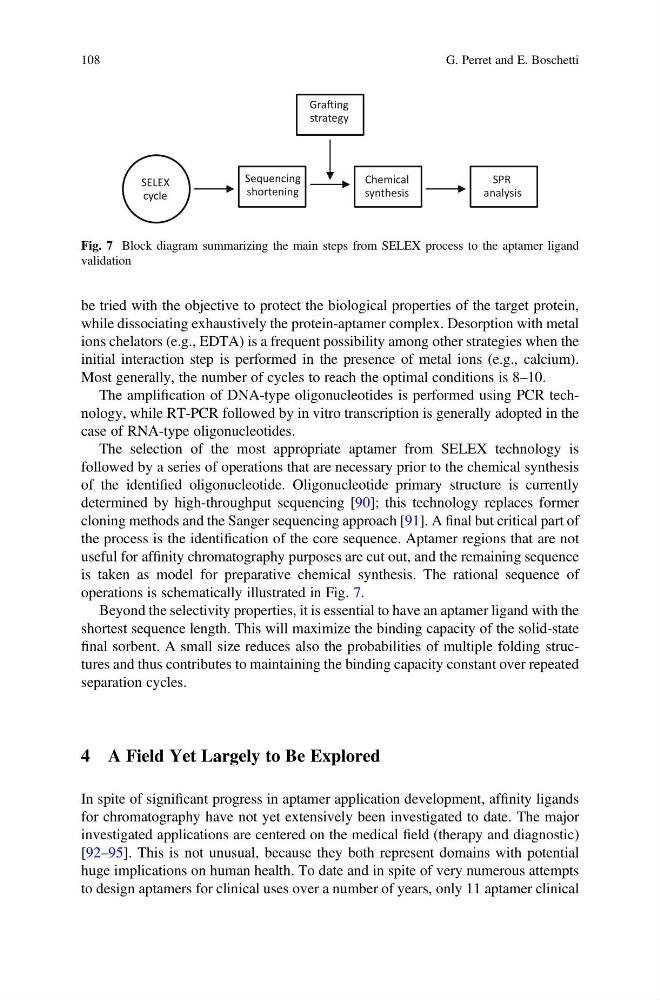
The selection of the most appropriate aptamer from SELEX technology is
followed by a series of operations that are necessary prior to the chemical synthesis
of the identified oligonucleotide. Oligonucleotide primary structure is currently
determined by high-throughput sequencing [90]; this technology replaces former
cloning methods and the Sanger sequencing approach [91]. A final but critical part of
the process is the identification of the core sequence. Aptamer regions that are not
useful for affinity chromatography purposes are cut out, and the remaining sequence
is taken as model for preparative chemical synthesis. The rational sequence of
operations is schematically illustrated in Fig. 7.
Beyond the selectivity properties, it is essential to have an aptamer ligand with the
shortest sequence length. This will maximize the binding capacity of the solid-state
final sorbent. A small size reduces also the probabilities of multiple folding structures and thus contributes to maintaining the binding capacity constant over repeated
separation cycles.
4 A Field Yet Largely to Be Explored
In spite of significant progress in aptamer application development, affinity ligands
for chromatography have not yet extensively been investigated to date. The major
investigated applications are centered on the medical field (therapy and diagnostic)
[92–95]. This is not unusual, because they both represent domains with potential
huge implications on human health. To date and in spite of very numerous attempts
to design aptamers for clinical uses over a number of years, only 11 aptamer clinical
SELEX
cycle
Sequencing
shortening
GraŌing
strategy
Chemical
synthesis
SPR
analysis
Fig. 7 Block diagram summarizing the main steps from SELEX process to the aptamer ligand
validation
108
G. Perret and E. Boschetti
while dissociating exhaustively the protein-aptamer complex. Desorption with metal
ions chelators (e.g., EDTA) is a frequent possibility among other strategies when the
initial interaction step is performed in the presence of metal ions (e.g., calcium).
Most generally, the number of cycles to reach the optimal conditions is 8–10.
The amplification of DNA-type oligonucleotides is performed using PCR technology, while RT-PCR followed by in vitro transcription is generally adopted in the
case of RNA-type oligonucleotides.
The selection of the most appropriate aptamer from SELEX technology is
followed by a series of operations that are necessary prior to the chemical synthesis
of the identified oligonucleotide. Oligonucleotide primary structure is currently
determined by high-throughput sequencing [90]; this technology replaces former
cloning methods and the Sanger sequencing approach [91]. A final but critical part of
the process is the identification of the core sequence. Aptamer regions that are not
useful for affinity chromatography purposes are cut out, and the remaining sequence
is taken as model for preparative chemical synthesis. The rational sequence of
operations is schematically illustrated in Fig. 7.
Beyond the selectivity properties, it is essential to have an aptamer ligand with the
shortest sequence length. This will maximize the binding capacity of the solid-state
final sorbent. A small size reduces also the probabilities of multiple folding structures and thus contributes to maintaining the binding capacity constant over repeated
separation cycles.
4 A Field Yet Largely to Be Explored
In spite of significant progress in aptamer application development, affinity ligands
for chromatography have not yet extensively been investigated to date. The major
investigated applications are centered on the medical field (therapy and diagnostic)
[92–95]. This is not unusual, because they both represent domains with potential
huge implications on human health. To date and in spite of very numerous attempts
to design aptamers for clinical uses over a number of years, only 11 aptamer clinical
SELEX
cycle
Sequencing
shortening
GraŌing
strategy
Chemical
synthesis
SPR
analysis
Fig. 7 Block diagram summarizing the main steps from SELEX process to the aptamer ligand
validation
108
G. Perret and E. Boschetti