

oligonucleotide ligand can be predefined (e.g., pH ionic strength, temperature,
presence of chemical agents). Conditions of dissociation between affinity partners
can also be designed during the SELEX process, in order to comply with the
imperatives of affinity chromatography, such as elution conditions or even regeneration of the ligand while preserving the functionality of both the aptamer ligand and
the harvested pure protein. Between the adsorption and the dissociation phases,
other steps can be defined, such as a washing step that eliminates impurities while
preserving the complex stability between the ligand and the protein to purify. In fact,
the separation phases included in SELEX technology are affinity chromatographylike processes, where the roles of the target protein and of the ligand are reversed, the
protein playing the role of ligand. The process is thus particularly flexible to adapt to
a large number of conditions, allowing to select the most appropriate affinity
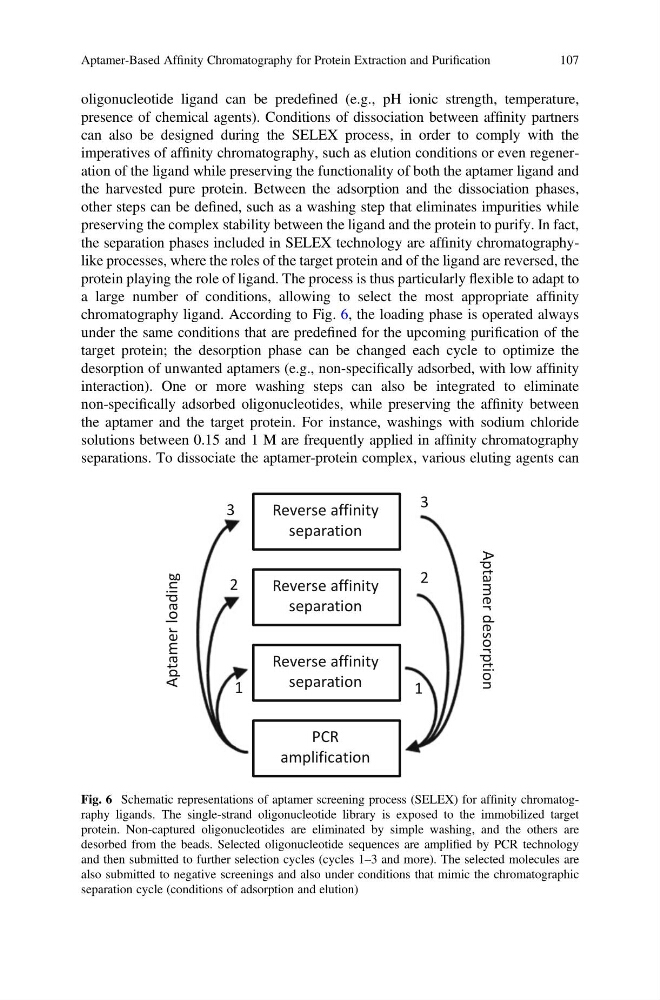
chromatography ligand. According to Fig. 6, the loading phase is operated always
under the same conditions that are predefined for the upcoming purification of the
target protein; the desorption phase can be changed each cycle to optimize the
desorption of unwanted aptamers (e.g., non-specifically adsorbed, with low affinity
interaction). One or more washing steps can also be integrated to eliminate
non-specifically adsorbed oligonucleotides, while preserving the affinity between
the aptamer and the target protein. For instance, washings with sodium chloride
solutions between 0.15 and 1 M are frequently applied in affinity chromatography
separations. To dissociate the aptamer-protein complex, various eluting agents can
Aptamer desorption
Aptamer loading
1
2
3
2
3
1
Reverse affinity
separation
PCR
amplification
Reverse affinity
separation
Reverse affinity
separation
Fig. 6 Schematic representations of aptamer screening process (SELEX) for affinity chromatography ligands. The single-strand oligonucleotide library is exposed to the immobilized target
protein. Non-captured oligonucleotides are eliminated by simple washing, and the others are
desorbed from the beads. Selected oligonucleotide sequences are amplified by PCR technology
and then submitted to further selection cycles (cycles 1–3 and more). The selected molecules are
also submitted to negative screenings and also under conditions that mimic the chromatographic
separation cycle (conditions of adsorption and elution)
Aptamer-Based Affinity Chromatography for Protein Extraction and Purification
107
presence of chemical agents). Conditions of dissociation between affinity partners
can also be designed during the SELEX process, in order to comply with the
imperatives of affinity chromatography, such as elution conditions or even regeneration of the ligand while preserving the functionality of both the aptamer ligand and
the harvested pure protein. Between the adsorption and the dissociation phases,
other steps can be defined, such as a washing step that eliminates impurities while
preserving the complex stability between the ligand and the protein to purify. In fact,
the separation phases included in SELEX technology are affinity chromatographylike processes, where the roles of the target protein and of the ligand are reversed, the
protein playing the role of ligand. The process is thus particularly flexible to adapt to
a large number of conditions, allowing to select the most appropriate affinity
chromatography ligand. According to Fig. 6, the loading phase is operated always
under the same conditions that are predefined for the upcoming purification of the
target protein; the desorption phase can be changed each cycle to optimize the
desorption of unwanted aptamers (e.g., non-specifically adsorbed, with low affinity
interaction). One or more washing steps can also be integrated to eliminate
non-specifically adsorbed oligonucleotides, while preserving the affinity between
the aptamer and the target protein. For instance, washings with sodium chloride
solutions between 0.15 and 1 M are frequently applied in affinity chromatography
separations. To dissociate the aptamer-protein complex, various eluting agents can
Aptamer desorption
Aptamer loading
1
2
3
2
3
1
Reverse affinity
separation
PCR
amplification
Reverse affinity
separation
Reverse affinity
separation
Fig. 6 Schematic representations of aptamer screening process (SELEX) for affinity chromatography ligands. The single-strand oligonucleotide library is exposed to the immobilized target
protein. Non-captured oligonucleotides are eliminated by simple washing, and the others are
desorbed from the beads. Selected oligonucleotide sequences are amplified by PCR technology
and then submitted to further selection cycles (cycles 1–3 and more). The selected molecules are
also submitted to negative screenings and also under conditions that mimic the chromatographic
separation cycle (conditions of adsorption and elution)
Aptamer-Based Affinity Chromatography for Protein Extraction and Purification
107