

3.4 The Power of SELEX for Aptameric Ligand Selection
The selection of the best aptamer ligand for a given protein is based on two powerful
pillars: affinity separation and molecular amplification.
Very large oligonucleotide libraries, comprising 10
14
–10
15 different sequences,
are commercially available. The length of the sequences is variable and usually
ranging between 20 and 60 nucleic bases. However, when the number of randomized
nucleotides is larger than about 25 (4
25
¼ 1.2 Â 10
15 combinations), not all
combinations are present, even if the synthesis scale is large. Each sequence is
present at extremely low proportions, since it represents less than 1 ppb of the
total oligonucleotide assembly. The oligonucleotide library is contacted with the
ligand, either in solution or with a surface on which the target protein to purify is
immobilized. In the first case, structures that have an affinity to the target protein are
further co-immobilized on a nitrocellulose filter, while the others without significant
affinity pass through and are eliminated. In the second case, structures that have an
affinity for the target protein are captured by the affinity solid phase, while all others
are washed out. Retained oligonucleotide sequences are then desorbed under
predefined and suitable conditions for the future affinity chromatography purification process. The amount of desorbed aptamer is extremely low and cannot be
analyzed by current methods. It is thus submitted to PCR, a well-known technology
for the amplification of nucleic acid sequences. It is by alternating these two
processes that the optimal oligonucleotide ligand is sorted out after several cycles.
This technology is called SELEX (systematic evolution of ligands by exponential
enrichment) [57, 63]. A cycle of ligand screening is thus characterized by a sequence
of operations, the most important being separation, selection, and amplification. Its
application to affinity chromatography ligands is particularly powerful, since it is
possible to adapt conditions for the selection of the proper ligand. For instance, the
affinity constant (a thermodynamic fundamental parameter) can be easily modulated.
Conditions of the molecular recognition between the protein to purify and the
SP
Protein
Aptamer
SM
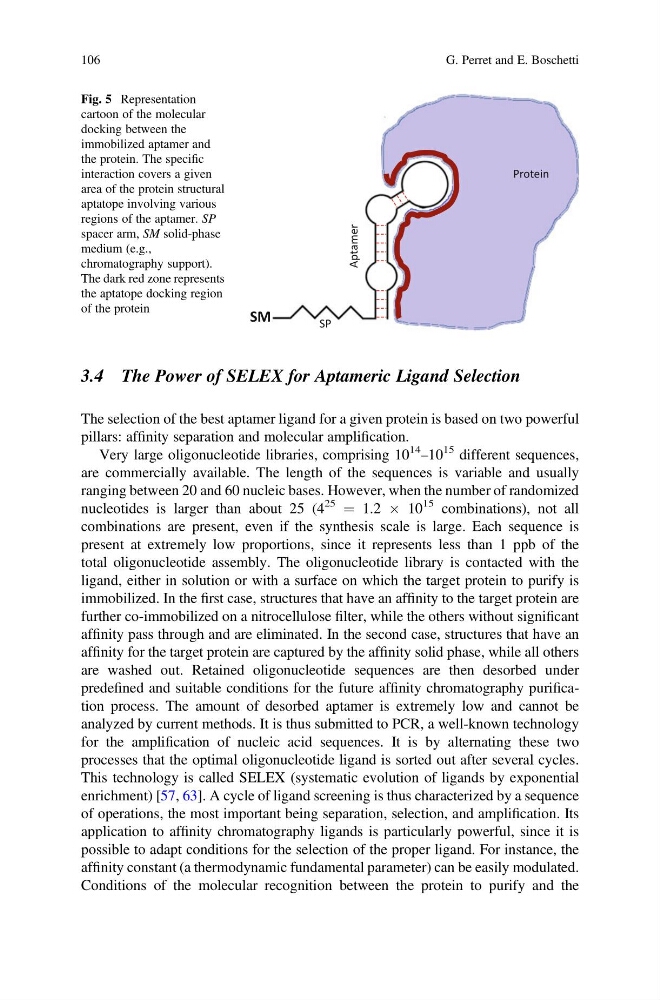
Fig. 5 Representation
cartoon of the molecular
docking between the
immobilized aptamer and
the protein. The specific
interaction covers a given
area of the protein structural
aptatope involving various
regions of the aptamer. SP
spacer arm, SM solid-phase
medium (e.g.,
chromatography support).
The dark red zone represents
the aptatope docking region
of the protein
106
G. Perret and E. Boschetti
The selection of the best aptamer ligand for a given protein is based on two powerful
pillars: affinity separation and molecular amplification.
Very large oligonucleotide libraries, comprising 10
14
–10
15 different sequences,
are commercially available. The length of the sequences is variable and usually
ranging between 20 and 60 nucleic bases. However, when the number of randomized
nucleotides is larger than about 25 (4
25
¼ 1.2 Â 10
15 combinations), not all
combinations are present, even if the synthesis scale is large. Each sequence is
present at extremely low proportions, since it represents less than 1 ppb of the
total oligonucleotide assembly. The oligonucleotide library is contacted with the
ligand, either in solution or with a surface on which the target protein to purify is
immobilized. In the first case, structures that have an affinity to the target protein are
further co-immobilized on a nitrocellulose filter, while the others without significant
affinity pass through and are eliminated. In the second case, structures that have an
affinity for the target protein are captured by the affinity solid phase, while all others
are washed out. Retained oligonucleotide sequences are then desorbed under
predefined and suitable conditions for the future affinity chromatography purification process. The amount of desorbed aptamer is extremely low and cannot be
analyzed by current methods. It is thus submitted to PCR, a well-known technology
for the amplification of nucleic acid sequences. It is by alternating these two
processes that the optimal oligonucleotide ligand is sorted out after several cycles.
This technology is called SELEX (systematic evolution of ligands by exponential
enrichment) [57, 63]. A cycle of ligand screening is thus characterized by a sequence
of operations, the most important being separation, selection, and amplification. Its
application to affinity chromatography ligands is particularly powerful, since it is
possible to adapt conditions for the selection of the proper ligand. For instance, the
affinity constant (a thermodynamic fundamental parameter) can be easily modulated.
Conditions of the molecular recognition between the protein to purify and the
SP
Protein
Aptamer
SM
Fig. 5 Representation
cartoon of the molecular
docking between the
immobilized aptamer and
the protein. The specific
interaction covers a given
area of the protein structural
aptatope involving various
regions of the aptamer. SP
spacer arm, SM solid-phase
medium (e.g.,
chromatography support).
The dark red zone represents
the aptatope docking region
of the protein
106
G. Perret and E. Boschetti