

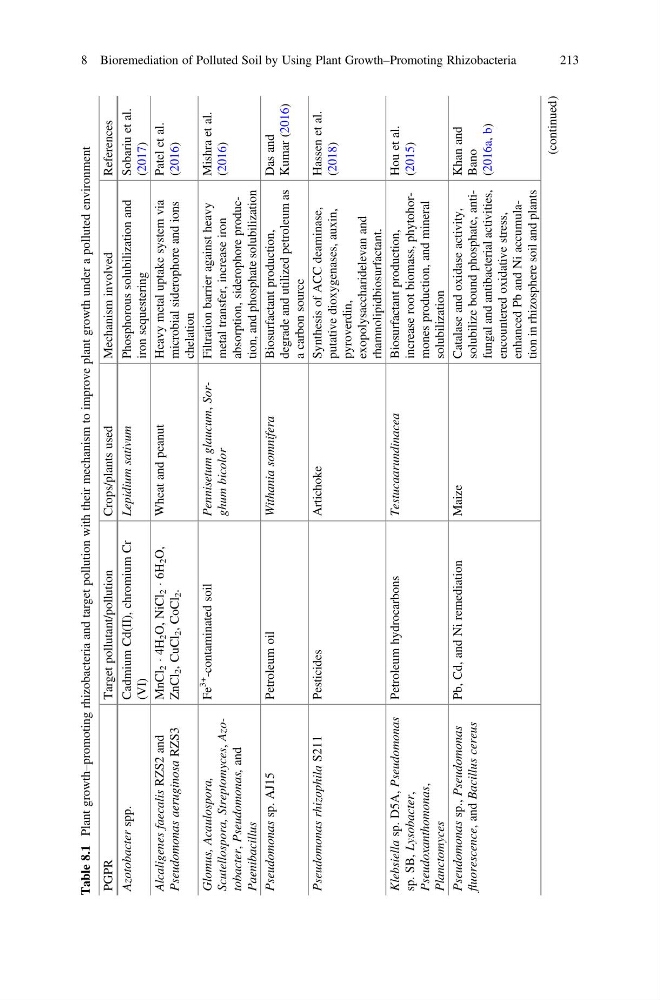
Table 8.1
Plant growth–promoting rhizobacteria and target pollution with their mechanism to improve plant growth under a polluted environment
PGPR
Target pollutant/pollution
Crops/plants used
Mechanism involved
References
Azotobacter
spp.
Cadmium Cd(II), chromium Cr
(VI)
Lepidium sativum
Phosphorous solubilization and
iron sequestering
Sobariu et al.
(2017)
Alcaligenes faecalis
RZS2 and
Pseudomonas aeruginosa
RZS3
MnCl
2
Á 4H
2 O, NiCl
2
Á 6H
2 O,
ZnCl
2 , CuCl
2 , CoCl
2 .
Wheat and peanut
Heavy metal uptake system via
microbial siderophore and ions
chelation
Patel et al.
(2016)
Glomus, Acaulospora,
Scutellospora, Streptomyces, Azotobacter, Pseudomonas,
and
Paenibacillus
Fe
3+
-contaminated soil
Pennisetum glaucum, Sorghum bicolor
Filtration barrier against heavy
metal transfer, increase iron
absorption, siderophore production, and phosphate solubilization
Mishra et al.
(2016)
Pseudomonas
sp. AJ15
Petroleum oil
Withania somnifera
Biosurfactant production,
degrade and utilized petroleum as
a carbon source
Das and
Kumar (2016)
Pseudomonas rhizophila
S211
Pesticides
Artichoke
Synthesis of ACC deaminase,
putative dioxygenases, auxin,
pyroverdin,
exopolysaccharidelevan and
rhamnolipidbiosurfactant.
Hassen et al.
(2018)
Klebsiella
sp. D5A, Pseudomonas
sp. SB, Lysobacter,
Pseudoxanthomonas,
Planctomyces
Petroleum hydrocarbons
Testucaarundinacea
Biosurfactant production,
increase root biomass, phytohormones production, and mineral
solubilization
Hou et al.
(2015)
Pseudomonas
sp., Pseudomonas
fluorescence, and Bacillus cereus
Pb, Cd, and Ni remediation
Maize
Catalase and oxidase activity,
solubilize bound phosphate, antifungal and antibacterial activities,
encountered oxidative stress,
enhanced Pb and Ni accumulation in rhizosphere soil and plants
Khan and
Bano
(2016a, b)
(continued)
8 Bioremediation of Polluted Soil by Using Plant Growth–Promoting Rhizobacteria
213
Plant growth–promoting rhizobacteria and target pollution with their mechanism to improve plant growth under a polluted environment
PGPR
Target pollutant/pollution
Crops/plants used
Mechanism involved
References
Azotobacter
spp.
Cadmium Cd(II), chromium Cr
(VI)
Lepidium sativum
Phosphorous solubilization and
iron sequestering
Sobariu et al.
(2017)
Alcaligenes faecalis
RZS2 and
Pseudomonas aeruginosa
RZS3
MnCl
2
Á 4H
2 O, NiCl
2
Á 6H
2 O,
ZnCl
2 , CuCl
2 , CoCl
2 .
Wheat and peanut
Heavy metal uptake system via
microbial siderophore and ions
chelation
Patel et al.
(2016)
Glomus, Acaulospora,
Scutellospora, Streptomyces, Azotobacter, Pseudomonas,
and
Paenibacillus
Fe
3+
-contaminated soil
Pennisetum glaucum, Sorghum bicolor
Filtration barrier against heavy
metal transfer, increase iron
absorption, siderophore production, and phosphate solubilization
Mishra et al.
(2016)
Pseudomonas
sp. AJ15
Petroleum oil
Withania somnifera
Biosurfactant production,
degrade and utilized petroleum as
a carbon source
Das and
Kumar (2016)
Pseudomonas rhizophila
S211
Pesticides
Artichoke
Synthesis of ACC deaminase,
putative dioxygenases, auxin,
pyroverdin,
exopolysaccharidelevan and
rhamnolipidbiosurfactant.
Hassen et al.
(2018)
Klebsiella
sp. D5A, Pseudomonas
sp. SB, Lysobacter,
Pseudoxanthomonas,
Planctomyces
Petroleum hydrocarbons
Testucaarundinacea
Biosurfactant production,
increase root biomass, phytohormones production, and mineral
solubilization
Hou et al.
(2015)
Pseudomonas
sp., Pseudomonas
fluorescence, and Bacillus cereus
Pb, Cd, and Ni remediation
Maize
Catalase and oxidase activity,
solubilize bound phosphate, antifungal and antibacterial activities,
encountered oxidative stress,
enhanced Pb and Ni accumulation in rhizosphere soil and plants
Khan and
Bano
(2016a, b)
(continued)
8 Bioremediation of Polluted Soil by Using Plant Growth–Promoting Rhizobacteria
213