

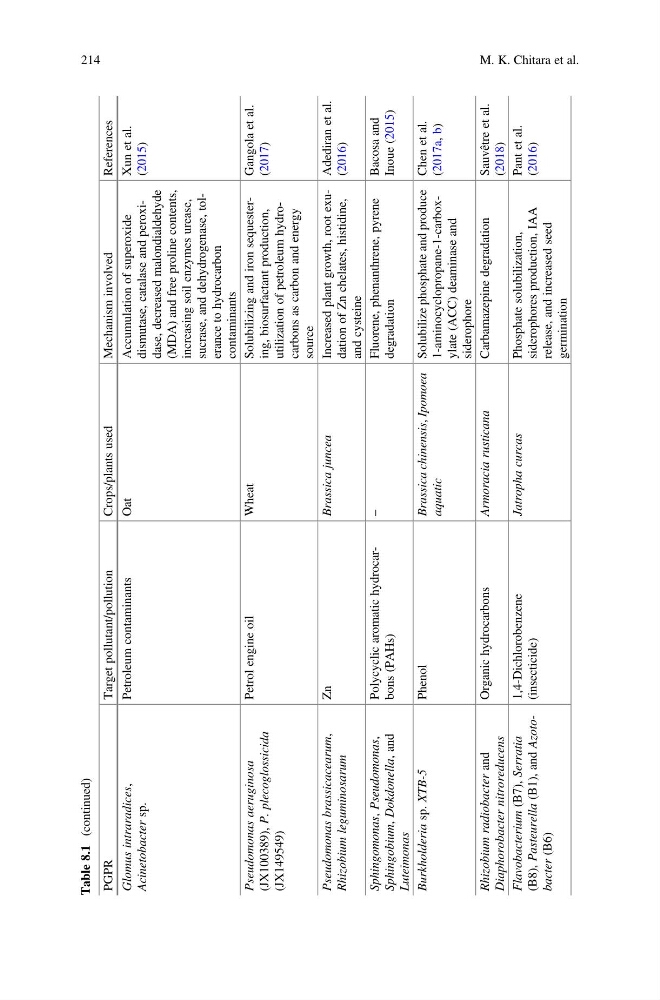
Table 8.1
(continued)
PGPR
Target pollutant/pollution
Crops/plants used
Mechanism involved
References
Glomus intraradices,
Acinetobacter
sp.
Petroleum contaminants
Oat
Accumulation of superoxide
dismutase, catalase and peroxidase, decreased malondialdehyde
(MDA) and free proline contents,
increasing soil enzymes urease,
sucrase, and dehydrogenase, tolerance to hydrocarbon
contaminants
Xun et al.
(2015)
Pseudomonas aeruginosa
(JX100389), P. plecoglossicida
(JX149549)
Petrol engine oil
Wheat
Solubilizing and iron sequestering, biosurfactant production,
utilization of petroleum hydrocarbons as carbon and energy
source
Gangola et al.
(2017)
Pseudomonas brassicacearum,
Rhizobium leguminosarum
Zn
Brassica juncea
Increased plant growth, root exudation of Zn chelates, histidine,
and cysteine
Adediran et al.
(2016)
Sphingomonas, Pseudomonas,
Sphingobium, Dokdonella,
and
Luteimonas
Polycyclic aromatic hydrocarbons (PAHs)
–
Fluorene, phenanthrene, pyrene
degradation
Bacosa and
Inoue (2015)
Burkholderia
sp. XTB-5
Phenol
Brassica chinensis, Ipomoea
aquatic
Solubilize phosphate and produce
1-aminocyclopropane-1-carboxylate (ACC) deaminase and
siderophore
Chen et al.
(2017a, b)
Rhizobium radiobacter
and
Diaphorobacter nitroreducens
Organic hydrocarbons
Armoracia rusticana
Carbamazepine degradation
Sauvêtre et al.
(2018)
Flavobacterium
(B7), Serratia
(B8), Pasteurella
(B1), and Azotobacter
(B6)
1,4-Dichlorobenzene
(insecticide)
Jatropha curcas
Phosphate solubilization,
siderophores production, IAA
release, and increased seed
germination
Pant et al.
(2016)
214
M. K. Chitara et al.
(continued)
PGPR
Target pollutant/pollution
Crops/plants used
Mechanism involved
References
Glomus intraradices,
Acinetobacter
sp.
Petroleum contaminants
Oat
Accumulation of superoxide
dismutase, catalase and peroxidase, decreased malondialdehyde
(MDA) and free proline contents,
increasing soil enzymes urease,
sucrase, and dehydrogenase, tolerance to hydrocarbon
contaminants
Xun et al.
(2015)
Pseudomonas aeruginosa
(JX100389), P. plecoglossicida
(JX149549)
Petrol engine oil
Wheat
Solubilizing and iron sequestering, biosurfactant production,
utilization of petroleum hydrocarbons as carbon and energy
source
Gangola et al.
(2017)
Pseudomonas brassicacearum,
Rhizobium leguminosarum
Zn
Brassica juncea
Increased plant growth, root exudation of Zn chelates, histidine,
and cysteine
Adediran et al.
(2016)
Sphingomonas, Pseudomonas,
Sphingobium, Dokdonella,
and
Luteimonas
Polycyclic aromatic hydrocarbons (PAHs)
–
Fluorene, phenanthrene, pyrene
degradation
Bacosa and
Inoue (2015)
Burkholderia
sp. XTB-5
Phenol
Brassica chinensis, Ipomoea
aquatic
Solubilize phosphate and produce
1-aminocyclopropane-1-carboxylate (ACC) deaminase and
siderophore
Chen et al.
(2017a, b)
Rhizobium radiobacter
and
Diaphorobacter nitroreducens
Organic hydrocarbons
Armoracia rusticana
Carbamazepine degradation
Sauvêtre et al.
(2018)
Flavobacterium
(B7), Serratia
(B8), Pasteurella
(B1), and Azotobacter
(B6)
1,4-Dichlorobenzene
(insecticide)
Jatropha curcas
Phosphate solubilization,
siderophores production, IAA
release, and increased seed
germination
Pant et al.
(2016)
214
M. K. Chitara et al.