

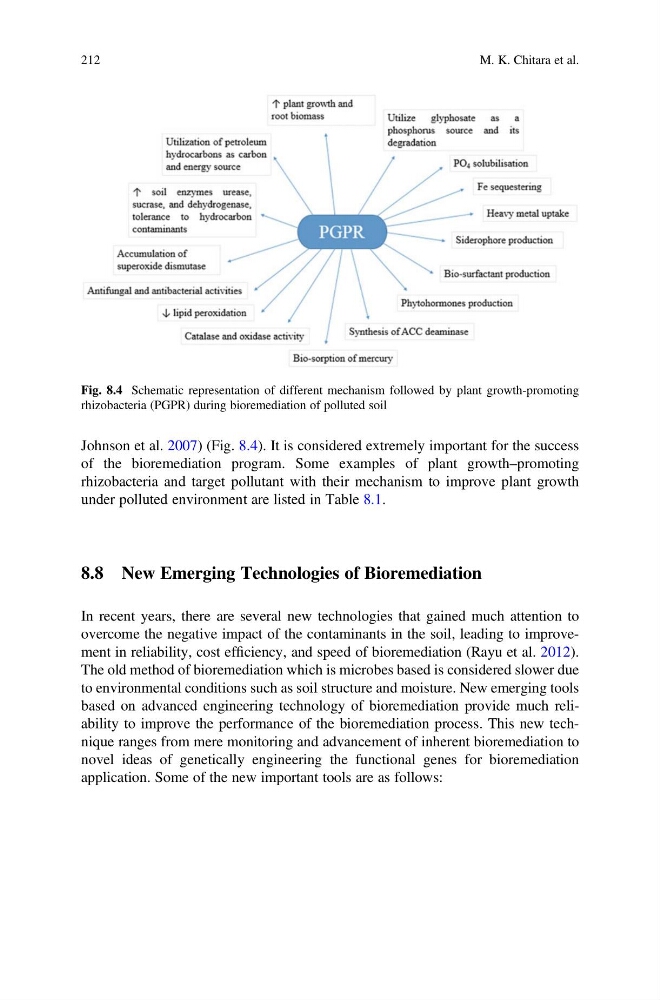
Johnson et al. 2007) (Fig. 8.4). It is considered extremely important for the success
of the bioremediation program. Some examples of plant growth–promoting
rhizobacteria and target pollutant with their mechanism to improve plant growth
under polluted environment are listed in Table 8.1.
8.8 New Emerging Technologies of Bioremediation
In recent years, there are several new technologies that gained much attention to
overcome the negative impact of the contaminants in the soil, leading to improvement in reliability, cost efficiency, and speed of bioremediation (Rayu et al. 2012).
The old method of bioremediation which is microbes based is considered slower due
to environmental conditions such as soil structure and moisture. New emerging tools
based on advanced engineering technology of bioremediation provide much reliability to improve the performance of the bioremediation process. This new technique ranges from mere monitoring and advancement of inherent bioremediation to
novel ideas of genetically engineering the functional genes for bioremediation
application. Some of the new important tools are as follows:
Fig. 8.4 Schematic representation of different mechanism followed by plant growth-promoting
rhizobacteria (PGPR) during bioremediation of polluted soil
212
M. K. Chitara et al.
of the bioremediation program. Some examples of plant growth–promoting
rhizobacteria and target pollutant with their mechanism to improve plant growth
under polluted environment are listed in Table 8.1.
8.8 New Emerging Technologies of Bioremediation
In recent years, there are several new technologies that gained much attention to
overcome the negative impact of the contaminants in the soil, leading to improvement in reliability, cost efficiency, and speed of bioremediation (Rayu et al. 2012).
The old method of bioremediation which is microbes based is considered slower due
to environmental conditions such as soil structure and moisture. New emerging tools
based on advanced engineering technology of bioremediation provide much reliability to improve the performance of the bioremediation process. This new technique ranges from mere monitoring and advancement of inherent bioremediation to
novel ideas of genetically engineering the functional genes for bioremediation
application. Some of the new important tools are as follows:
Fig. 8.4 Schematic representation of different mechanism followed by plant growth-promoting
rhizobacteria (PGPR) during bioremediation of polluted soil
212
M. K. Chitara et al.