

2. Optimization strategy: Optimization of culture conditions like C and N sources,
surfactants using single factorial, and statistical optimization should be carried
out to increase degradation.
3. Co-culture strategy: Microcosm or growing two or more fungi together is the
best way to achieve the higher degradation.
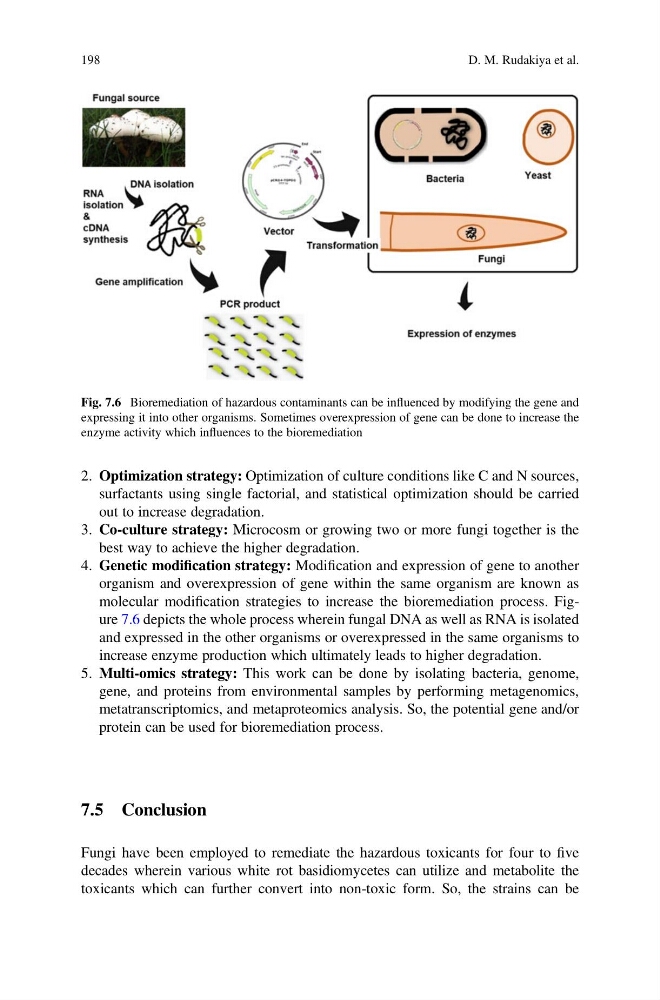
4. Genetic modification strategy: Modification and expression of gene to another
organism and overexpression of gene within the same organism are known as
molecular modification strategies to increase the bioremediation process. Figure 7.6 depicts the whole process wherein fungal DNA as well as RNA is isolated
and expressed in the other organisms or overexpressed in the same organisms to
increase enzyme production which ultimately leads to higher degradation.
5. Multi-omics strategy: This work can be done by isolating bacteria, genome,
gene, and proteins from environmental samples by performing metagenomics,
metatranscriptomics, and metaproteomics analysis. So, the potential gene and/or
protein can be used for bioremediation process.
7.5 Conclusion
Fungi have been employed to remediate the hazardous toxicants for four to five
decades wherein various white rot basidiomycetes can utilize and metabolite the
toxicants which can further convert into non-toxic form. So, the strains can be
Fig. 7.6 Bioremediation of hazardous contaminants can be influenced by modifying the gene and
expressing it into other organisms. Sometimes overexpression of gene can be done to increase the
enzyme activity which influences to the bioremediation
198
D. M. Rudakiya et al.
surfactants using single factorial, and statistical optimization should be carried
out to increase degradation.
3. Co-culture strategy: Microcosm or growing two or more fungi together is the
best way to achieve the higher degradation.
4. Genetic modification strategy: Modification and expression of gene to another
organism and overexpression of gene within the same organism are known as
molecular modification strategies to increase the bioremediation process. Figure 7.6 depicts the whole process wherein fungal DNA as well as RNA is isolated
and expressed in the other organisms or overexpressed in the same organisms to
increase enzyme production which ultimately leads to higher degradation.
5. Multi-omics strategy: This work can be done by isolating bacteria, genome,
gene, and proteins from environmental samples by performing metagenomics,
metatranscriptomics, and metaproteomics analysis. So, the potential gene and/or
protein can be used for bioremediation process.
7.5 Conclusion
Fungi have been employed to remediate the hazardous toxicants for four to five
decades wherein various white rot basidiomycetes can utilize and metabolite the
toxicants which can further convert into non-toxic form. So, the strains can be
Fig. 7.6 Bioremediation of hazardous contaminants can be influenced by modifying the gene and
expressing it into other organisms. Sometimes overexpression of gene can be done to increase the
enzyme activity which influences to the bioremediation
198
D. M. Rudakiya et al.