

Fungal cell wall comprises various proteins, fatty acids, and carbohydrates that
comprise certain functional groups in which COOH-, NH 3 -, and PO 4 - groups are
involved in the metal chelation. In addition to that, white rot fungi and brown rot
fungi produce extra polymeric substances such as exopolysaccharides in the environment which is effective to binding of various toxicants, metal chelation, reduction
of heavy metals, and tolerance to metals. Anionic property of exopolysaccharides
carries out the electrostatic interactions with heavy metals (Shah et al. 2018). Some
fungi show the efficient biosorption efficacy with different heavy metals (Rudakiya
et al. 2018).
7.4 Strategies to Improve Bioremediation Technology
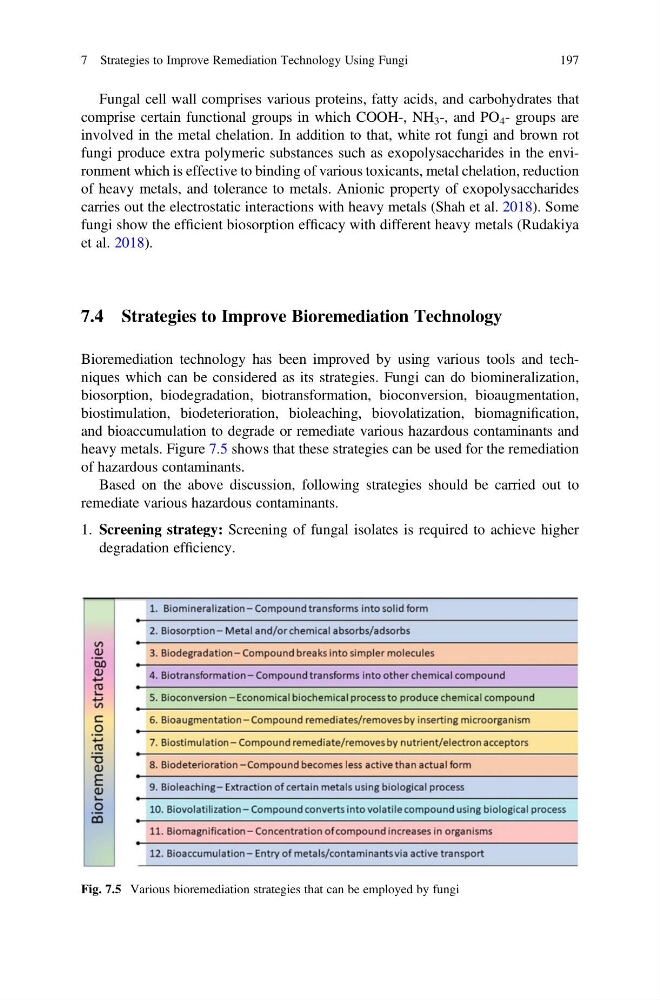
Bioremediation technology has been improved by using various tools and techniques which can be considered as its strategies. Fungi can do biomineralization,
biosorption, biodegradation, biotransformation, bioconversion, bioaugmentation,
biostimulation, biodeterioration, bioleaching, biovolatization, biomagnification,
and bioaccumulation to degrade or remediate various hazardous contaminants and
heavy metals. Figure 7.5 shows that these strategies can be used for the remediation
of hazardous contaminants.
Based on the above discussion, following strategies should be carried out to
remediate various hazardous contaminants.
1. Screening strategy: Screening of fungal isolates is required to achieve higher
degradation efficiency.
Fig. 7.5 Various bioremediation strategies that can be employed by fungi
7 Strategies to Improve Remediation Technology Using Fungi
197
comprise certain functional groups in which COOH-, NH 3 -, and PO 4 - groups are
involved in the metal chelation. In addition to that, white rot fungi and brown rot
fungi produce extra polymeric substances such as exopolysaccharides in the environment which is effective to binding of various toxicants, metal chelation, reduction
of heavy metals, and tolerance to metals. Anionic property of exopolysaccharides
carries out the electrostatic interactions with heavy metals (Shah et al. 2018). Some
fungi show the efficient biosorption efficacy with different heavy metals (Rudakiya
et al. 2018).
7.4 Strategies to Improve Bioremediation Technology
Bioremediation technology has been improved by using various tools and techniques which can be considered as its strategies. Fungi can do biomineralization,
biosorption, biodegradation, biotransformation, bioconversion, bioaugmentation,
biostimulation, biodeterioration, bioleaching, biovolatization, biomagnification,
and bioaccumulation to degrade or remediate various hazardous contaminants and
heavy metals. Figure 7.5 shows that these strategies can be used for the remediation
of hazardous contaminants.
Based on the above discussion, following strategies should be carried out to
remediate various hazardous contaminants.
1. Screening strategy: Screening of fungal isolates is required to achieve higher
degradation efficiency.
Fig. 7.5 Various bioremediation strategies that can be employed by fungi
7 Strategies to Improve Remediation Technology Using Fungi
197