

their large size. So, fungi have to secrete smaller radicals which are the primary
agents to start the degradation process, wherein reactive oxygen species play an
important role in initiating the wood decay. There are three types of ROS, which
includes hydroxyl radical (OH
•
), peroxyl radicals (ROO
• ), and superoxide radicals
(O 2
•À
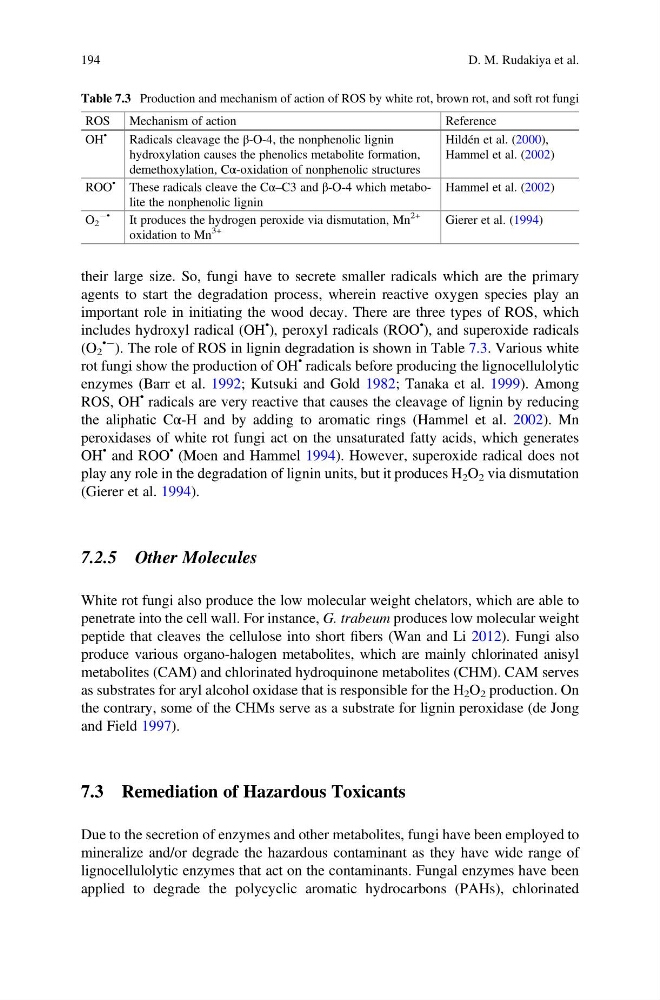
). The role of ROS in lignin degradation is shown in Table 7.3. Various white
rot fungi show the production of OH
• radicals before producing the lignocellulolytic
enzymes (Barr et al. 1992; Kutsuki and Gold 1982; Tanaka et al. 1999). Among
ROS, OH
• radicals are very reactive that causes the cleavage of lignin by reducing
the aliphatic Cα-H and by adding to aromatic rings (Hammel et al. 2002). Mn
peroxidases of white rot fungi act on the unsaturated fatty acids, which generates
OH
• and ROO
• (Moen and Hammel 1994). However, superoxide radical does not
play any role in the degradation of lignin units, but it produces H 2 O 2 via dismutation
(Gierer et al. 1994).
7.2.5 Other Molecules
White rot fungi also produce the low molecular weight chelators, which are able to
penetrate into the cell wall. For instance, G. trabeum produces low molecular weight
peptide that cleaves the cellulose into short fibers (Wan and Li 2012). Fungi also
produce various organo-halogen metabolites, which are mainly chlorinated anisyl
metabolites (CAM) and chlorinated hydroquinone metabolites (CHM). CAM serves
as substrates for aryl alcohol oxidase that is responsible for the H 2 O 2 production. On
the contrary, some of the CHMs serve as a substrate for lignin peroxidase (de Jong
and Field 1997).
7.3 Remediation of Hazardous Toxicants
Due to the secretion of enzymes and other metabolites, fungi have been employed to
mineralize and/or degrade the hazardous contaminant as they have wide range of
lignocellulolytic enzymes that act on the contaminants. Fungal enzymes have been
applied to degrade the polycyclic aromatic hydrocarbons (PAHs), chlorinated
Table 7.3 Production and mechanism of action of ROS by white rot, brown rot, and soft rot fungi
ROS
Mechanism of action
Reference
OH
•
Radicals cleavage the β-O-4, the nonphenolic lignin
hydroxylation causes the phenolics metabolite formation,
demethoxylation, Cα-oxidation of nonphenolic structures
Hildén et al. (2000),
Hammel et al. (2002)
ROO
•
These radicals cleave the Cα–C3 and β-O-4 which metabolite the nonphenolic lignin
Hammel et al. (2002)
O 2
À•
It produces the hydrogen peroxide via dismutation, Mn
2+
oxidation to Mn
3+
Gierer et al. (1994)
194
D. M. Rudakiya et al.
agents to start the degradation process, wherein reactive oxygen species play an
important role in initiating the wood decay. There are three types of ROS, which
includes hydroxyl radical (OH
•
), peroxyl radicals (ROO
• ), and superoxide radicals
(O 2
•À
). The role of ROS in lignin degradation is shown in Table 7.3. Various white
rot fungi show the production of OH
• radicals before producing the lignocellulolytic
enzymes (Barr et al. 1992; Kutsuki and Gold 1982; Tanaka et al. 1999). Among
ROS, OH
• radicals are very reactive that causes the cleavage of lignin by reducing
the aliphatic Cα-H and by adding to aromatic rings (Hammel et al. 2002). Mn
peroxidases of white rot fungi act on the unsaturated fatty acids, which generates
OH
• and ROO
• (Moen and Hammel 1994). However, superoxide radical does not
play any role in the degradation of lignin units, but it produces H 2 O 2 via dismutation
(Gierer et al. 1994).
7.2.5 Other Molecules
White rot fungi also produce the low molecular weight chelators, which are able to
penetrate into the cell wall. For instance, G. trabeum produces low molecular weight
peptide that cleaves the cellulose into short fibers (Wan and Li 2012). Fungi also
produce various organo-halogen metabolites, which are mainly chlorinated anisyl
metabolites (CAM) and chlorinated hydroquinone metabolites (CHM). CAM serves
as substrates for aryl alcohol oxidase that is responsible for the H 2 O 2 production. On
the contrary, some of the CHMs serve as a substrate for lignin peroxidase (de Jong
and Field 1997).
7.3 Remediation of Hazardous Toxicants
Due to the secretion of enzymes and other metabolites, fungi have been employed to
mineralize and/or degrade the hazardous contaminant as they have wide range of
lignocellulolytic enzymes that act on the contaminants. Fungal enzymes have been
applied to degrade the polycyclic aromatic hydrocarbons (PAHs), chlorinated
Table 7.3 Production and mechanism of action of ROS by white rot, brown rot, and soft rot fungi
ROS
Mechanism of action
Reference
OH
•
Radicals cleavage the β-O-4, the nonphenolic lignin
hydroxylation causes the phenolics metabolite formation,
demethoxylation, Cα-oxidation of nonphenolic structures
Hildén et al. (2000),
Hammel et al. (2002)
ROO
•
These radicals cleave the Cα–C3 and β-O-4 which metabolite the nonphenolic lignin
Hammel et al. (2002)
O 2
À•
It produces the hydrogen peroxide via dismutation, Mn
2+
oxidation to Mn
3+
Gierer et al. (1994)
194
D. M. Rudakiya et al.