

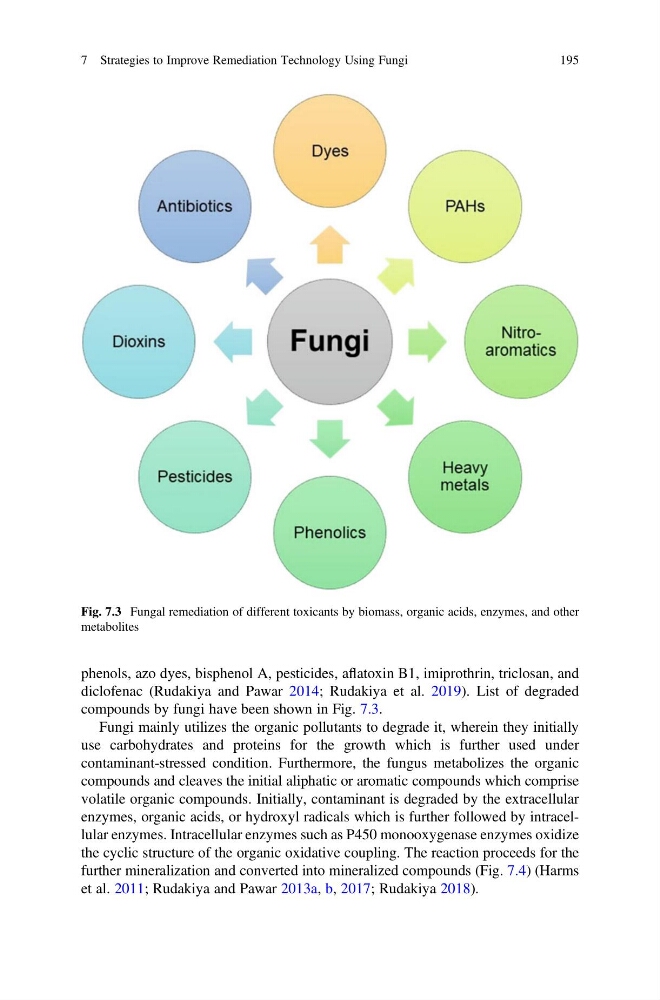
phenols, azo dyes, bisphenol A, pesticides, aflatoxin B1, imiprothrin, triclosan, and
diclofenac (Rudakiya and Pawar 2014; Rudakiya et al. 2019). List of degraded
compounds by fungi have been shown in Fig. 7.3.
Fungi mainly utilizes the organic pollutants to degrade it, wherein they initially
use carbohydrates and proteins for the growth which is further used under
contaminant-stressed condition. Furthermore, the fungus metabolizes the organic
compounds and cleaves the initial aliphatic or aromatic compounds which comprise
volatile organic compounds. Initially, contaminant is degraded by the extracellular
enzymes, organic acids, or hydroxyl radicals which is further followed by intracellular enzymes. Intracellular enzymes such as P450 monooxygenase enzymes oxidize
the cyclic structure of the organic oxidative coupling. The reaction proceeds for the
further mineralization and converted into mineralized compounds (Fig. 7.4) (Harms
et al. 2011; Rudakiya and Pawar 2013a, b, 2017; Rudakiya 2018).
Fig. 7.3 Fungal remediation of different toxicants by biomass, organic acids, enzymes, and other
metabolites
7 Strategies to Improve Remediation Technology Using Fungi
195
diclofenac (Rudakiya and Pawar 2014; Rudakiya et al. 2019). List of degraded
compounds by fungi have been shown in Fig. 7.3.
Fungi mainly utilizes the organic pollutants to degrade it, wherein they initially
use carbohydrates and proteins for the growth which is further used under
contaminant-stressed condition. Furthermore, the fungus metabolizes the organic
compounds and cleaves the initial aliphatic or aromatic compounds which comprise
volatile organic compounds. Initially, contaminant is degraded by the extracellular
enzymes, organic acids, or hydroxyl radicals which is further followed by intracellular enzymes. Intracellular enzymes such as P450 monooxygenase enzymes oxidize
the cyclic structure of the organic oxidative coupling. The reaction proceeds for the
further mineralization and converted into mineralized compounds (Fig. 7.4) (Harms
et al. 2011; Rudakiya and Pawar 2013a, b, 2017; Rudakiya 2018).
Fig. 7.3 Fungal remediation of different toxicants by biomass, organic acids, enzymes, and other
metabolites
7 Strategies to Improve Remediation Technology Using Fungi
195