

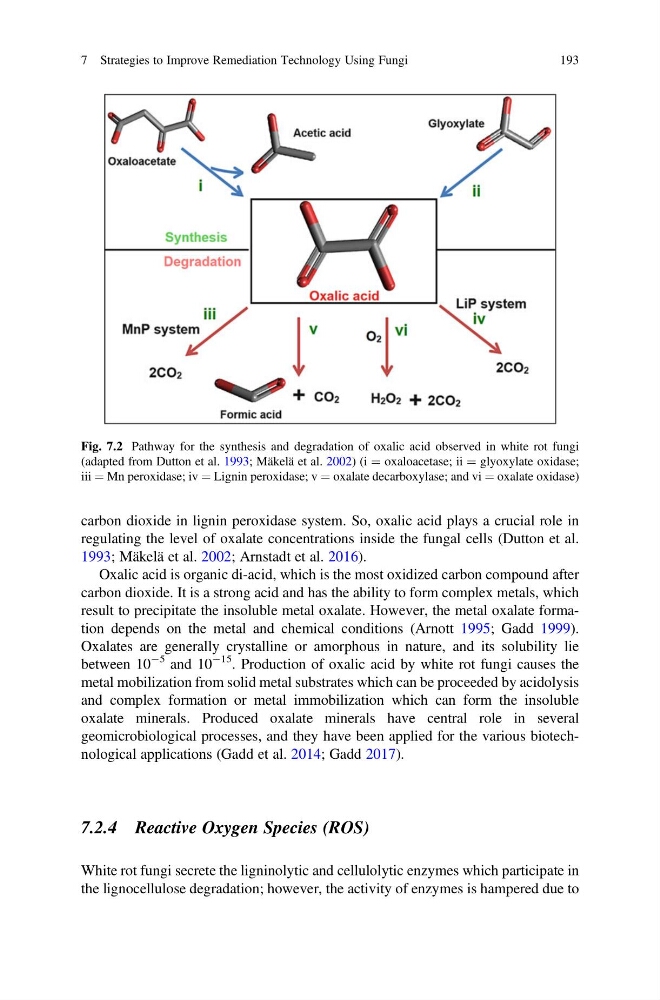
carbon dioxide in lignin peroxidase system. So, oxalic acid plays a crucial role in
regulating the level of oxalate concentrations inside the fungal cells (Dutton et al.
1993; Mäkelä et al. 2002; Arnstadt et al. 2016).
Oxalic acid is organic di-acid, which is the most oxidized carbon compound after
carbon dioxide. It is a strong acid and has the ability to form complex metals, which
result to precipitate the insoluble metal oxalate. However, the metal oxalate formation depends on the metal and chemical conditions (Arnott 1995; Gadd 1999).
Oxalates are generally crystalline or amorphous in nature, and its solubility lie
between 10
À5 and 10
À15 . Production of oxalic acid by white rot fungi causes the
metal mobilization from solid metal substrates which can be proceeded by acidolysis
and complex formation or metal immobilization which can form the insoluble
oxalate minerals. Produced oxalate minerals have central role in several
geomicrobiological processes, and they have been applied for the various biotechnological applications (Gadd et al. 2014; Gadd 2017).
7.2.4 Reactive Oxygen Species (ROS)
White rot fungi secrete the ligninolytic and cellulolytic enzymes which participate in
the lignocellulose degradation; however, the activity of enzymes is hampered due to
Fig. 7.2 Pathway for the synthesis and degradation of oxalic acid observed in white rot fungi
(adapted from Dutton et al. 1993; Mäkelä et al. 2002) (i ¼ oxaloacetase; ii ¼ glyoxylate oxidase;
iii ¼ Mn peroxidase; iv ¼ Lignin peroxidase; v ¼ oxalate decarboxylase; and vi ¼ oxalate oxidase)
7 Strategies to Improve Remediation Technology Using Fungi
193
regulating the level of oxalate concentrations inside the fungal cells (Dutton et al.
1993; Mäkelä et al. 2002; Arnstadt et al. 2016).
Oxalic acid is organic di-acid, which is the most oxidized carbon compound after
carbon dioxide. It is a strong acid and has the ability to form complex metals, which
result to precipitate the insoluble metal oxalate. However, the metal oxalate formation depends on the metal and chemical conditions (Arnott 1995; Gadd 1999).
Oxalates are generally crystalline or amorphous in nature, and its solubility lie
between 10
À5 and 10
À15 . Production of oxalic acid by white rot fungi causes the
metal mobilization from solid metal substrates which can be proceeded by acidolysis
and complex formation or metal immobilization which can form the insoluble
oxalate minerals. Produced oxalate minerals have central role in several
geomicrobiological processes, and they have been applied for the various biotechnological applications (Gadd et al. 2014; Gadd 2017).
7.2.4 Reactive Oxygen Species (ROS)
White rot fungi secrete the ligninolytic and cellulolytic enzymes which participate in
the lignocellulose degradation; however, the activity of enzymes is hampered due to
Fig. 7.2 Pathway for the synthesis and degradation of oxalic acid observed in white rot fungi
(adapted from Dutton et al. 1993; Mäkelä et al. 2002) (i ¼ oxaloacetase; ii ¼ glyoxylate oxidase;
iii ¼ Mn peroxidase; iv ¼ Lignin peroxidase; v ¼ oxalate decarboxylase; and vi ¼ oxalate oxidase)
7 Strategies to Improve Remediation Technology Using Fungi
193