

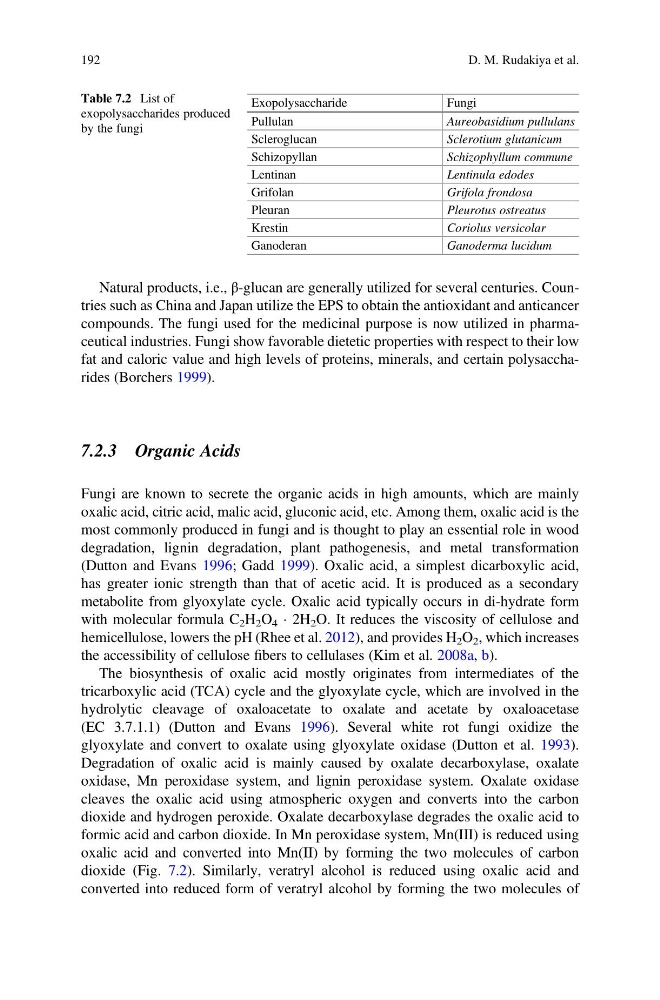
Natural products, i.e., β-glucan are generally utilized for several centuries. Countries such as China and Japan utilize the EPS to obtain the antioxidant and anticancer
compounds. The fungi used for the medicinal purpose is now utilized in pharmaceutical industries. Fungi show favorable dietetic properties with respect to their low
fat and caloric value and high levels of proteins, minerals, and certain polysaccharides (Borchers 1999).
7.2.3 Organic Acids
Fungi are known to secrete the organic acids in high amounts, which are mainly
oxalic acid, citric acid, malic acid, gluconic acid, etc. Among them, oxalic acid is the
most commonly produced in fungi and is thought to play an essential role in wood
degradation, lignin degradation, plant pathogenesis, and metal transformation
(Dutton and Evans 1996; Gadd 1999). Oxalic acid, a simplest dicarboxylic acid,
has greater ionic strength than that of acetic acid. It is produced as a secondary
metabolite from glyoxylate cycle. Oxalic acid typically occurs in di-hydrate form
with molecular formula C 2 H 2 O 4 Á 2H 2 O. It reduces the viscosity of cellulose and
hemicellulose, lowers the pH (Rhee et al. 2012), and provides H 2 O 2 , which increases
the accessibility of cellulose fibers to cellulases (Kim et al. 2008a, b).
The biosynthesis of oxalic acid mostly originates from intermediates of the
tricarboxylic acid (TCA) cycle and the glyoxylate cycle, which are involved in the
hydrolytic cleavage of oxaloacetate to oxalate and acetate by oxaloacetase
(EC 3.7.1.1) (Dutton and Evans 1996). Several white rot fungi oxidize the
glyoxylate and convert to oxalate using glyoxylate oxidase (Dutton et al. 1993).
Degradation of oxalic acid is mainly caused by oxalate decarboxylase, oxalate
oxidase, Mn peroxidase system, and lignin peroxidase system. Oxalate oxidase
cleaves the oxalic acid using atmospheric oxygen and converts into the carbon
dioxide and hydrogen peroxide. Oxalate decarboxylase degrades the oxalic acid to
formic acid and carbon dioxide. In Mn peroxidase system, Mn(III) is reduced using
oxalic acid and converted into Mn(II) by forming the two molecules of carbon
dioxide (Fig. 7.2). Similarly, veratryl alcohol is reduced using oxalic acid and
converted into reduced form of veratryl alcohol by forming the two molecules of
Table 7.2 List of
exopolysaccharides produced
by the fungi
Exopolysaccharide
Fungi
Pullulan
Aureobasidium pullulans
Scleroglucan
Sclerotium glutanicum
Schizopyllan
Schizophyllum commune
Lentinan
Lentinula edodes
Grifolan
Grifola frondosa
Pleuran
Pleurotus ostreatus
Krestin
Coriolus versicolar
Ganoderan
Ganoderma lucidum
192
D. M. Rudakiya et al.
compounds. The fungi used for the medicinal purpose is now utilized in pharmaceutical industries. Fungi show favorable dietetic properties with respect to their low
fat and caloric value and high levels of proteins, minerals, and certain polysaccharides (Borchers 1999).
7.2.3 Organic Acids
Fungi are known to secrete the organic acids in high amounts, which are mainly
oxalic acid, citric acid, malic acid, gluconic acid, etc. Among them, oxalic acid is the
most commonly produced in fungi and is thought to play an essential role in wood
degradation, lignin degradation, plant pathogenesis, and metal transformation
(Dutton and Evans 1996; Gadd 1999). Oxalic acid, a simplest dicarboxylic acid,
has greater ionic strength than that of acetic acid. It is produced as a secondary
metabolite from glyoxylate cycle. Oxalic acid typically occurs in di-hydrate form
with molecular formula C 2 H 2 O 4 Á 2H 2 O. It reduces the viscosity of cellulose and
hemicellulose, lowers the pH (Rhee et al. 2012), and provides H 2 O 2 , which increases
the accessibility of cellulose fibers to cellulases (Kim et al. 2008a, b).
The biosynthesis of oxalic acid mostly originates from intermediates of the
tricarboxylic acid (TCA) cycle and the glyoxylate cycle, which are involved in the
hydrolytic cleavage of oxaloacetate to oxalate and acetate by oxaloacetase
(EC 3.7.1.1) (Dutton and Evans 1996). Several white rot fungi oxidize the
glyoxylate and convert to oxalate using glyoxylate oxidase (Dutton et al. 1993).
Degradation of oxalic acid is mainly caused by oxalate decarboxylase, oxalate
oxidase, Mn peroxidase system, and lignin peroxidase system. Oxalate oxidase
cleaves the oxalic acid using atmospheric oxygen and converts into the carbon
dioxide and hydrogen peroxide. Oxalate decarboxylase degrades the oxalic acid to
formic acid and carbon dioxide. In Mn peroxidase system, Mn(III) is reduced using
oxalic acid and converted into Mn(II) by forming the two molecules of carbon
dioxide (Fig. 7.2). Similarly, veratryl alcohol is reduced using oxalic acid and
converted into reduced form of veratryl alcohol by forming the two molecules of
Table 7.2 List of
exopolysaccharides produced
by the fungi
Exopolysaccharide
Fungi
Pullulan
Aureobasidium pullulans
Scleroglucan
Sclerotium glutanicum
Schizopyllan
Schizophyllum commune
Lentinan
Lentinula edodes
Grifolan
Grifola frondosa
Pleuran
Pleurotus ostreatus
Krestin
Coriolus versicolar
Ganoderan
Ganoderma lucidum
192
D. M. Rudakiya et al.