

6.3.2 On the Basis of Separation Method
6.3.2.1 Physical Method
In this method, only contaminants are separated from the site, degradation does not
takes place (Bento et al. 2005; Gong et al. 2005), and posttreatment requirements for
proper treatment are water solutions, solvents, or vegetable oils. Like regeneration of
the solvent by distillation (Khodadoust et al. 1998), UV-degradation (Isosaari et al.
2001, 2005) or adsorption of contaminants by activated carbons (Ahn et al. 2007),
through soil replacement method, dilutes the concentration of heavy metal(loid)s in
soil and increases soil fertility (Yao et al. 2012). High-temperature treatment is used
for the removal of heavy metal(loid)s from contaminated site (Mallampati et al.
2015) which leads to the formation of vitreous material. In vitrification, some
metallic species (along with Hg) can be volatilized under excessive temperature
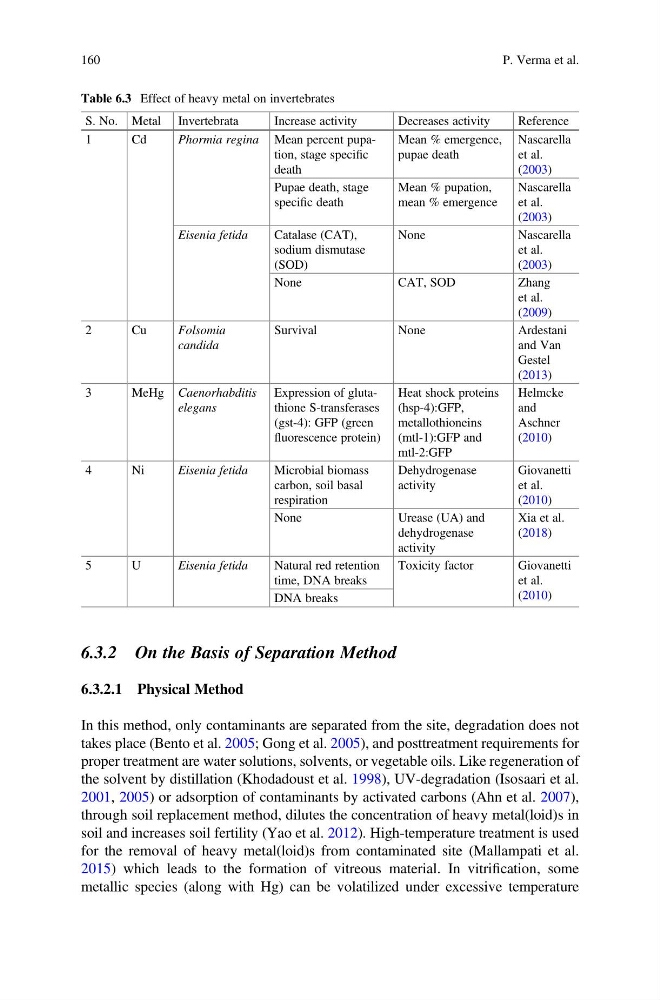
Table 6.3 Effect of heavy metal on invertebrates
S. No. Metal Invertebrata
Increase activity
Decreases activity
Reference
1
C d
Phormia regina Mean percent pupation, stage specific
death
Mean % emergence,
pupae death
Nascarella
et al.
(2003)
Pupae death, stage
specific death
Mean % pupation,
mean % emergence
Nascarella
et al.
(2003)
Eisenia fetida
Catalase (CAT),
sodium dismutase
(SOD)
None
Nascarella
et al.
(2003)
None
CAT, SOD
Zhang
et al.
(2009)
2
C u
Folsomia
candida
Survival
None
Ardestani
and Van
Gestel
(2013)
3
MeHg Caenorhabditis
elegans
Expression of glutathione S-transferases
(gst-4): GFP (green
fluorescence protein)
Heat shock proteins
(hsp-4):GFP,
metallothioneins
(mtl-1):GFP and
mtl-2:GFP
Helmcke
and
Aschner
(2010)
4
N i
Eisenia fetida
Microbial biomass
carbon, soil basal
respiration
Dehydrogenase
activity
Giovanetti
et al.
(2010)
None
Urease (UA) and
dehydrogenase
activity
Xia et al.
(2018)
5
U
Eisenia fetida
Natural red retention
time, DNA breaks
Toxicity factor
Giovanetti
et al.
(2010)
DNA breaks
160
P. Verma et al.
6.3.2.1 Physical Method
In this method, only contaminants are separated from the site, degradation does not
takes place (Bento et al. 2005; Gong et al. 2005), and posttreatment requirements for
proper treatment are water solutions, solvents, or vegetable oils. Like regeneration of
the solvent by distillation (Khodadoust et al. 1998), UV-degradation (Isosaari et al.
2001, 2005) or adsorption of contaminants by activated carbons (Ahn et al. 2007),
through soil replacement method, dilutes the concentration of heavy metal(loid)s in
soil and increases soil fertility (Yao et al. 2012). High-temperature treatment is used
for the removal of heavy metal(loid)s from contaminated site (Mallampati et al.
2015) which leads to the formation of vitreous material. In vitrification, some
metallic species (along with Hg) can be volatilized under excessive temperature
Table 6.3 Effect of heavy metal on invertebrates
S. No. Metal Invertebrata
Increase activity
Decreases activity
Reference
1
C d
Phormia regina Mean percent pupation, stage specific
death
Mean % emergence,
pupae death
Nascarella
et al.
(2003)
Pupae death, stage
specific death
Mean % pupation,
mean % emergence
Nascarella
et al.
(2003)
Eisenia fetida
Catalase (CAT),
sodium dismutase
(SOD)
None
Nascarella
et al.
(2003)
None
CAT, SOD
Zhang
et al.
(2009)
2
C u
Folsomia
candida
Survival
None
Ardestani
and Van
Gestel
(2013)
3
MeHg Caenorhabditis
elegans
Expression of glutathione S-transferases
(gst-4): GFP (green
fluorescence protein)
Heat shock proteins
(hsp-4):GFP,
metallothioneins
(mtl-1):GFP and
mtl-2:GFP
Helmcke
and
Aschner
(2010)
4
N i
Eisenia fetida
Microbial biomass
carbon, soil basal
respiration
Dehydrogenase
activity
Giovanetti
et al.
(2010)
None
Urease (UA) and
dehydrogenase
activity
Xia et al.
(2018)
5
U
Eisenia fetida
Natural red retention
time, DNA breaks
Toxicity factor
Giovanetti
et al.
(2010)
DNA breaks
160
P. Verma et al.