

4 Types of Natural Selection and Tests of Selection
73
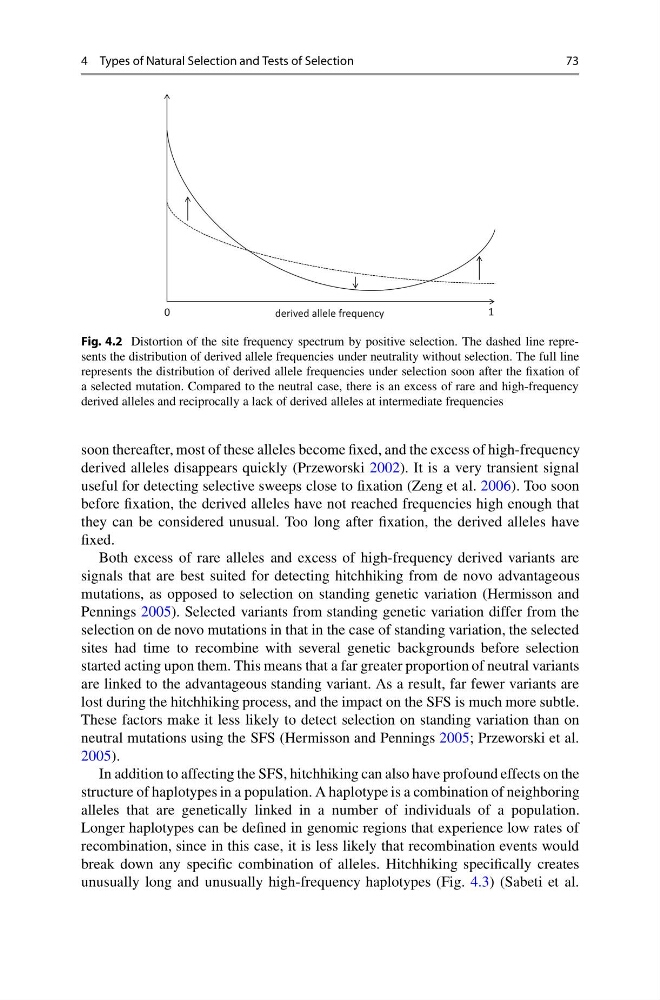
Fig. 4.2 Distortion of the site frequency spectrum by positive selection. The dashed line represents the distribution of derived allele frequencies under neutrality without selection. The full line
represents the distribution of derived allele frequencies under selection soon after the fixation of
a selected mutation. Compared to the neutral case, there is an excess of rare and high-frequency
derived alleles and reciprocally a lack of derived alleles at intermediate frequencies
soon thereafter, most of these alleles become fixed, and the excess of high-frequency
derived alleles disappears quickly (Przeworski 2002). It is a very transient signal
useful for detecting selective sweeps close to fixation (Zeng et al. 2006). Too soon
before fixation, the derived alleles have not reached frequencies high enough that
they can be considered unusual. Too long after fixation, the derived alleles have
fixed.
Both excess of rare alleles and excess of high-frequency derived variants are
signals that are best suited for detecting hitchhiking from de novo advantageous
mutations, as opposed to selection on standing genetic variation (Hermisson and
Pennings 2005). Selected variants from standing genetic variation differ from the
selection on de novo mutations in that in the case of standing variation, the selected
sites had time to recombine with several genetic backgrounds before selection
started acting upon them. This means that a far greater proportion of neutral variants
are linked to the advantageous standing variant. As a result, far fewer variants are
lost during the hitchhiking process, and the impact on the SFS is much more subtle.
These factors make it less likely to detect selection on standing variation than on
neutral mutations using the SFS (Hermisson and Pennings 2005; Przeworski et al.
2005).
In addition to affecting the SFS, hitchhiking can also have profound effects on the
structure of haplotypes in a population. A haplotype is a combination of neighboring
alleles that are genetically linked in a number of individuals of a population.
Longer haplotypes can be defined in genomic regions that experience low rates of
recombination, since in this case, it is less likely that recombination events would
break down any specific combination of alleles. Hitchhiking specifically creates
unusually long and unusually high-frequency haplotypes (Fig. 4.3) (Sabeti et al.
73
Fig. 4.2 Distortion of the site frequency spectrum by positive selection. The dashed line represents the distribution of derived allele frequencies under neutrality without selection. The full line
represents the distribution of derived allele frequencies under selection soon after the fixation of
a selected mutation. Compared to the neutral case, there is an excess of rare and high-frequency
derived alleles and reciprocally a lack of derived alleles at intermediate frequencies
soon thereafter, most of these alleles become fixed, and the excess of high-frequency
derived alleles disappears quickly (Przeworski 2002). It is a very transient signal
useful for detecting selective sweeps close to fixation (Zeng et al. 2006). Too soon
before fixation, the derived alleles have not reached frequencies high enough that
they can be considered unusual. Too long after fixation, the derived alleles have
fixed.
Both excess of rare alleles and excess of high-frequency derived variants are
signals that are best suited for detecting hitchhiking from de novo advantageous
mutations, as opposed to selection on standing genetic variation (Hermisson and
Pennings 2005). Selected variants from standing genetic variation differ from the
selection on de novo mutations in that in the case of standing variation, the selected
sites had time to recombine with several genetic backgrounds before selection
started acting upon them. This means that a far greater proportion of neutral variants
are linked to the advantageous standing variant. As a result, far fewer variants are
lost during the hitchhiking process, and the impact on the SFS is much more subtle.
These factors make it less likely to detect selection on standing variation than on
neutral mutations using the SFS (Hermisson and Pennings 2005; Przeworski et al.
2005).
In addition to affecting the SFS, hitchhiking can also have profound effects on the
structure of haplotypes in a population. A haplotype is a combination of neighboring
alleles that are genetically linked in a number of individuals of a population.
Longer haplotypes can be defined in genomic regions that experience low rates of
recombination, since in this case, it is less likely that recombination events would
break down any specific combination of alleles. Hitchhiking specifically creates
unusually long and unusually high-frequency haplotypes (Fig. 4.3) (Sabeti et al.