

72
D. Enard
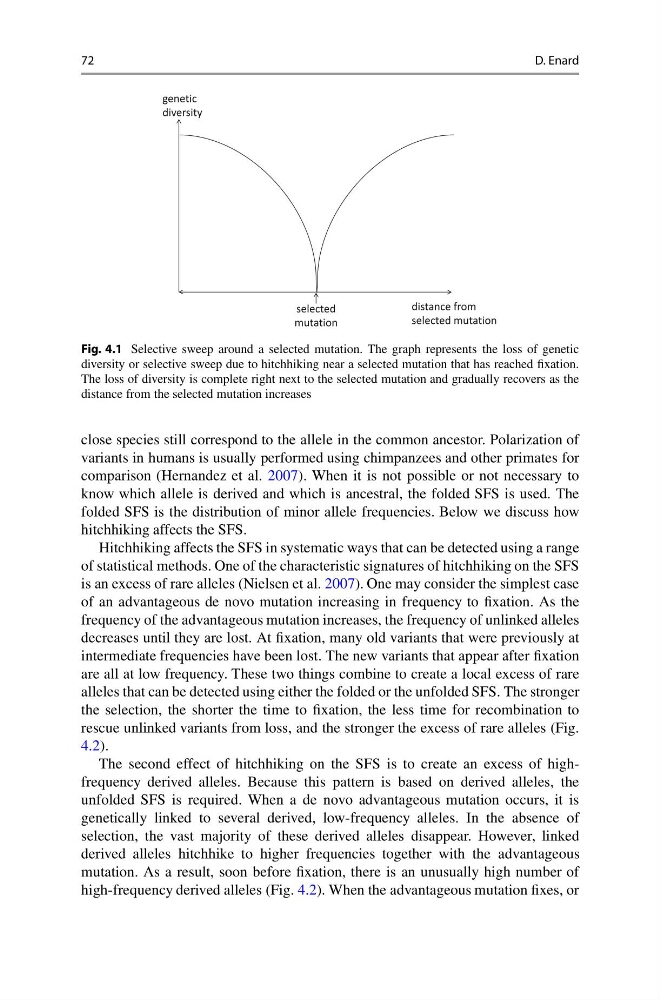
Fig. 4.1 Selective sweep around a selected mutation. The graph represents the loss of genetic
diversity or selective sweep due to hitchhiking near a selected mutation that has reached fixation.
The loss of diversity is complete right next to the selected mutation and gradually recovers as the
distance from the selected mutation increases
close species still correspond to the allele in the common ancestor. Polarization of
variants in humans is usually performed using chimpanzees and other primates for
comparison (Hernandez et al. 2007). When it is not possible or not necessary to
know which allele is derived and which is ancestral, the folded SFS is used. The
folded SFS is the distribution of minor allele frequencies. Below we discuss how
hitchhiking affects the SFS.
Hitchhiking affects the SFS in systematic ways that can be detected using a range
of statistical methods. One of the characteristic signatures of hitchhiking on the SFS
is an excess of rare alleles (Nielsen et al. 2007). One may consider the simplest case
of an advantageous de novo mutation increasing in frequency to fixation. As the
frequency of the advantageous mutation increases, the frequency of unlinked alleles
decreases until they are lost. At fixation, many old variants that were previously at
intermediate frequencies have been lost. The new variants that appear after fixation
are all at low frequency. These two things combine to create a local excess of rare
alleles that can be detected using either the folded or the unfolded SFS. The stronger
the selection, the shorter the time to fixation, the less time for recombination to
rescue unlinked variants from loss, and the stronger the excess of rare alleles (Fig.
4.2).
The second effect of hitchhiking on the SFS is to create an excess of highfrequency derived alleles. Because this pattern is based on derived alleles, the
unfolded SFS is required. When a de novo advantageous mutation occurs, it is
genetically linked to several derived, low-frequency alleles. In the absence of
selection, the vast majority of these derived alleles disappear. However, linked
derived alleles hitchhike to higher frequencies together with the advantageous
mutation. As a result, soon before fixation, there is an unusually high number of
high-frequency derived alleles (Fig. 4.2). When the advantageous mutation fixes, or
D. Enard
Fig. 4.1 Selective sweep around a selected mutation. The graph represents the loss of genetic
diversity or selective sweep due to hitchhiking near a selected mutation that has reached fixation.
The loss of diversity is complete right next to the selected mutation and gradually recovers as the
distance from the selected mutation increases
close species still correspond to the allele in the common ancestor. Polarization of
variants in humans is usually performed using chimpanzees and other primates for
comparison (Hernandez et al. 2007). When it is not possible or not necessary to
know which allele is derived and which is ancestral, the folded SFS is used. The
folded SFS is the distribution of minor allele frequencies. Below we discuss how
hitchhiking affects the SFS.
Hitchhiking affects the SFS in systematic ways that can be detected using a range
of statistical methods. One of the characteristic signatures of hitchhiking on the SFS
is an excess of rare alleles (Nielsen et al. 2007). One may consider the simplest case
of an advantageous de novo mutation increasing in frequency to fixation. As the
frequency of the advantageous mutation increases, the frequency of unlinked alleles
decreases until they are lost. At fixation, many old variants that were previously at
intermediate frequencies have been lost. The new variants that appear after fixation
are all at low frequency. These two things combine to create a local excess of rare
alleles that can be detected using either the folded or the unfolded SFS. The stronger
the selection, the shorter the time to fixation, the less time for recombination to
rescue unlinked variants from loss, and the stronger the excess of rare alleles (Fig.
4.2).
The second effect of hitchhiking on the SFS is to create an excess of highfrequency derived alleles. Because this pattern is based on derived alleles, the
unfolded SFS is required. When a de novo advantageous mutation occurs, it is
genetically linked to several derived, low-frequency alleles. In the absence of
selection, the vast majority of these derived alleles disappear. However, linked
derived alleles hitchhike to higher frequencies together with the advantageous
mutation. As a result, soon before fixation, there is an unusually high number of
high-frequency derived alleles (Fig. 4.2). When the advantageous mutation fixes, or