

74
D. Enard
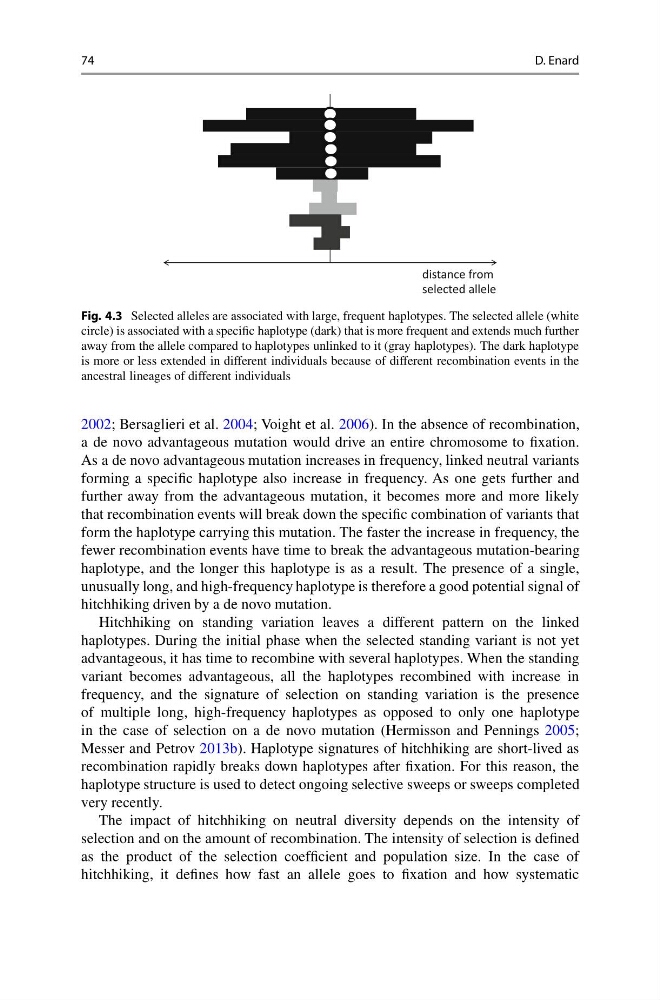
Fig. 4.3 Selected alleles are associated with large, frequent haplotypes. The selected allele (white
circle) is associated with a specific haplotype (dark) that is more frequent and extends much further
away from the allele compared to haplotypes unlinked to it (gray haplotypes). The dark haplotype
is more or less extended in different individuals because of different recombination events in the
ancestral lineages of different individuals
2002; Bersaglieri et al. 2004; Voight et al. 2006). In the absence of recombination,
a de novo advantageous mutation would drive an entire chromosome to fixation.
As a de novo advantageous mutation increases in frequency, linked neutral variants
forming a specific haplotype also increase in frequency. As one gets further and
further away from the advantageous mutation, it becomes more and more likely
that recombination events will break down the specific combination of variants that
form the haplotype carrying this mutation. The faster the increase in frequency, the
fewer recombination events have time to break the advantageous mutation-bearing
haplotype, and the longer this haplotype is as a result. The presence of a single,
unusually long, and high-frequency haplotype is therefore a good potential signal of
hitchhiking driven by a de novo mutation.
Hitchhiking on standing variation leaves a different pattern on the linked
haplotypes. During the initial phase when the selected standing variant is not yet
advantageous, it has time to recombine with several haplotypes. When the standing
variant becomes advantageous, all the haplotypes recombined with increase in
frequency, and the signature of selection on standing variation is the presence
of multiple long, high-frequency haplotypes as opposed to only one haplotype
in the case of selection on a de novo mutation (Hermisson and Pennings 2005;
Messer and Petrov 2013b). Haplotype signatures of hitchhiking are short-lived as
recombination rapidly breaks down haplotypes after fixation. For this reason, the
haplotype structure is used to detect ongoing selective sweeps or sweeps completed
very recently.
The impact of hitchhiking on neutral diversity depends on the intensity of
selection and on the amount of recombination. The intensity of selection is defined
as the product of the selection coefficient and population size. In the case of
hitchhiking, it defines how fast an allele goes to fixation and how systematic
D. Enard
Fig. 4.3 Selected alleles are associated with large, frequent haplotypes. The selected allele (white
circle) is associated with a specific haplotype (dark) that is more frequent and extends much further
away from the allele compared to haplotypes unlinked to it (gray haplotypes). The dark haplotype
is more or less extended in different individuals because of different recombination events in the
ancestral lineages of different individuals
2002; Bersaglieri et al. 2004; Voight et al. 2006). In the absence of recombination,
a de novo advantageous mutation would drive an entire chromosome to fixation.
As a de novo advantageous mutation increases in frequency, linked neutral variants
forming a specific haplotype also increase in frequency. As one gets further and
further away from the advantageous mutation, it becomes more and more likely
that recombination events will break down the specific combination of variants that
form the haplotype carrying this mutation. The faster the increase in frequency, the
fewer recombination events have time to break the advantageous mutation-bearing
haplotype, and the longer this haplotype is as a result. The presence of a single,
unusually long, and high-frequency haplotype is therefore a good potential signal of
hitchhiking driven by a de novo mutation.
Hitchhiking on standing variation leaves a different pattern on the linked
haplotypes. During the initial phase when the selected standing variant is not yet
advantageous, it has time to recombine with several haplotypes. When the standing
variant becomes advantageous, all the haplotypes recombined with increase in
frequency, and the signature of selection on standing variation is the presence
of multiple long, high-frequency haplotypes as opposed to only one haplotype
in the case of selection on a de novo mutation (Hermisson and Pennings 2005;
Messer and Petrov 2013b). Haplotype signatures of hitchhiking are short-lived as
recombination rapidly breaks down haplotypes after fixation. For this reason, the
haplotype structure is used to detect ongoing selective sweeps or sweeps completed
very recently.
The impact of hitchhiking on neutral diversity depends on the intensity of
selection and on the amount of recombination. The intensity of selection is defined
as the product of the selection coefficient and population size. In the case of
hitchhiking, it defines how fast an allele goes to fixation and how systematic