

36
M. Slatkin
largely responsible for the genetic basis of complex inherited diseases. For complex
diseases, such as most cancers, most forms of heart disease, and many psychiatric
disorders and autoimmune diseases, disease risk in close relatives of an affected
individual is higher than the average risk in a population, which strongly suggests
there is a genetic basis, yet the genetic basis is not attributable to single Mendelian
loci.
2.5
Dynamics of D
The term “linkage disequilibrium” is unfortunate for two reasons. First, it does not
necessarily tell us something about the linkage of two loci. Two loci on different
chromosomes might be in linkage disequilibrium, while two closely linked loci
might be in linkage equilibrium. Second, the term implies that it describes a dynamic
process, but it does not. Instead, D, D
, and r 2 quantify the relationship between
haplotype and allele frequencies in a population at a given time. We can understand
the dynamics of LD by determining how D changes under the influence of various
forces, including random mating, natural selection, recombination, and genetic
drift.
We will begin with random mating and recombination. We assume that zygotes
are formed by randomly combining haplotypes and that the two loci have a recombination rate c between them. We also assume the haplotype frequencies in generation
t are f AB , f Ab , f aB , and f ab . We can compute the haplotype frequencies in the next
generation (t + 1) by assuming gametes are randomly combined into genotypes.
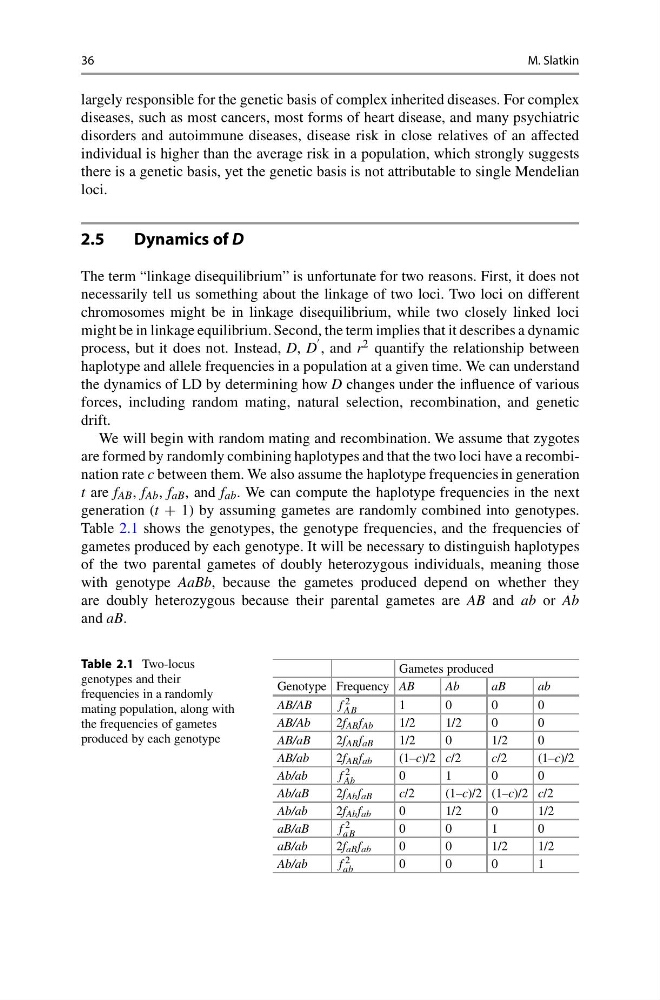
Table 2.1 shows the genotypes, the genotype frequencies, and the frequencies of
gametes produced by each genotype. It will be necessary to distinguish haplotypes
of the two parental gametes of doubly heterozygous individuals, meaning those
with genotype AaBb, because the gametes produced depend on whether they
are doubly heterozygous because their parental gametes are AB and ab or Ab
and aB.
Table 2.1 Two-locus
genotypes and their
frequencies in a randomly
mating population, along with
the frequencies of gametes
produced by each genotype
Gametes produced
Genotype Frequency AB
Ab
aB
ab
AB/AB
f 2
AB
1
0
0
0
AB/Ab
2f AB f Ab
1/2
1/2
0
0
AB/aB
2f AB f aB
1/2
0
1/2
0
AB/ab
2f AB f ab
(1–c)/2 c/2
c/2
(1–c)/2
Ab/ab
f 2
Ab
0
1
0
0
Ab/aB
2f Ab f aB
c/2
(1–c)/2 (1–c)/2 c/2
Ab/ab
2f Ab f ab
0
1/2
0
1/2
aB/aB
f 2
aB
0
0
1
0
aB/ab
2f aB f ab
0
0
1/2
1/2
Ab/ab
f 2
ab
0
0
0
1
M. Slatkin
largely responsible for the genetic basis of complex inherited diseases. For complex
diseases, such as most cancers, most forms of heart disease, and many psychiatric
disorders and autoimmune diseases, disease risk in close relatives of an affected
individual is higher than the average risk in a population, which strongly suggests
there is a genetic basis, yet the genetic basis is not attributable to single Mendelian
loci.
2.5
Dynamics of D
The term “linkage disequilibrium” is unfortunate for two reasons. First, it does not
necessarily tell us something about the linkage of two loci. Two loci on different
chromosomes might be in linkage disequilibrium, while two closely linked loci
might be in linkage equilibrium. Second, the term implies that it describes a dynamic
process, but it does not. Instead, D, D
, and r 2 quantify the relationship between
haplotype and allele frequencies in a population at a given time. We can understand
the dynamics of LD by determining how D changes under the influence of various
forces, including random mating, natural selection, recombination, and genetic
drift.
We will begin with random mating and recombination. We assume that zygotes
are formed by randomly combining haplotypes and that the two loci have a recombination rate c between them. We also assume the haplotype frequencies in generation
t are f AB , f Ab , f aB , and f ab . We can compute the haplotype frequencies in the next
generation (t + 1) by assuming gametes are randomly combined into genotypes.
Table 2.1 shows the genotypes, the genotype frequencies, and the frequencies of
gametes produced by each genotype. It will be necessary to distinguish haplotypes
of the two parental gametes of doubly heterozygous individuals, meaning those
with genotype AaBb, because the gametes produced depend on whether they
are doubly heterozygous because their parental gametes are AB and ab or Ab
and aB.
Table 2.1 Two-locus
genotypes and their
frequencies in a randomly
mating population, along with
the frequencies of gametes
produced by each genotype
Gametes produced
Genotype Frequency AB
Ab
aB
ab
AB/AB
f 2
AB
1
0
0
0
AB/Ab
2f AB f Ab
1/2
1/2
0
0
AB/aB
2f AB f aB
1/2
0
1/2
0
AB/ab
2f AB f ab
(1–c)/2 c/2
c/2
(1–c)/2
Ab/ab
f 2
Ab
0
1
0
0
Ab/aB
2f Ab f aB
c/2
(1–c)/2 (1–c)/2 c/2
Ab/ab
2f Ab f ab
0
1/2
0
1/2
aB/aB
f 2
aB
0
0
1
0
aB/ab
2f aB f ab
0
0
1/2
1/2
Ab/ab
f 2
ab
0
0
0
1