

2 Linkage Disequilibrium
37
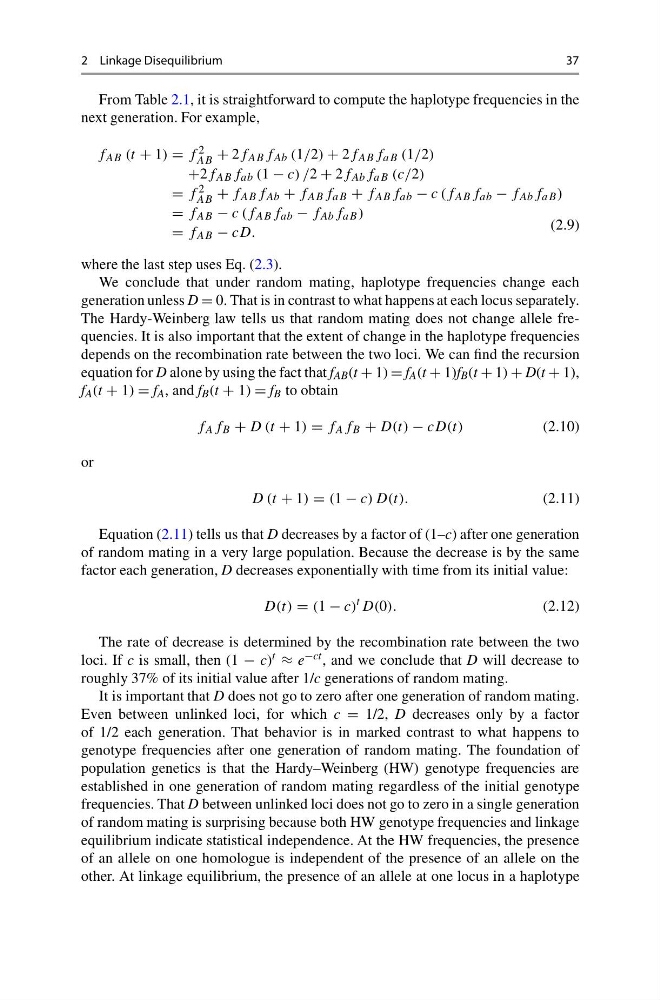
From Table 2.1, it is straightforward to compute the haplotype frequencies in the
next generation. For example,
f AB (t + 1) = f 2
AB + 2f AB f Ab (1/2) + 2f AB f aB (1/2)
+2f AB f ab (1 − c) /2 + 2f Ab f aB (c/2)
= f 2
AB + f AB f Ab + f AB f aB + f AB f ab − c (f AB f ab − f Ab f aB )
= f AB − c (f AB f ab − f Ab f aB )
= f AB − cD.
(2.9)
where the last step uses Eq. (2.3).
We conclude that under random mating, haplotype frequencies change each
generation unless D = 0. That is in contrast to what happens at each locus separately.
The Hardy-Weinberg law tells us that random mating does not change allele frequencies. It is also important that the extent of change in the haplotype frequencies
depends on the recombination rate between the two loci. We can find the recursion
equation for D alone by using the fact that f AB (t + 1) = f A (t + 1)f B (t + 1) + D(t + 1),
f A (t + 1) = f A , and f B (t + 1) = f B to obtain
f A f B + D (t + 1) = f A f B + D(t) − cD(t)
(2.10)
or
D (t + 1) = (1 − c) D(t).
(2.11)
Equation (2.11) tells us that D decreases by a factor of (1–c) after one generation
of random mating in a very large population. Because the decrease is by the same
factor each generation, D decreases exponentially with time from its initial value:
D(t) = (1 − c)
t
D(0).
(2.12)
The rate of decrease is determined by the recombination rate between the two
loci. If c is small, then (1 − c) t ≈ e −ct , and we conclude that D will decrease to
roughly 37% of its initial value after 1/c generations of random mating.
It is important that D does not go to zero after one generation of random mating.
Even between unlinked loci, for which c = 1/2, D decreases only by a factor
of 1/2 each generation. That behavior is in marked contrast to what happens to
genotype frequencies after one generation of random mating. The foundation of
population genetics is that the Hardy–Weinberg (HW) genotype frequencies are
established in one generation of random mating regardless of the initial genotype
frequencies. That D between unlinked loci does not go to zero in a single generation
of random mating is surprising because both HW genotype frequencies and linkage
equilibrium indicate statistical independence. At the HW frequencies, the presence
of an allele on one homologue is independent of the presence of an allele on the
other. At linkage equilibrium, the presence of an allele at one locus in a haplotype
37
From Table 2.1, it is straightforward to compute the haplotype frequencies in the
next generation. For example,
f AB (t + 1) = f 2
AB + 2f AB f Ab (1/2) + 2f AB f aB (1/2)
+2f AB f ab (1 − c) /2 + 2f Ab f aB (c/2)
= f 2
AB + f AB f Ab + f AB f aB + f AB f ab − c (f AB f ab − f Ab f aB )
= f AB − c (f AB f ab − f Ab f aB )
= f AB − cD.
(2.9)
where the last step uses Eq. (2.3).
We conclude that under random mating, haplotype frequencies change each
generation unless D = 0. That is in contrast to what happens at each locus separately.
The Hardy-Weinberg law tells us that random mating does not change allele frequencies. It is also important that the extent of change in the haplotype frequencies
depends on the recombination rate between the two loci. We can find the recursion
equation for D alone by using the fact that f AB (t + 1) = f A (t + 1)f B (t + 1) + D(t + 1),
f A (t + 1) = f A , and f B (t + 1) = f B to obtain
f A f B + D (t + 1) = f A f B + D(t) − cD(t)
(2.10)
or
D (t + 1) = (1 − c) D(t).
(2.11)
Equation (2.11) tells us that D decreases by a factor of (1–c) after one generation
of random mating in a very large population. Because the decrease is by the same
factor each generation, D decreases exponentially with time from its initial value:
D(t) = (1 − c)
t
D(0).
(2.12)
The rate of decrease is determined by the recombination rate between the two
loci. If c is small, then (1 − c) t ≈ e −ct , and we conclude that D will decrease to
roughly 37% of its initial value after 1/c generations of random mating.
It is important that D does not go to zero after one generation of random mating.
Even between unlinked loci, for which c = 1/2, D decreases only by a factor
of 1/2 each generation. That behavior is in marked contrast to what happens to
genotype frequencies after one generation of random mating. The foundation of
population genetics is that the Hardy–Weinberg (HW) genotype frequencies are
established in one generation of random mating regardless of the initial genotype
frequencies. That D between unlinked loci does not go to zero in a single generation
of random mating is surprising because both HW genotype frequencies and linkage
equilibrium indicate statistical independence. At the HW frequencies, the presence
of an allele on one homologue is independent of the presence of an allele on the
other. At linkage equilibrium, the presence of an allele at one locus in a haplotype