

2 Linkage Disequilibrium
35
The D ij are not independent because of the requirement that allele frequencies at
each locus sum to 1. If there are n 1 alleles at the first locus and n 2 at the second,
there are (n 1 − 1)(n 2 − 1) independent values of the D ij .
The theory of LD for multiple alleles has been important, particularly in the
application to the major histocompatibility complex (MHC) region in humans and
other vertebrates. MHC loci often have dozens and even hundreds of alleles, and
there is abundant LD among most of the loci (Hedrick et al. 1986). Furthermore,
there is evidence of balancing selection which could contribute to the extent of
LD. For genomic data, nearly all single-nucleotide polymorphisms (SNPs) and
insertion/deletion polymorphisms are biallelic, so a single value of D is sufficient.
2.4
More than Two Loci: Haplotype Blocks and the HapMap
Project
When more than two polymorphic loci are analyzed together, as is always the case
with genomic data, the analysis can become quite complicated. There are analogs
of D defined for three or more loci that represent higher-order linkage disequilibria.
For example, with three diallelic loci (A/a, B/b, C/c), the third-order disequilibrium
coefficient is defined to be
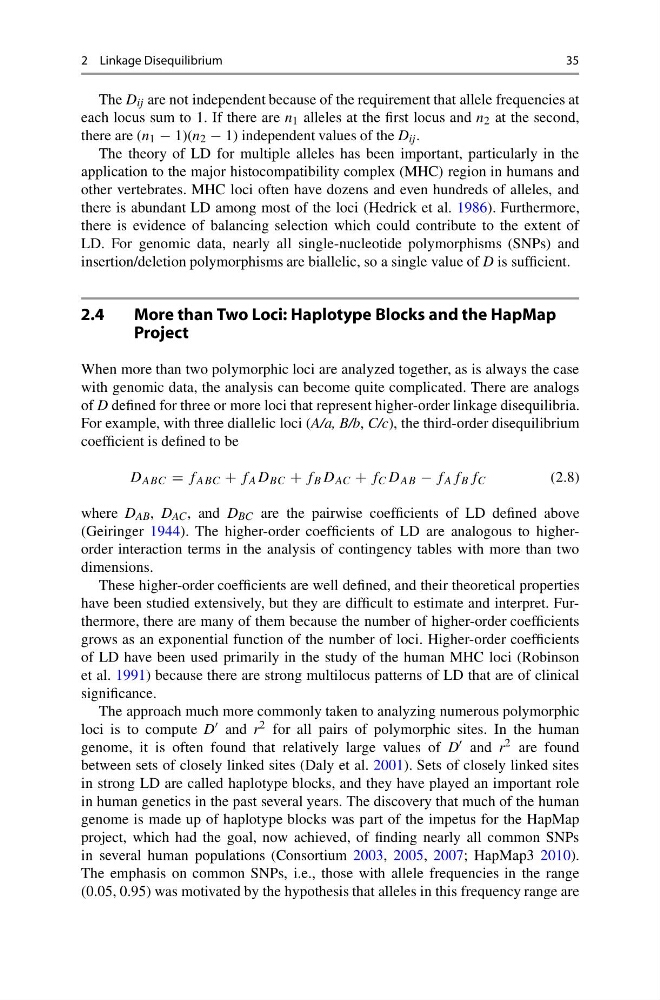
D ABC = f ABC + f A D BC + f B D AC + f C D AB − f A f B f C
(2.8)
where D AB , D AC , and D BC are the pairwise coefficients of LD defined above
(Geiringer 1944). The higher-order coefficients of LD are analogous to higherorder interaction terms in the analysis of contingency tables with more than two
dimensions.
These higher-order coefficients are well defined, and their theoretical properties
have been studied extensively, but they are difficult to estimate and interpret. Furthermore, there are many of them because the number of higher-order coefficients
grows as an exponential function of the number of loci. Higher-order coefficients
of LD have been used primarily in the study of the human MHC loci (Robinson
et al. 1991) because there are strong multilocus patterns of LD that are of clinical
significance.
The approach much more commonly taken to analyzing numerous polymorphic
loci is to compute D and r 2 for all pairs of polymorphic sites. In the human
genome, it is often found that relatively large values of D and r 2 are found
between sets of closely linked sites (Daly et al. 2001). Sets of closely linked sites
in strong LD are called haplotype blocks, and they have played an important role
in human genetics in the past several years. The discovery that much of the human
genome is made up of haplotype blocks was part of the impetus for the HapMap
project, which had the goal, now achieved, of finding nearly all common SNPs
in several human populations (Consortium 2003, 2005, 2007; HapMap3 2010).
The emphasis on common SNPs, i.e., those with allele frequencies in the range
(0.05, 0.95) was motivated by the hypothesis that alleles in this frequency range are
35
The D ij are not independent because of the requirement that allele frequencies at
each locus sum to 1. If there are n 1 alleles at the first locus and n 2 at the second,
there are (n 1 − 1)(n 2 − 1) independent values of the D ij .
The theory of LD for multiple alleles has been important, particularly in the
application to the major histocompatibility complex (MHC) region in humans and
other vertebrates. MHC loci often have dozens and even hundreds of alleles, and
there is abundant LD among most of the loci (Hedrick et al. 1986). Furthermore,
there is evidence of balancing selection which could contribute to the extent of
LD. For genomic data, nearly all single-nucleotide polymorphisms (SNPs) and
insertion/deletion polymorphisms are biallelic, so a single value of D is sufficient.
2.4
More than Two Loci: Haplotype Blocks and the HapMap
Project
When more than two polymorphic loci are analyzed together, as is always the case
with genomic data, the analysis can become quite complicated. There are analogs
of D defined for three or more loci that represent higher-order linkage disequilibria.
For example, with three diallelic loci (A/a, B/b, C/c), the third-order disequilibrium
coefficient is defined to be
D ABC = f ABC + f A D BC + f B D AC + f C D AB − f A f B f C
(2.8)
where D AB , D AC , and D BC are the pairwise coefficients of LD defined above
(Geiringer 1944). The higher-order coefficients of LD are analogous to higherorder interaction terms in the analysis of contingency tables with more than two
dimensions.
These higher-order coefficients are well defined, and their theoretical properties
have been studied extensively, but they are difficult to estimate and interpret. Furthermore, there are many of them because the number of higher-order coefficients
grows as an exponential function of the number of loci. Higher-order coefficients
of LD have been used primarily in the study of the human MHC loci (Robinson
et al. 1991) because there are strong multilocus patterns of LD that are of clinical
significance.
The approach much more commonly taken to analyzing numerous polymorphic
loci is to compute D and r 2 for all pairs of polymorphic sites. In the human
genome, it is often found that relatively large values of D and r 2 are found
between sets of closely linked sites (Daly et al. 2001). Sets of closely linked sites
in strong LD are called haplotype blocks, and they have played an important role
in human genetics in the past several years. The discovery that much of the human
genome is made up of haplotype blocks was part of the impetus for the HapMap
project, which had the goal, now achieved, of finding nearly all common SNPs
in several human populations (Consortium 2003, 2005, 2007; HapMap3 2010).
The emphasis on common SNPs, i.e., those with allele frequencies in the range
(0.05, 0.95) was motivated by the hypothesis that alleles in this frequency range are