

20
20
20 30
SE
Contaminated site
Lignite-mining area
NW
B1 B2
G2
G1
Groundwater level
Flow profile 2: contam. site
Gas PRB
Flow profile 3: mining area
207
Reactive (Oxygen) Gas Barrier and Zone Technologies
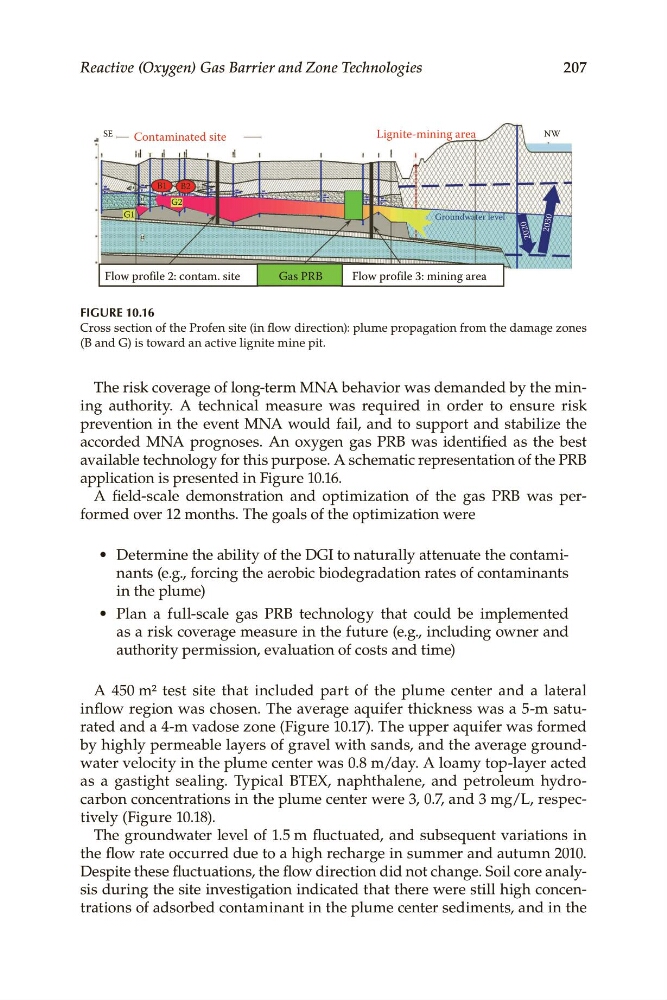
FIGURE 10.16
Cross section of the Profen site (in flow direction): plume propagation from the damage zones
(B and G) is toward an active lignite mine pit.
The risk coverage of long-term MNA behavior was demanded by the mining authority. A technical measure was required in order to ensure risk
prevention in the event MNA would fail, and to support and stabilize the
accorded MNA prognoses. An oxygen gas PRB was identified as the best
available technology for this purpose. A schematic representation of the PRB
application is presented in Figure 10.16.
A field-scale demonstration and optimization of the gas PRB was performed over 12 months. The goals of the optimization were
• Determine the ability of the DGI to naturally attenuate the contaminants (e.g., forcing the aerobic biodegradation rates of contaminants
in the plume)
• Plan a full-scale gas PRB technology that could be implemented
as a risk coverage measure in the future (e.g., including owner and
authority permission, evaluation of costs and time)
A 450 m² test site that included part of the plume center and a lateral
inflow region was chosen. The average aquifer thickness was a 5-m saturated and a 4-m vadose zone (Figure 10.17). The upper aquifer was formed
by highly permeable layers of gravel with sands, and the average groundwater velocity in the plume center was 0.8 m/day. A loamy top-layer acted
as a gastight sealing. Typical BTEX, naphthalene, and petroleum hydrocarbon concentrations in the plume center were 3, 0.7, and 3 mg/L, respectively (Figure 10.18).
The groundwater level of 1.5 m fluctuated, and subsequent variations in
the flow rate occurred due to a high recharge in summer and autumn 2010.
Despite these fluctuations, the flow direction did not change. Soil core analysis during the site investigation indicated that there were still high concentrations of adsorbed contaminant in the plume center sediments, and in the
20
20 30
SE
Contaminated site
Lignite-mining area
NW
B1 B2
G2
G1
Groundwater level
Flow profile 2: contam. site
Gas PRB
Flow profile 3: mining area
207
Reactive (Oxygen) Gas Barrier and Zone Technologies
FIGURE 10.16
Cross section of the Profen site (in flow direction): plume propagation from the damage zones
(B and G) is toward an active lignite mine pit.
The risk coverage of long-term MNA behavior was demanded by the mining authority. A technical measure was required in order to ensure risk
prevention in the event MNA would fail, and to support and stabilize the
accorded MNA prognoses. An oxygen gas PRB was identified as the best
available technology for this purpose. A schematic representation of the PRB
application is presented in Figure 10.16.
A field-scale demonstration and optimization of the gas PRB was performed over 12 months. The goals of the optimization were
• Determine the ability of the DGI to naturally attenuate the contaminants (e.g., forcing the aerobic biodegradation rates of contaminants
in the plume)
• Plan a full-scale gas PRB technology that could be implemented
as a risk coverage measure in the future (e.g., including owner and
authority permission, evaluation of costs and time)
A 450 m² test site that included part of the plume center and a lateral
inflow region was chosen. The average aquifer thickness was a 5-m saturated and a 4-m vadose zone (Figure 10.17). The upper aquifer was formed
by highly permeable layers of gravel with sands, and the average groundwater velocity in the plume center was 0.8 m/day. A loamy top-layer acted
as a gastight sealing. Typical BTEX, naphthalene, and petroleum hydrocarbon concentrations in the plume center were 3, 0.7, and 3 mg/L, respectively (Figure 10.18).
The groundwater level of 1.5 m fluctuated, and subsequent variations in
the flow rate occurred due to a high recharge in summer and autumn 2010.
Despite these fluctuations, the flow direction did not change. Soil core analysis during the site investigation indicated that there were still high concentrations of adsorbed contaminant in the plume center sediments, and in the