

G r o u n d w a t e r f l o w
B I O X W A N D z o n e
D is t a n c e ( m )
D i s t a n c e ( m )
–15
NH 4 -N
mg/L
Horizons
OP: 0–10 m
–20
–15
MP1: 10–20 m
MP2: 20–30 m
MP3: 30–40 m
–25
UP: 40–50 m
Depth below surface (m)
–20
30
–30
25
20
15
–35
10
750
700
650
600
550
500
–25
450
400
350
300
–30
5
0
50
0
250
200
150
100
50
250
200
150
100
–35
206
Permeable Reactive Barrier
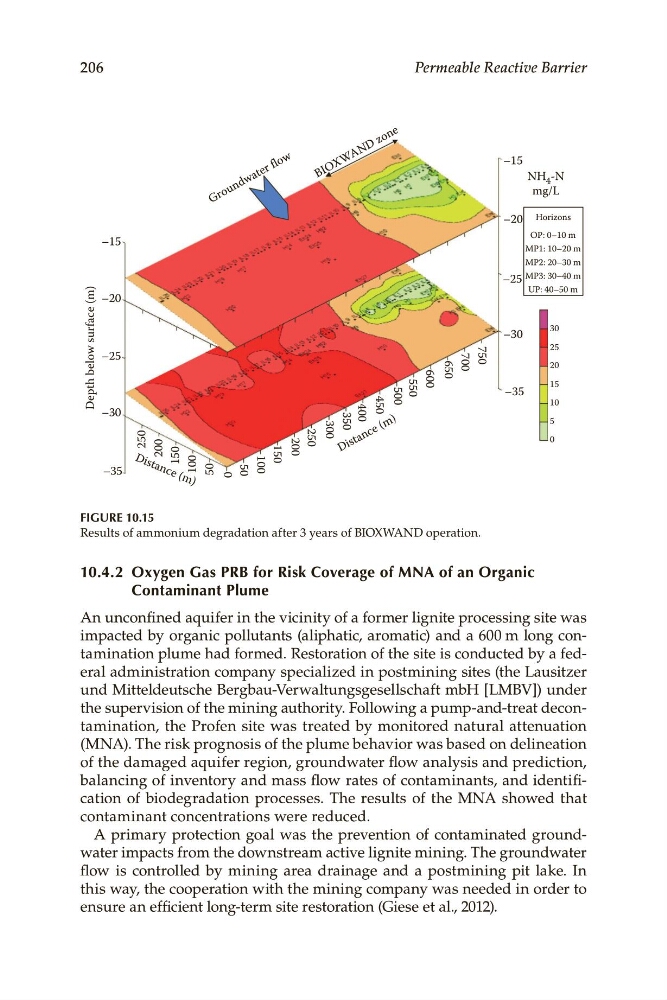
FIGURE 10.15
Results of ammonium degradation after 3 years of BIOXWAND operation.
10.4.2 O xygen Gas PRB for Risk Coverage of MNA of an Organic
Contaminant Plume
An unconfined aquifer in the vicinity of a former lignite processing site was
impacted by organic pollutants (aliphatic, aromatic) and a 600 m long contamination plume had formed. Restoration of the site is conducted by a federal administration company specialized in postmining sites (the Lausitzer
und Mitteldeutsche Bergbau-Verwaltungsgesellschaft mbH [LMBV]) under
the supervision of the mining authority. Following a pump-and-treat decontamination, the Profen site was treated by monitored natural attenuation
(MNA). The risk prognosis of the plume behavior was based on delineation
of the damaged aquifer region, groundwater flow analysis and prediction,
balancing of inventory and mass flow rates of contaminants, and identification of biodegradation processes. The results of the MNA showed that
contaminant concentrations were reduced.
A primary protection goal was the prevention of contaminated groundwater impacts from the downstream active lignite mining. The groundwater
flow is controlled by mining area drainage and a postmining pit lake. In
this way, the cooperation with the mining company was needed in order to
ensure an efficient long-term site restoration (Giese et al., 2012).
B I O X W A N D z o n e
D is t a n c e ( m )
D i s t a n c e ( m )
–15
NH 4 -N
mg/L
Horizons
OP: 0–10 m
–20
–15
MP1: 10–20 m
MP2: 20–30 m
MP3: 30–40 m
–25
UP: 40–50 m
Depth below surface (m)
–20
30
–30
25
20
15
–35
10
750
700
650
600
550
500
–25
450
400
350
300
–30
5
0
50
0
250
200
150
100
50
250
200
150
100
–35
206
Permeable Reactive Barrier
FIGURE 10.15
Results of ammonium degradation after 3 years of BIOXWAND operation.
10.4.2 O xygen Gas PRB for Risk Coverage of MNA of an Organic
Contaminant Plume
An unconfined aquifer in the vicinity of a former lignite processing site was
impacted by organic pollutants (aliphatic, aromatic) and a 600 m long contamination plume had formed. Restoration of the site is conducted by a federal administration company specialized in postmining sites (the Lausitzer
und Mitteldeutsche Bergbau-Verwaltungsgesellschaft mbH [LMBV]) under
the supervision of the mining authority. Following a pump-and-treat decontamination, the Profen site was treated by monitored natural attenuation
(MNA). The risk prognosis of the plume behavior was based on delineation
of the damaged aquifer region, groundwater flow analysis and prediction,
balancing of inventory and mass flow rates of contaminants, and identification of biodegradation processes. The results of the MNA showed that
contaminant concentrations were reduced.
A primary protection goal was the prevention of contaminated groundwater impacts from the downstream active lignite mining. The groundwater
flow is controlled by mining area drainage and a postmining pit lake. In
this way, the cooperation with the mining company was needed in order to
ensure an efficient long-term site restoration (Giese et al., 2012).